
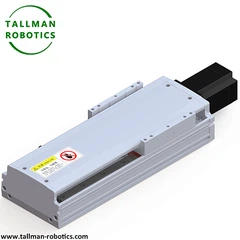


TallMan Robotics' High End Manufacturing and Quality Control System
In the field of industrial automation, TallMan Robotics takes "precision manufacturing+ultimate quality control" as its core competitiveness, relying on a cluster of high-end production equipment and a full process quality control system. In the aluminum and steel plate processing of core products such as linear modules, electric cylinders, RV reducers, hollow rotating platforms, and planetary reducers, Linear Guides, Ball Screw, Gearboxes, etc, TallMan Robotics has achieved full chain control from micrometer level processing to nanometer level detection. Its intelligent machining system, represented by CNC, not only breaks through the precision limit of traditional precision mechanical manufacturing, but also meets the stringent demands of users in multiple fields such as semiconductor, medical, aerospace, etc. for high-quality industrial components through customized solutions.
High End Equipment Cluster: Building the Cornerstone of Precision Machining
1.CNC Machining Center Matrix
TallMan Robotics has built a full range of CNC machining systems covering five axis linkage, high-speed milling, and turn milling composites:
1). Five axis linkage machining center: Introduced the German DMG MORI CLX 400 machining center (positioning accuracy ± 2 μ m, repeat positioning accuracy ± 1 μ m), specially designed for complex surface machining of linear module aluminum alloy frames. The device is equipped with a real-time compensation system for laser interferometers, which can perform five axis linked milling on the module installation surface, ensuring a flatness of ≤ 3 μ m and a tolerance control of ± 5 μ m for the spacing between guide rail installation slots. The lightweight frame processing of linear modules typically used in medical equipment achieves a 40% reduction in frame weight and a 25% increase in rigidity through five axis milling of aerospace grade aluminum alloy (6061-T6).
2). High speed milling center: The Japanese Fanuc alpha-D14MiA high-speed milling center (spindle speed 40000 rpm) is used for precision hole machining of electric cylinder bodies (aluminum alloy 6063). This device adopts thermal displacement compensation technology, and when processing a diameter of 8mm through hole, the hole spacing accuracy can reach ± 3 μ m, and the surface roughness Ra is ≤ 0.4 μ m, meeting the strict requirements of cleanliness (ISO Class 5) and sealing for electric cylinders used in semiconductor equipment.
3). Turning and milling composite machining center: Swiss Baomei TECHNOPOLIS 300 turning and milling composite center (integrated 12 axis linkage) is used for precision machining of RV reducer cycloidal axle. By completing the entire process of turning, milling, and grinding with one clamping, the coaxiality of the cycloidal wheel axle hole is ensured to be ≤ 5 μ m, and the tooth surface roughness Ra is ≤ 0.2 μ m. Compared with traditional split type machining, the efficiency is improved by 60%, and the accuracy stability is improved by 40%.
2. Special Processing Equipment
1). Slow wire cutting machine: The Japanese Shadick AQ325L slow wire cutting equipment (processing accuracy ± 2 μ m) is used for tooth profile machining of high-precision gears (SCM435 steel plate) on hollow rotating platforms. By using a copper wire electrode with a diameter of 0.05mm, micro gears with a modulus of 0.5 or less can be machined, with a tooth surface roughness Ra ≤ 0.8 μ m and a tooth orientation error ≤ 8 μ m, meeting the requirements for silent operation of hollow rotating platforms for medical devices (noise ≤ 45dB).
2). Five axis grinder: The German Schlafling Cylinder Grinding Machine (grinding accuracy ± 1 μ m) is used for precision grinding of planetary gearbox sun shafts. CBN grinding wheel is used to grind the 20CrMnTi steel plate shaft after carburizing and quenching (HRC60 ± 2), with a shaft diameter tolerance controlled at ± 2 μ m and roundness ≤ 1 μ m, ensuring that the planetary gear transmission error is ≤ 1 arc minute.
3. Automated Production Line
In the assembly process of the linear module, an intelligent production line consisting of the Japanese Fanuc collaborative robot M-10iA/12 and a visual inspection system is introduced: the robot achieves precise pressing of the guide rail and slider through force control sensors (pressure fluctuation ≤ 5N), and the visual system performs 100% online detection of the pre tightening force of the ball screw to ensure that the module operation noise is ≤ 50dB and the positioning accuracy is ≤ ± 0.005mm/m. The production line adopts MES system for real-time monitoring, reducing the production cycle to 45 minutes per unit and controlling the defect rate below 0.03%.
Material and Process Innovation: the Ultimate Breakthrough of Aluminum and Steel Plates
1. Precision Machining Technology for Aluminum Alloy
1). Lightweight structural design: The main body of the linear module is made of aerospace grade aluminum alloy 6061-T6 (tensile strength 310MPa). Through topology optimization design, a "honeycomb" internal structure is achieved. After CNC milling, the density is reduced to 2.7g/cm ³, and the bending strength is increased to 280MPa. Low temperature cutting technology (-20 ℃ cold air cooling) is used in processing to suppress thermal deformation of aluminum alloy and ensure that the flatness of the guide rail installation surface is ≤ 5 μ m.
2). Surface treatment process: The electric cylinder body adopts hard anodizing process (film thickness 25 μ m, hardness HV500+), and the current density is precisely controlled by CNC electrolysis equipment (15A/dm ² ± 10%), achieving surface roughness Ra ≤ 0.8 μ m, salt spray resistance test for more than 1000 hours, and meeting long-term stable operation in humid environments (humidity ≥ 90% RH).
2.Precision Machining Technology for Steel Plates
1). Gear heat treatment process: The cycloidal gear of the RV reducer is made of SCM435 steel plate (carbon content 0.35%), and after vacuum carburizing and quenching (temperature 930 ℃± 5 ℃, time 4 hours), the surface hardness reaches HRC62 ± 2 and the core hardness reaches HRC35 ± 2. Through precise temperature control (± 3 ℃) of Japanese and foreign vacuum furnaces, the deformation of the cycloidal gear is ensured to be ≤ 0.01mm, the residual compressive stress on the tooth surface is ≥ -500MPa, and the fatigue life is increased to more than 10 times.
2). Precision grinding technology: The hollow rotating platform gearbox housing (SS400 steel plate) is ground using a Sumitomo precision surface grinder (grinding head speed 6000rpm) from Japan, with surface roughness Ra ≤ 0.2 μ m and flatness ≤ 3 μ m. Cooperate with the German Mahr roughness tester for online detection to ensure that the leakage rate of the gearbox after assembly is ≤ 0.01ml/min, meeting the hygiene standards of the food processing industry (FDA certification).


TallMan Robotics Innovation and Capability Upgrade in Processing Equipment
In the increasingly fierce competition in the field of industrial automation, TallMan Robotics deeply recognizes that processing equipment is the core element to ensure product quality. To meet the stringent quality requirements of high-end customers for products in harsh environments, the company is driven by innovative research and development, actively introducing well-known high-end processing equipment, continuously upgrading processing capabilities, and has embarked on a unique development path.
TallMan Robotics regards innovative research and development of new processing equipment as the key to enhancing competitiveness. Enterprises establish professional R&D teams to conduct in-depth research on the processing requirements of products in extreme environments, and develop suitable processing techniques and equipment for harsh working conditions such as high humidity, strong corrosion, and ultra-high temperature. For example, in response to the high requirements for anti-corrosion of components in marine engineering equipment, special surface treatment equipment has been developed. Through innovative coating processes, a dense protective layer is formed on the surfaces of aluminum and steel plates, greatly improving the product's salt spray corrosion resistance.
At the same time, enterprises closely monitor cutting-edge technologies in the industry and actively introduce well-known high-end processing equipment. In the field of five axis linkage machining, a new type of machining center from Germany's Demage has been introduced, which has more advanced thermal stability control technology and can maintain the machining accuracy of parts at the micrometer level even in environments with large temperature fluctuations. In terms of special processing, advanced slow wire cutting equipment from Japan has been introduced, which has more precise control of electrode wire loss and can meet the processing needs of high-precision gears and other key components in harsh environments, ensuring the transmission stability and reliability of products under complex working conditions.
Through innovative research and development and the introduction of high-end equipment, TallMan Robotics continuously upgrades its processing capabilities. The application of new devices and technologies not only improves production efficiency, but also significantly optimizes product quality. In extreme temperature environment simulation testing, the upgraded linear module and electric cylinder can operate stably in the temperature range of -40 ℃ to 120 ℃, with an accuracy retention rate of over 98%; In high humidity and strong acid-base environments, the specially treated RV reducer and hollow rotating platform reduce the corrosion rate of their metal components by more than 80%, greatly extending the product's service life and fully meeting the quality requirements of high-end customers such as aerospace and deep-sea exploration for products in harsh environments.
The above content demonstrates TallMan Robotics' efforts and achievements in processing equipment.