
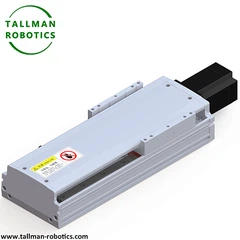


Large Central Opening Rotary Table, also known as the Large Central Rotary Table, is a rotating platform with a large central through-hole. The central through-hole of Large Central Opening Rotary Table allows cables, pipelines, laser beams, or mechanical components to pass through it while achieving high-precision rotational motion. It is widely used in the fields of automation equipment, machine tool processing, detection systems, and robots, especially suitable for applications that require hollow design to simplify wiring or transfer media (such as gases, liquids).
Large Central Opening Rotary Table solves the cable management problem of traditional rotary tables through a large hollow design, while maintaining high precision and rigidity, making it an ideal choice for high-end automation, CNC machining, and optical systems.
Here is a specific introduction about Large Central Opening Rotary Table:
Structural Features: Its main feature is a large central opening, with a variety of central aperture sizes ranging from over 100 millimeters to several hundred millimeters. For example, Intellidrives' rotary table rt la-280-400 model has a table diameter of 400mm and a central aperture of 280mm. High precision bearing structures such as cross roller bearings are usually used to ensure rotation accuracy and stability.
Performance parameters: High positioning accuracy, generally up to ≤ 1 arc minute, and repeated positioning accuracy up to ≤ 15 arc seconds. The reduction ratio can be selected according to the needs, and common ones include 10, 20, 30, 50, 70, 100, etc. The load capacity varies by model and can meet the processing needs of workpieces of different weights.
Functional Features: It can achieve 360 degree free rotation, and can also achieve specific angle indexing rotation according to programming. The large central opening facilitates the passage of cables, air pipes, etc., avoiding pipeline entanglement and providing installation space for other equipment or devices, saving floor space. It can usually be connected to servo motors or stepper motors to achieve precise rotational motion control through motor drive.
Application Fields: Commonly used in semiconductor assembly equipment, wafer inspection and cutting, optical applications, precision part indexing, and robotics. It plays an important role in welding, drilling, milling, assembly, and testing processes in industries such as automotive, aerospace, and electronics. It can help achieve precise positioning and rotation of workpieces, improve machining accuracy and production efficiency.
Here In this page, we introduce series of Large Central Opening Rotary Table, you will see data sheet, production pictures,vedios of test as follows:
Also You are welcome to watch more projects or visit our video gallery by Youtube: https://www.youtube.com/@tallmanrobotics

Packing and delivery of Large Central Opening Rotary Table:


Production of Large Central Opening Rotary Table:


When purchasing a Large Central Opening Rotary Table, it is necessary to consider the actual application scenario, technical requirements, and long-term stability to avoid equipment failure to meet production needs due to parameter mismatch or detail omissions. The following are key precautions:
1. Matching core parameters with performance
1). Accurate calculation of the central opening size
The core value of a large central opening lies in "threading, feeding, or equipment integration", which requires strict confirmation of the actual required size of the central aperture
Not only should it meet the diameter requirements of current cables, air pipes, and workpieces, but it is also necessary to reserve a certain margin (usually recommended to be 10% -20% larger than the maximum diameter of the passing object) to avoid being unusable due to assembly errors or subsequent upgrades.
Pay attention to the shape and tolerance of the opening: Some scenes may require non-circular openings (such as square or irregular shapes), and the feasibility of customization needs to be confirmed with the supplier in advance; Simultaneously confirm the aperture tolerance (such as ± 0.1mm) to avoid interference with the passing equipment.
2). Match precision parameters with process requirements
The accuracy of large rotary tables directly affects the quality of machining/testing, and the following parameters need to be clarified:
Positioning accuracy: the deviation between the actual rotation angle and the target angle, selected according to the requirements of the scene (such as semiconductor processing requiring ≤± 5 arc seconds, and general industrial assembly can relax to ± 1 arc minute).
Repetitive positioning accuracy: The error of returning to the same position after multiple rotations must be ≤ the maximum allowable deviation of the process (such as precision detection requiring ≤± 10 arc seconds).
Backlash: The backlash error during reverse rotation should be controlled within the minimum range (usually ≤ 3 arc seconds) to avoid affecting the stability of dynamic positioning.
3). Comprehensive evaluation of load capacity
The load capacity of a large rotary table needs to cover the total weight of "workpiece+fixture+additional equipment", with a focus on:
Axial load: The pressure borne by the table in the vertical direction (such as placing heavy workpieces) must be ≤ the rated axial load of the equipment.
Radial Load: The horizontal force borne by the tabletop (such as in machining scenarios where side forces are applied), to avoid bearing wear caused by radial overload.
Overturning moment: The moment generated when a large workpiece is placed eccentrically, which must be ≤ the equipment's anti overturning ability, otherwise it will cause the table to tilt and accuracy to decrease.
2. Structural and reliability verification
1). Rigid and Stability Design
Large rotating tables are prone to vibration or deformation during rotation due to their large table size, heavy load, and insufficient rigidity. Attention should be paid to:
Materials and Structure: High strength materials such as cast iron HT300 and high-strength aluminum alloy 6061-T6 are preferred for the countertop and base, and the structure is optimized through finite element analysis (such as reinforcement design) to ensure deflection ≤ 0.01mm/m under full load.
Bearing selection: High precision bearings (such as cross roller bearings and four point contact ball bearings) are required for the core load-bearing components, which have high radial/axial stiffness and can withstand multi-directional loads simultaneously. The rated life of the bearings (L10 life ≥ 10000 hours) needs to be confirmed.
2). Drive and transmission system adaptation
The drive system directly affects the response speed and control accuracy of the rotary table:
Motor type: High precision scenarios are preferred servo motor (with encoder closed-loop control, fast response, high precision); Stepper motors can be used in low-cost scenarios, but it is necessary to confirm whether they are equipped with segmented drivers (to reduce the risk of step loss).
Reduction mechanism: If high torque output is required, it is necessary to match precision reducers (such as planetary reducers, harmonic reducers), confirm whether the reduction ratio (such as 10:1, 20:1) meets the speed and torque requirements, and ensure that the backlash of the reducer is ≤ 1 arc minute.
Braking device: For vertical installation or inclined use scenarios, it is necessary to confirm whether an electromagnetic brake is equipped to prevent the table from slipping when power is cut off (brake response time ≤ 50ms).
3). Protection and environmental adaptability
Select the protection level according to the usage environment to avoid equipment damage:
Dustproof and Waterproof: Industrial workshops must have at least IP54 (dust-proof and splash proof); In damp or oily environments, IP65 or above (completely dust-proof, low pressure water spray without intrusion) is required.
Temperature and vibration: In high-temperature environments (such as welding scenes), it is necessary to confirm the temperature resistance range of the motor and bearings (≥ 80 ℃); Additional shock-absorbing pads or models with anti vibration design should be installed in situations with high vibration.
3. Application scenarios and integration adaptation
1). Customization confirmation of functional requirements
Large rotating tables often need to be used in conjunction with other equipment, and it is necessary to clarify whether special functions are required:
Dividing mode: Do you need fixed angle division (such as 90 ° per step) or continuous rotation? Does it support programming from any angle (controlled by PLC or upper computer)?
Tabletop interface: Does the countertop need to reserve T-shaped slots and threaded holes (for installing fixtures)? Does the hole size and distribution match the installation requirements of the workpiece fixture?
Central opening additional function: Is it necessary to integrate pneumatic/hydraulic interfaces and sensors (such as position detection) at the opening? Is it necessary to install a protective cover (to prevent foreign objects from falling into the opening)?
2). Control and communication compatibility
Ensure seamless integration of the rotary table with existing automation systems:
Control interface: The supported communication protocols (such as Modbus, EtherCAT, PROFINET) need to be matched with PLC, robot or upper computer to avoid adding additional conversion modules.
Signal feedback: Whether to provide origin signal, limit signal (forward and reverse limit), alarm signal (overload, overheating) for system monitoring and troubleshooting.
Programming flexibility: Does it support multi-stage speed settings, angle presets, and smooth speed transitions (S-curve acceleration and deceleration) to meet the motion requirements of complex processes.
4.Supplier and Service Assurance
1).Brand and Qualification Screening
Large rotary tables belong to precision equipment, and brands with mature technology and good reputation should be preferred:
Foreign brands: such as THK, Yaskawa, Intellidrives (high precision, strong stability, suitable for high-end scenarios);
Domestic brands such as Huxing Transmission, Sanqi Automation, and Taman Robotics (with high cost-effectiveness, fast customization response, suitable for mid to high end industrial scenarios).
Confirm whether the supplier has passed ISO9001 quality management system certification and whether the equipment has a factory precision testing report (with actual measurement data attached).
2). After sales service and technical support
The installation, debugging, and maintenance of large equipment rely on professional support:
Installation and Debugging: Do you provide on-site installation services? Does it include linkage debugging with other devices (such as collaborative motion with robots and laser equipment)?
Warranty and Maintenance: The warranty period is at least 1 year (core components such as bearings and motors are recommended to be 2 years), and it is confirmed whether the faulty components will be replaced free of charge during the warranty period; Do you provide localized repair services (response time ≤ 48 hours).
Spare parts supply: Whether key spare parts (such as bearings, motors, encoders) are supplied for a long time to avoid equipment aging and inability to repair due to missing parts.
3). Cost and cost-effectiveness evaluation
In addition to the purchase price, the full lifecycle cost needs to be accounted for:
Initial cost: equipment price, transportation cost, installation and commissioning cost, training cost (operation and maintenance training);
Long term costs: energy consumption (motor power, such as the long-term electricity cost difference between 1.5kW and 2.2kW), maintenance costs (bearing replacement cycle, lubricant type, and replacement frequency);
Customization cost: If special opening sizes, countertop processing, or functional customization are required, additional fees and delivery cycles need to be specified (usually the customization cycle is 2-4 weeks longer than the standard product).
5. Testing and Validation
Prototype testing: For high-precision or high load scenarios, it is recommended to request suppliers to provide prototype testing to verify whether the accuracy, vibration, and noise (no-load/full load noise ≤ 75dB) under actual load meet the requirements.
On site working condition simulation: Provide parameters of actual usage scenarios (such as workpiece weight, rotation speed, ambient temperature) for suppliers to conduct working condition simulation analysis and evaluate whether the equipment can operate stably for a long time.
Through the comprehensive evaluation of the above dimensions, it can be ensured that the purchased large center opening rotary table can meet current process requirements, have long-term reliability and scalability, and avoid rework or equipment idle due to parameter mismatch.
Hot Tags: large central opening rotary table, China large central opening rotary table manufacturers, suppliers, factory, Double Lead Worm Gear Hollow Rotating Stages, Indexing Table Featuring a Hollow Shaft, Electric Rotary Stage, Hypoid Gear Hollow Shaft Actuator, Motor Driven Rotary Table, Precision Hollow Rotary Indexer


