
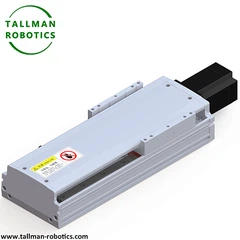


Linear motion actuator is a driving device that converts various types of energy into linear motion. Its core is to directly convert the energy of the power source into linear actions such as pushing, pulling, lifting, etc. through a mechanical structure. Unlike the complex guidance system of a motion platform, Linear motion actuator focuses more on the integration of power output and displacement execution, and is widely used in scenarios that require direct driving of loads for linear motion.
Its working principle revolves around "energy conversion motion transmission". Power sources such as DC motors, hydraulic pumps, and pneumatic cylinders provide energy, which is then converted into linear displacement through internal transmission mechanisms such as screw nuts, gear racks, push rods, etc. For example, in electric actuators, the motor rotates to drive the screw to rotate, and the nut pair converts the rotational motion into linear extension and contraction of the push rod; The hydraulic type uses hydraulic pressure to push the piston and directly output axial thrust. Some precision models integrate position sensors, which can provide real-time feedback on displacement and achieve controllable stroke adjustment.
In terms of application, in industrial automation, electric linear actuators are often used for material pushing on production lines, which achieve precise pushing of centimeter level strokes through screw transmission, replacing traditional cylinders to reduce gas source dependence; In medical equipment, the lifting mechanism of electric hospital beds is driven by a DC motor with a trapezoidal screw, relying on self-locking characteristics to ensure the stability of the patient's position after adjustment; In smart homes, the column drive of the lifting table adopts a silent linear actuator, which achieves low-speed and smooth height adjustment through a gear reduction mechanism; In the field of agricultural machinery, hydraulic linear actuators are used for the lifting and lowering of the harvester's header, which utilizes high-pressure oil to output high thrust and adapt to complex load changes in the field. In addition, the bracket adjustment of the solar tracking system, the driving of gate opening and closing, and other scenarios also rely on linear motion actuators to achieve efficient linear power output. Its compact structure makes it more advantageous than motion platforms in space limited situations.
You are welcome to watch more projects or visit our video gallery by Youtube: https://www.youtube.com/@tallmanrobotics
Here, we introduce Linear motion actuator, TMSL135-CM with data as follows:


Accuracy detection method for Linear motion actuator
1.Positioning accuracy detection
Build a measurement system using a laser interferometer, fix the reflector on the platform slider, and set multiple detection points along the motion axis (such as one measurement point every 50mm). After the platform moves to the target position according to the instructions, record the deviation between the actual displacement displayed by the laser interferometer and the instruction value, and calculate the maximum deviation value throughout the entire stroke, which is the positioning accuracy. For example, in a semiconductor detection platform with a 300mm stroke, if the maximum deviation is ± 0.003mm, it meets the micrometer level positioning requirements. During testing, attention should be paid to the ambient temperature (controlled at 20 ± 0.5 ℃) to avoid temperature changes that may cause thermal expansion and contraction of the guide rail and affect the data.
2.Repetitive positioning accuracy detection
Select a fixed point (usually the midpoint) within the itinerary, and have the platform repeat the same procedure to move to that point (recommended number of times ≥ 30). Use a grating ruler or high-precision dial gauge to record the actual position after each arrival. Calculate the standard deviation of these data, which is the repeatability accuracy. If the standard deviation of 30 measurements on a certain machine tool platform is 0.001mm, it indicates excellent repeatability stability. Before testing, the platform needs to run without load for 10 minutes to preheat and reduce the impact of motor temperature rise on transmission accuracy.
3.Straightness error detection
Fix a precision level parallel to the axis of motion on the base, install a lever dial gauge on the slider, and make contact between the gauge head and the working surface of the level. When the platform moves at a constant speed, the swing amplitude of the dial indicator pointer reflects the deviation of straightness, which is divided into horizontal direction (left-right swing) and vertical direction (up and down fluctuation). For example, if the vertical straightness error of the laser cutting platform exceeds 0.02mm/m, it may cause inclined patterns on the cutting surface. During testing, it is necessary to ensure that the flat ruler is securely installed to avoid interference from its own deflection on the results.
4.Stability testing during operation
Install vibration sensors on the platform and record the vibration acceleration values at different speeds (usually in mm/s ²). During high-speed operation (such as 300mm/s), if the vibration value suddenly increases, it may be caused by uneven tension of the synchronous belt or wear of the guide rail slider. In addition, periodic abnormal noises can be detected through auditory perception, and the temperature of the motor and screw bearings can be checked with an infrared thermometer. If the temperature rise in a certain part exceeds 40 ℃, it may cause operational lag due to poor lubrication, indirectly affecting accuracy.
5.Accuracy verification under load conditions
Simulate actual workloads (such as installing fixtures of corresponding weight), repeat the above positioning and repeat the positioning detection. Some platforms meet the accuracy standards when unloaded, but deformation occurs due to insufficient rigidity of the guide rails after loading, resulting in increased deviation. For example, when the translation stage of a medical CT bed carries 150kg, if the positioning accuracy changes from ± 0.01mm when unloaded to ± 0.03mm, it is necessary to check whether the guide rail support structure needs to be reinforced.
Hot Tags: linear motion actuator, China linear motion actuator manufacturers, suppliers, factory, Automated Ball Screw Positioning Stage, Automated Linear System, Crossed Roller Stage, Linear Indexing Table, Linear Translation Stage, Precision Positioning


