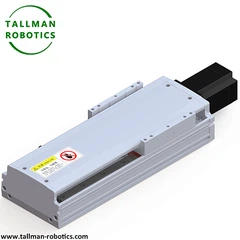
Linear Drive Unit

Linear Drive Unit

Details
Linear Drive Unit is an electromechanical integrated device that converts rotational motion into linear motion. By integrating the drive motor, transmission mechanism, guide components, and control system, Linear Drive Unit achieves high-precision and high stability linear displacement output, and is widely used in automation equipment to replace traditional linear actuators such as cylinders and hydraulic cylinders.
Category
Ball Screw Linear Modules
Share to
Send Inquiry
Description
Technical Parameters

Linear Drive Unit is an electromechanical integrated device that converts rotational motion into linear motion. By integrating the drive motor, transmission mechanism, guide components, and control system, Linear Drive Unit achieves high-precision and high stability linear displacement output, and is widely used in automation equipment to replace traditional linear actuators such as cylinders and hydraulic cylinders.


A typical linear drive unit consists of four core components:

1. Drive motor: provides power source, commonly used servo motor or stepper motor, determines output force and speed range;

2. Transmission mechanism: converts rotational motion into linear motion, with mainstream types including ball screws (high precision, high load), synchronous belts (high speed, long stroke), gears and racks (high load, low precision), etc;

3. Guidance system: Ensure the linearity of motion, such as linear guides, sliders, etc., reduce friction and withstand radial forces;

4. Control system: Implement position and speed closed-loop control through encoders, PLCs, or motion controllers to improve motion accuracy.


Working principle:

After receiving electrical signals, the motor generates rotational motion, which is converted into linear displacement through a transmission mechanism (such as the nut of a ball screw engaging with the screw), driving the load to perform reciprocating motion along the guiding system. The control system monitors the position feedback in real-time (such as encoder signals) and adjusts the motor output to ensure that the actual displacement is consistent with the command, achieving millimeter or even micrometer level positioning accuracy.


Linear drive units are widely used in:

Industrial automation: arm movements of assembly line handling, precision assembly, and welding robots;

Medical equipment: CT bed positioning, precise operation of surgical robots;

3C manufacturing: precise displacement for semiconductor wafer handling and PCB board inspection;

Smart home: automatic drive for electric lifting tables and curtains;

Logistics warehousing: the pushing mechanism of sorting machines and the lifting system of stacker cranes.

Compared to traditional pneumatic/hydraulic systems, its advantage lies in the precise control of speed and position, and it is more suitable for intelligent and dust-free working environments.


You are welcome to watch more projects or visit our video gallery by Youtube: https://www.youtube.com/@tallmanrobotics


Here, we introduce Linear Drive Unit, TMS220-CM with data as follows:

73

42

43


31
32
33
34
35
36
37
38


Compared with traditional cylinders and hydraulic cylinders, Linear Drive Unit has significant advantages in performance, controllability, adaptability, and other aspects. The specific differences are as follows:

1. Higher precision in motion control

The linear drive unit achieves closed-loop control through servo/stepper motors combined with encoders, with a positioning accuracy of up to 0.01mm-0.1mm, and can accurately control speed, acceleration, and displacement. It supports complex motion modes such as multi speed, uniform speed, and variable speed.

Cylinders/hydraulic cylinders rely on gas/liquid pressure to drive, and are affected by the compressibility of the medium. The positioning accuracy is usually only 1mm-5mm, and the speed is uncontrollable (can only be roughly adjusted through throttle valves), making it impossible to achieve complex trajectory planning.


2. Stronger adjustability of output force and speed

The output force (thrust/tension) and speed of the linear drive unit can be adjusted in real time through current and pulse signals. For example, by changing the motor power, it can flexibly adapt to a load range of 1N-10000N, and the speed range covers 0.1mm/s-1000mm/s to meet different working conditions.

The output force and speed of the cylinder/hydraulic cylinder are determined by the pressure of the air source/hydraulic source, and adjustment requires the replacement of hardware such as valves and cylinder diameters. The flexibility is poor, and there is a phenomenon of "crawling" (instability at low speeds).


3. Better environmental adaptability

linear drive unit has no risk of medium leakage, does not require lubricating oil/hydraulic oil, is suitable for dust-free environments (such as semiconductors, medical), food grade production lines, or clean laboratories, and is not affected by drastic changes in temperature and humidity (stable operation at -20 ℃ -80 ℃).

The cylinder requires a compressed air source, which can be easily affected by impurities in the air source (water, oil, dust) and cause malfunctions; There is a risk of oil leakage and environmental pollution in hydraulic cylinders, and the increase in hydraulic oil viscosity at low temperatures can reduce efficiency. At high temperatures, it may cause seal aging.


4. Lower energy consumption and maintenance costs

The linear drive unit only consumes power during operation, with almost no energy consumption in standby mode. The core components (motor, guide rail, screw) have a lifespan of over 10000 hours, and maintenance only requires regular cleaning of the guide rail and checking of screw tightness, without frequent replacement of seals or replenishment of media.

Cylinders require continuous supply of compressed air (air compressors consume electricity during long-term operation), while hydraulic cylinders require hydraulic pumps to maintain pressure, resulting in high energy consumption; And the sealing components are prone to wear and tear, requiring regular replacement (maintenance every 3-6 months on average), resulting in a high cumulative maintenance cost.


5. Intelligent integration is more convenient

The linear drive unit can be directly connected to PLC, industrial buses (such as EtherCAT, Modbus) or IoT systems, supporting remote monitoring and data feedback (such as real-time load, temperature, position information), facilitating intelligent scheduling and fault warning of automated production lines.

Cylinder/hydraulic cylinder requires additional sensors (such as magnetic switches) to achieve basic position detection, and cannot provide feedback on force, speed, and other data, making it difficult to integrate into intelligent control systems.


6. More flexible installation and layout

The linear drive unit does not require an external air source/hydraulic pipeline, and has a compact structure (integrating motor, transmission, and guide components). It can be installed at multiple angles such as vertical, horizontal, and inclined, saving equipment space. It is particularly suitable for miniaturized and modular equipment (such as 3C manufacturing equipment and medical instruments).

Cylinders/hydraulic cylinders rely on pipeline connections, and their layout is limited by the position of the gas source/hydraulic station. If the pipeline is too long, it will cause response delays and noise due to pipeline vibration.


Linear drive unit is more suitable for the modern industrial needs of high precision, intelligence, and cleanliness, especially in the fields of precision assembly, medical equipment, semiconductor manufacturing, and have obvious advantages; However, due to their low cost and strong explosive power, cylinders/hydraulic cylinders are still suitable for scenarios with low precision requirements such as simple reciprocating movements (such as stamping and handling). With the upgrading of industrial automation, linear drive unit is gradually replacing traditional fluid drive components and becoming the mainstream linear execution solution.


Hot Tags: linear drive unit, China linear drive unit manufacturers, suppliers, factory, Automated Ball Screw Positioning Stage, Automated Linear System, High Load Capacity, Linear Guide Actuator, Mechanical Stage, Telescoping Linear Actuator

Send Inquiry
Contact us

You can either contact us via phone, email or online form below. Our specialist will contact you back shortly.

Contact now!