
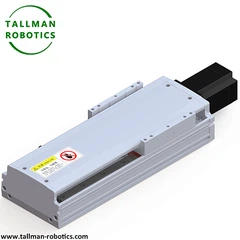


What is Cartesian Robot Module?
Cartesian Robot Module is a Modular XYZ Linear Robotic Motion Unit.
A Cartesian robot module is a modular robotic motion unit built for industrial automation. It adopts orthogonal XYZ linear axis layout to deliver spatial linear motion. Unlike jointed robotic arms, it uses pure linear translation for tool and workpiece positioning. Moreover, it features intuitive coordinate motion logic for simple program deployment. It serves as a standard building block for gantry and handling robot systems.
Core Structural Composition
First, this module integrates independent X, Y, Z linear single-axis units. It adopts rigid aluminum frame brackets to fix orthogonal axis positions. Meanwhile, it equips dedicated linear guides to stabilize each axis travel track.
In addition, it carries matched transmission components for steady linear output. Furthermore, it reserves standard end-effector mounting interfaces. Lastly, it uses unified wiring terminals to simplify robotic system integration.
Difference from other robots: Cartesian Robot vs. SCARA/Delta Robot
|
Types of sports |
Motion Mode |
Advantages |
Disadvantages |
Typical applications |
|
Cartesian |
straight line X/Y/Z high precision |
High rigidity, easy programming |
Large space occupation, slow speed |
CNC, 3D printing, inspection |
|
SCARA |
rotation+linear (XY+Z) |
Fast speed, suitable for planar operations |
Limited Z-axis travel |
Assembly and sorting |
|
Delta (parallel) |
three arm parallel motion |
Ultra high speed, light load |
Small workspace, low precisio |
Packaging, sorting |
Here, we introduce Cartesian Robot Module from TallMan Robotics as follows:
You are welcome to watch more projects or visit our video gallery by Youtube: https://www.youtube.com/@tallmanrobotics
|
|
|
|
|
|
TM-FA |
TM-FB |
TM-FB2Z2 |
TM-FBZ2 |
|
|
|
|
|
|
TM-FC |
TM-FCZ |
TM-FD |
TM-FDZ |
|
|
|
|
|
|
TM-FE |
TM-FEZ |
TM-FF |
TM-FFZ |
|
|
|
|
|
|
TM-FG |
TM-FF2 |
TM-FGZ |
TM-FBZ2 |


|
Model of Each Axis |
Model of Each Axis |
Model of Each Axis |
||||||
|
X Axis |
Y Axis |
Z Axis |
X Axis |
Y Axis |
Z Axis |
X Axis |
Y Axis |
Z Axis |
|
TM100 |
TM45 |
TM135 |
TM100 |
TM100 |
TM150 |
TM135 |
TM135 |
|
|
TM100 |
TM62 |
TM135 |
TM135 |
TM100 |
TM200 |
TM100 |
TM62 |
|
|
TM100 |
TM100 |
TM45 |
TM135 |
TM135 |
TM135 |
TM200 |
TM100 |
TM100 |
|
TM100 |
TM100 |
TM62 |
TM150 |
TM62 |
TM200 |
TM135 |
TM100 |
|
|
TM100 |
TM100 |
TM100 |
TM150 |
TM100 |
TM62 |
TM200 |
TM150 |
TM100 |
|
TM135 |
TM62 |
TM150 |
TM100 |
TM100 |
TM200 |
TM150 |
TM135 |
|
|
TM135 |
TM100 |
TM62 |
TM150 |
TM135 |
TM100 |
|||
|
Model of Each Axis |
Model of Each Axis |
Model of Each Axis |
||||||
|
X Axis |
Y Axis |
Z Axis |
X Axis |
Y Axis |
Z Axis |
X Axis |
Y Axis |
Z Axis |
|
TM100 |
TM45 |
TM135 |
TM100 |
TM100 |
TM150 |
TM135 |
TM135 |
|
|
TM100 |
TM62 |
TM135 |
TM135 |
TM100 |
TM200 |
TM100 |
TM62 |
|
|
TM100 |
TM100 |
TM45 |
TM135 |
TM135 |
TM135 |
TM200 |
TM100 |
TM100 |
|
TM100 |
TM100 |
TM62 |
TM150 |
TM62 |
TM200 |
TM135 |
TM100 |
|
|
TM100 |
TM100 |
TM100 |
TM150 |
TM100 |
TM62 |
TM200 |
TM150 |
TM100 |
|
TM135 |
TM62 |
TM150 |
TM100 |
TM100 |
TM200 |
TM150 |
TM135 |
|


Technical Features & Functional Advantages
|
Item |
Technical Feature |
Core Function |
Application Advantage |
|---|---|---|---|
|
Motion Logic |
Cartesian coordinate-based linear movement |
Locate targets via intuitive XYZ coordinates |
Lower robotic programming and debugging difficulty |
|
Structural Property |
Modular orthogonal axis combination |
Support flexible axis stroke and layout matching |
Adapt diverse industrial robotic working spaces |
|
Operation Performance |
Stable repeated linear translation |
Maintain consistent spatial positioning |
Fit long-cycle batch robotic operation tasks |
|
System Adaptation |
Universal robotic docking structure |
Connect with common end effectors steadily |
Simplify customized robotic automation upgrade |
Frequently Asked Questions
Q1: What differentiates Cartesian robot module from traditional multi-axis linear systems?
It takes robotic end-effector operation as the core design goal. It matches grippers and probes directly for robotic tasks. It uses unified coordinate logic to unify motion control, unlike common linear systems focused on single-axis displacement output.
Q2: Is the Cartesian robot module easy to integrate into custom automation equipment?
Yes. The standardized modular structure supports free stroke and axis combination adjustment. It reserves universal mechanical and electrical interfaces. It connects seamlessly with mainstream robotic controllers and execution accessories.
Q3: What core scenarios suit Cartesian robot module best?
It fits electronic component handling, gantry product inspection, automated packaging positioning, small workpiece sorting and fixed-space robotic pick-and-place automation scenarios.
Q4: Does orthogonal axis layout affect the module's motion stability?
: No. The rigid fixed frame ensures vertical and parallel precision of each axis. The independent guide structure eliminates motion interference. It maintains smooth and accurate spatial motion during long-term cyclic work.
Q5: What are the main application limits of Cartesian robot module?
It only adapts regular rectangular working spaces. It cannot complete flexible curved and rotary joint motion like articulated robots. It does not suit ultra-complex irregular trajectory robotic tasks.
Hot Tags: cartesian robot module, China cartesian robot module manufacturers, suppliers, factory, Multi Axis Linear Motion Stage, Multi Axis Linear Platform System, 3 Axis Gantry Platform, Multi Axis Linear Positioning System, Multi Axis Linear Actuator Module, Triaxial Gantry Manipulator


