
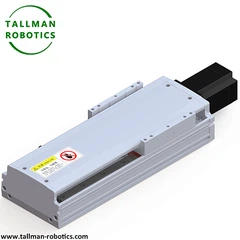


What is XY Positioning Stage?
XY Positioning Stage is a 2D Precision Planar Motion Platform.
An XY positioning stage is a dedicated two-dimensional planar motion platform for industrial precision automation. It integrates two orthogonal linear axes to deliver free planar displacement. Unlike single-axis modules, it supports full-range plane positioning without extra structural expansion. Moreover, it features compact planar layout for precision workstation integration. It serves as core positioning equipment for detection and micro-processing scenarios.
Core Structural Composition
First, the stage adopts a flat integrated base for stable horizontal mounting. It arranges X-axis and Y-axis in vertical orthogonal distribution. Meanwhile, it equips embedded linear guide pairs for smooth planar movement.
In addition, it installs independent transmission units for dual-axis individual drive. Furthermore, it carries a flat load platform for workpiece and tool placement. Lastly, it integrates anti-offset limit parts to standardize planar motion tracks.
Difference from similar devices
|
Comparison Dimension |
XY Positioning Stage |
XY Linear Stage |
Three Axis Gantry |
|
Core functions |
Emphasize "high-precision positioning" and position control accuracy |
Focus on "linear motion" and pay more attention to the smoothness and stroke of motion |
Three dimensional space motion, side heavy load and large workspace |
|
Accuracy level |
High (usually ± 0.001mm to ± 0.1mm) |
Medium (± 0.01mm to ± 1mm) |
Medium to High (± 0.01mm to ± 0.1mm, depending on the load) |
|
Typical applications |
Precision testing, micro operations (such as chip bonding) |
Automated handling, general assembly |
Large scale processing, heavy-duty handling (such as automotive manufacturing) |
You are welcome to watch more projects or visit our video gallery by Youtube: https://www.youtube.com/@tallmanrobotics
|
|
|
|
|
|
TM-FA |
TM-FB |
TM-FB2Z2 |
TM-FBZ2 |
|
|
|
|
|
|
TM-FC |
TM-FCZ |
TM-FD |
TM-FDZ |
|
|
|
|
|
|
TM-FE |
TM-FEZ |
TM-FF |
TM-FFZ |
|
|
|
|
|
|
TM-FG |
TM-FF2 |
TM-FGZ |
TM-FBZ2 |


|
Model of Each Axis |
Model of Each Axis |
Model of Each Axis |
||||||
|
X Axis |
Y Axis |
Z Axis |
X Axis |
Y Axis |
Z Axis |
X Axis |
Y Axis |
Z Axis |
|
TM100 |
TM45 |
TM135 |
TM100 |
TM100 |
TM150 |
TM135 |
TM135 |
|
|
TM100 |
TM62 |
TM135 |
TM135 |
TM100 |
TM200 |
TM100 |
TM62 |
|
|
TM100 |
TM100 |
TM45 |
TM135 |
TM135 |
TM135 |
TM200 |
TM100 |
TM100 |
|
TM100 |
TM100 |
TM62 |
TM150 |
TM62 |
TM200 |
TM135 |
TM100 |
|
|
TM100 |
TM100 |
TM100 |
TM150 |
TM100 |
TM62 |
TM200 |
TM150 |
TM100 |
|
TM135 |
TM62 |
TM150 |
TM100 |
TM100 |
TM200 |
TM150 |
TM135 |
|
|
TM135 |
TM100 |
TM62 |
TM150 |
TM135 |
TM100 |
|||
|
Model of Each Axis |
Model of Each Axis |
Model of Each Axis |
||||||
|
X Axis |
Y Axis |
Z Axis |
X Axis |
Y Axis |
Z Axis |
X Axis |
Y Axis |
Z Axis |
|
TM100 |
TM45 |
TM135 |
TM100 |
TM100 |
TM150 |
TM135 |
TM135 |
|
|
TM100 |
TM62 |
TM135 |
TM135 |
TM100 |
TM200 |
TM100 |
TM62 |
|
|
TM100 |
TM100 |
TM45 |
TM135 |
TM135 |
TM135 |
TM200 |
TM100 |
TM100 |
|
TM100 |
TM100 |
TM62 |
TM150 |
TM62 |
TM200 |
TM135 |
TM100 |
|
|
TM100 |
TM100 |
TM100 |
TM150 |
TM100 |
TM62 |
TM200 |
TM150 |
TM100 |
|
TM135 |
TM62 |
TM150 |
TM100 |
TM100 |
TM200 |
TM150 |
TM135 |
|


Technical Features & Functional Advantages
|
Item |
Technical Feature |
Core Function |
Application Advantage |
|---|---|---|---|
|
Motion Mode |
Dual-axis coordinated planar motion |
Realize arbitrary 2D plane positioning |
Meet full coverage precision alignment demands |
|
Structural Trait |
Low-profile flat integrated structure |
Adapt confined desktop workstation layout |
Simplify precision equipment overall assembly |
|
Positioning Performance |
Stable micro displacement output |
Complete tiny workpiece calibration |
Guarantee high consistency for fine processing |
|
Control Adaptability |
Independent dual-axis programmable control |
Support flexible planar motion trajectory |
Fit diversified precision automation tasks |
Frequently Asked Questions
Q1: What differences exist between XY positioning stage and single linear modules?
It integrates two orthogonal axes to achieve independent 2D planar motion. Single linear modules only support one-way straight displacement. The stage completes full-plane positioning in one compact unit without extra axis combination assembly.
Q2: Can dual-axis movement run synchronously without motion interference?
Yes. The vertical orthogonal structural design avoids axis motion overlap. Independent drive and guiding systems eliminate mutual interference. It keeps smooth and accurate coordinated movement during synchronous dual-axis operation.
Q3: What core scenarios suit XY positioning stage best?
It perfectly fits semiconductor wafer detection, laser precision processing, optical sample measurement, electronic component micro-alignment and all kinds of 2D planar precision automation scenarios.
Q4: Does the flat structure affect the stage's load stability?
No. The integral thickened base improves overall structural rigidity. The symmetrical axis layout balances platform stress. It maintains stable load bearing and positioning during long-term cyclic operation.
Q5: What are the main application limits of XY positioning stage? A5: It only supports two-dimensional planar motion. It cannot complete vertical spatial movement like three-axis systems. It does not suit large-stroke and heavy-load industrial handling tasks.
Hot Tags: xy positioning stage, China xy positioning stage manufacturers, suppliers, factory, Multi Axis Linear Motion Stage, Multi Axis Linear Platform System, 3 Axis Gantry Platform, Multi Axis Linear Positioning System, Multi Axis Linear Actuator Module, Triaxial Gantry Manipulator


