
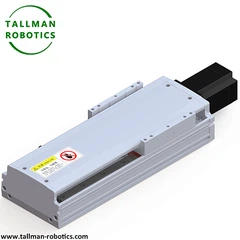


What is Rack and Pinion Linear Module?
Rack and Pinion Linear Module is a Long-Stroke Heavy-Duty Motion Unit.
A rack and pinion linear module is a robust mechanical motion unit for heavy-duty industrial automation. It meshes pinion gears with linear racks to convert rotary torque into straight-line movement. Unlike screw-driven modules, it supports unlimited stroke extension for large-range operation. Furthermore, it delivers rigid power transmission for steady heavy-load motion. It acts as a core linear drive unit for large automation equipment.
Core Structural Composition
First, the module adopts a high-strength linear rack as the fixed transmission base. It matches precision machined pinion gears for tight tooth meshing. Meanwhile, it installs heavy-duty linear guides to stabilize carriage traveling tracks.
In addition, it integrates a rigid mobile carriage for workpiece bearing. Moreover, it reserves standard motor mounting seats for power assembly. Lastly, it adds adjustable tension structures to maintain meshing accuracy.
Comparison with other linear modules
|
Comparison dimensions |
Rack&Pinion |
Ball Screw |
Timing Belt |
|
Travel |
Extra long (can infinitely splice racks) |
Limited (limited by screw length) |
Long (belt length is limited and needs to be tensioned) |
|
Speed |
High (1-5 m/s) |
Medium (0.5-2 m/s) |
High (2-10 m/s) |
|
Positioning accuracy |
Medium (± 0.1- ± 0.5mm) |
High (± 0.001- ± 0.05mm) |
Low (± 0.1- ± 1mm) |
|
Load capacity |
Medium high (suitable for radial loads) |
High (suitable for axial loads) |
Low (mainly for light loads) |
|
Maintenance cost |
Medium (requires regular lubrication of gears and racks) |
High (requires anti contamination of lead screws) |
Low (belts are prone to wear and easy to replace) |
Here, in this page, we introduce models with technical parameter as follows:
You are welcome to watch more projects or visit our video gallery by Youtube: https://www.youtube.com/@tallmanrobotics
|
Model No |
TMG135CM |
tMG135CR |
TMG170CM |
TMG170CR |
TMG220CM |
TMG220CR |
|||||
|
Motor Power (W) |
400 |
750 |
750 |
1500 |
|||||||
|
Repeatability (mm) |
±0.01/±0.02 |
±0.01/±0.02 |
±0.01/±0.02 |
||||||||
|
Gear Teeth |
22 |
32 |
30 |
||||||||
|
Gear Pitch |
5 |
5 |
6.666 |
||||||||
|
Reduction Ratio |
1:5 |
1:5 |
1:10 |
1:5 |
1:10 |
||||||
|
Lead (mm) |
22 |
32 |
16 |
40/20 |
40/20 |
||||||
|
Max Speed(mm/s) |
1100 |
1600 |
800 |
2000/1000 |
2000/1000 |
||||||
|
Motor Speed 3000(rpm/min) |
|||||||||||
|
Max Load |
Acceleration Deceleration |
Horizontal |
0.3G |
25 |
30 |
90 |
25/60 |
60/120 |
|||
|
Vertical |
0.3G |
5 |
5 |
15 |
5/10 |
10/22 |
|||||
|
Rated Thrust |
56 |
98 |
490 |
60/120 |
120/240 |
||||||
|
Linear guide (mm) |
15*12.5-2 |
15*12.5-2 |
23*18-2 |
||||||||
|
Origin Sensor |
Out plug |
EE-SX672(NPN-SX672P(PNP) |
EE-SX672(NPN-SX672P(PNP) |
EE-SX672(NPN-SX672P(PNP) |
|||||||
|
Inside |
E2S-W13 |
EE-SX674(NPN-SX674P(PNP) |
EE-SX674(NPN-SX674P(PNP) |
||||||||
|
Closed type |
Open |
Fully-closed |
Open |
Fully-closed |
Open |
Fully-closed |
|||||


Technical Features & Functional Advantages
|
Item |
Technical Feature |
Core Function |
Application Advantage |
|---|---|---|---|
|
Transmission Mode |
Gear rack meshing drive |
Convert motor rotation to linear thrust |
Output rigid and stable mechanical power |
|
Stroke Capacity |
Splicable extended rack structure |
Break fixed stroke length limits |
Adapt ultra-long distance industrial motion tasks |
|
Load Performance |
High-rigidity bearing structure |
Support heavy industrial workpiece movement |
Maintain stable operation under heavy load conditions |
|
Motion Adaptability |
Continuous linear traveling design |
Realize uninterrupted long-stroke displacement |
Fit large gantry and cross-station automation systems |
Frequently Asked Questions
Q1: What core strengths does rack and pinion linear module have over screw-driven modules?
It supports unlimited splicable stroke extension while screw modules have fixed stroke limits. It bears heavier industrial loads and runs stable long-distance motion. It suits large-range heavy-duty scenarios that screw modules cannot adapt to.
Q2: Does gear meshing structure cause obvious motion vibration?
No. Precision tooth machining and adjustable meshing clearance eliminate severe vibration. The matched linear guide restricts motion deviation. It keeps smooth and steady linear output during long-cycle operation.
Q3: What scenarios fit rack and pinion linear module best?
It fits large gantry machining equipment, automated warehouse long-stroke handling, heavy workpiece sorting, cross-station industrial conveying and all heavy-load ultra-long-stroke automation scenarios.
Q4: Can the module extend stroke length according to on-site demands?
Yes. The linear rack adopts segmented splicing design. Staff can add rack sections to extend effective travel. The whole structure retains transmission stability after standardized splicing installation.
Q5: What are the main application limitations of this module?
It cannot achieve micro-level ultra-high precision positioning like screw modules. Gear meshing leaves tiny transmission gaps. It does not suit fine processing and micro-alignment precision automation tasks.
Hot Tags: rack and pinion linear module, China rack and pinion linear module manufacturers, suppliers, factory, Linear Rack and Pinion Transmission


