
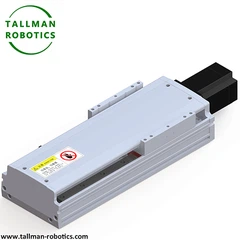


What is Belt Drive Actuator?
A belt drive actuator is a core linear motion component for industrial automation. It converts motor rotary motion into straight linear movement via synchronous belt transmission. Unlike rigid drive structures, this device delivers flexible, stable motion for automated equipment operation.
Core Structural Composition
First, the actuator adopts a compact integrated structure. It mainly includes synchronous belt, drive pulley, linear guide rail, moving carriage and servo motor module. Moreover, the enclosed shell shields internal parts from industrial dust and debris.
In addition, the steel-reinforced synchronous belt ensures tight meshing with pulleys. This structure eliminates motion slippage and supports continuous reciprocating linear movement steadily.
You are welcome to watch more projects or visit our video gallery by Youtube: https://www.youtube.com/@tallmanrobotics
Here, we introduce Belt Drive Actuator, TMB62-CM for general environment with data as follows:


Industrial Application Areas
Primarily, this linear actuator fits high-speed long-stroke automation scenarios. It applies to material handling, automated packaging and robotic positioning processes. Furthermore, it works well in light-load assembly and logistics sorting industrial equipment.
Standard Installation Guidelines
To begin with, fix the guide rail base on flat equipment mounting surfaces. Next, align the pulley axis to avoid motion deviation. Then, connect the motor power interface and calibrate belt tension properly.
Finally, test idle linear movement to confirm smooth operation. Simple installation steps enable fast equipment integration for industrial production lines.
Technical Performance Comparison
|
Technical Item |
Belt Drive Actuator Performance |
Traditional Screw Actuator Performance |
|---|---|---|
|
Motion Speed |
High-speed linear operation |
Limited low-speed operation |
|
Effective Stroke |
Support ultra-long stroke travel |
Short stroke range constraint |
|
Operating Noise |
Low noise smooth transmission |
Obvious mechanical friction noise |
|
Maintenance Demand |
Low frequency routine maintenance |
Frequent lubrication maintenance |
Frequently Asked Questions
Q1: What core advantages does a belt drive actuator have in linear motion control?
It features high-speed response, long-stroke adaptability and low operational noise. It also maintains stable synchronous transmission for long-term automated cyclic motion.
Q2: Can the belt drive actuator adapt to multi-axis linkage automation systems?
Yes. Its standardized interface and compact structure support seamless multi-axis combination. It matches most servo and stepper motor drive systems for linkage control.
Q3: What industrial environments suit this belt drive actuator best?
It fits dry, dust-controlled industrial workshops. It adapts to packaging, logistics, assembly and light robotic automation working environments.
Q4: How to ensure long-term positioning stability of the actuator?
Regularly calibrate belt tension and check pulley alignment. Keep the guide rail clean to avoid friction resistance that affects linear positioning accuracy.
Q5: What load type is the belt drive actuator designed for?
It targets light to medium load linear motion tasks. It excels at high-frequency reciprocating positioning rather than heavy-load pressure processing scenarios.
Hot Tags: belt drive actuator, China belt drive actuator manufacturers, suppliers, factory, Belt Pulley Linear Traverse System, Linear Belt Drive, Timing toothed belt linear actuator, Pulley Belt Linear Propulsion Assembly, Totally Enclosed Belt Drive System, Linear Sliding Rail System


