
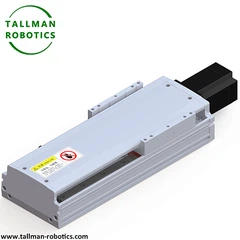


Belt Driven System is mainly composed of components such as belts and pulleys (also known as pulleys). Its working principle is to wrap a belt around the driving wheel and the driven wheel. When the driving wheel rotates, it relies on the friction between the belt and the pulley to drive the driven wheel to rotate together, thereby achieving the transmission of power from one shaft to another.
There are various types of Belt Driven System, including flat belt transmission, V-belt transmission, and synchronous belt transmission. The flat belt transmission structure is simple and suitable for situations where the center distance between two axes is large; V-belt transmission, due to its good fit between the trapezoidal cross-section and the pulley groove, can generate greater frictional force, transmit greater power, and have a wider range of applications; Belt Driven System has a tooth profile, which can ensure the synchronous rotation of the driving wheel and the driven wheel, and has high positioning accuracy.
Belt Driven System has many advantages. It has a certain degree of flexibility and can adapt to the misalignment between the input shaft and the output shaft; Relatively quiet during operation because the belt can absorb vibration and noise; Low maintenance cost, no need for frequent lubrication and maintenance; It can also transmit large torque and is suitable for some heavy-duty applications. However, it also has some limitations, such as the transmission ratio not necessarily being constant, as the belt may slip and stretch; It will generate heat, and the speed and power transmission are also subject to certain limitations, usually with a speed not exceeding 35 meters per second and a power not exceeding 370 kilowatts.
Belt Driven System is widely used in industrial fields, such as production lines in mechanical manufacturing, textiles, food processing, and other industries, to drive various mechanical equipment, achieve power transmission and motion control.
You are welcome to watch more projects or visit our video gallery by Youtube: https://www.youtube.com/@tallmanrobotics
Here, we introduce Belt Driven System, TMB65-CM for general environment with data as follows:


The common faults and solutions of Belt Driven System are as follows:
Slipping
Reason: Insufficient belt tension, surface wear or contamination of the pulley, severe belt wear leading to a decrease in friction force.
Solution: Adjust the tension of the belt to ensure sufficient friction between the belt and the drive wheel; Clean the surface of the belt and pulley to remove pollutants such as oil and dust; Replace the severely worn belt.
Deviation
Reason : Belt pulley not aligned, bearing wear, improper belt installation, damaged guide device.
Solution: Re center the pulley to ensure its axis is parallel; Check and replace worn bearings; Adjust the installation position of the belt to ensure it is correctly installed on the pulley; Check and replace damaged guiding devices.
Wear and tear
Reason: Excessive friction between the belt and pulley, foreign objects embedded, and environmental factors such as humidity and temperature.
Solution: Optimize the transmission system to reduce friction between the belt and the drive wheel, such as adjusting the position of the pulley or replacing it with a suitable one; Clean the belt and pulley to prevent foreign objects from entering; Choose the appropriate belt material based on environmental conditions, or take protective measures such as installing a protective cover.
Fracture
Reason: Belt aging, excessive tension, mechanical impact, excessive load.
Solution: Replace the belt with a new one to ensure reliable quality and suitable performance; Adjust the load distribution of the transmission device to avoid overload operation; Check and adjust the tension of the belt to meet the specified requirements; Strengthen the safety protection measures of the belt to prevent accidental breakage.
Noise
Reason: Mismatch between belt and pulley, uneven belt tension, damaged bearings, excessive surface wear of pulley.
Solution: Replace the appropriate belt and pulley to ensure they match; Adjust the belt tension to make it uniform; Replace damaged bearings; Replace severely worn pulleys.
Hot Tags: belt driven system, China belt driven system manufacturers, suppliers, factory, Belt Based Positioning Stage, Belt Pulley Linear Traverse System, Belt Driven CNC Linear Rail System, Belt Powered Positioning Assembly, Non Enclosed Belt Driven Linear Slide, Pulley Belt Actuated Linear Mechanism


