
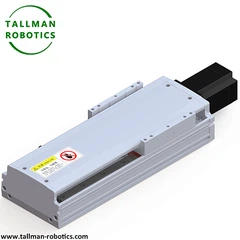


The core definition of an Electric Rotary Table is a mechanical device that uses electricity as its power source, converts the rotational motion of the motor into precise rotation or indexing motion of the worktable through a mechanical transmission structure, and combines it with a control system to achieve high-precision positioning and motion control. Its core features are "electric drive" and "precise rotary positioning", which are different from manual rotary tables or pneumatic/hydraulic driven rotary devices. Electric rotary tables have higher control accuracy, wider speed range, and stronger automation integration capabilities.
From a functional perspective, Electric Rotary Table can not only achieve 360 ° continuous rotation, but also perform fixed angle indexing positioning (such as pausing at 90 ° and 60 ° per rotation). Some high-end models support programmable positioning at any angle, meeting the diverse requirements of complex processes for rotation trajectories. Its positioning accuracy can usually reach seconds (in angular units) or micrometers (in radial/axial runout), making it a key equipment in precision manufacturing to ensure consistency in processing and testing.
Electric Rotary Table is an automated mechanical component driven by electricity that can achieve precise rotational positioning. It is widely used in industrial automation, precision manufacturing, robotics technology, and other fields. It drives the worktable to perform controllable rotational motion through a motor-driven transmission mechanism, and can achieve functions such as angle positioning, continuous rotation, and indexing motion. It is the core component for achieving multi station operation and angle adjustment in automated production lines and precision equipment.
The structure of Electric Rotary Table usually consists of six parts: a drive system, a transmission system, a worktable, a support structure, a detection feedback system, and a control system. Each part works together to achieve precise rotation function:
|
Drive system |
The core is the driving motor, and common types include servo motors (such as AC servo motors, DC servo motors) and stepper motors. Servo motors, with their closed-loop control advantages, have better positioning accuracy, speed stability, and dynamic response, making them suitable for high-precision scenarios; Stepper motors have lower costs and are suitable for simple indexing scenarios with low positioning accuracy requirements. Some high-end models will be equipped with a reduction motor to increase output torque by lowering the speed. |
|
Transmission system |
Responsible for transmitting the motor power to the workbench, which is the core link that determines the rotation accuracy. Common transmission methods include: 1).Worm gear transmission: compact structure, large transmission ratio, self-locking function (the worktable is not easy to loosen after power failure), but there may be a "crawling" phenomenon at low speeds, suitable for low to medium speeds and high torque scenarios; 2)Gear transmission: such as spur gears, helical gears, or harmonic gears, among which harmonic gear transmission has high accuracy and small return clearance (up to 0.1 °), suitable for high-precision indexing; 3).Direct Drive (DD Motor): The motor rotor is directly connected to the worktable without intermediate transmission components, eliminating transmission gaps and achieving positioning accuracy within ± 5 arc seconds. However, the cost is high and it is suitable for ultra precision scenarios such as semiconductor manufacturing. |
|
Workbench and supporting structure |
The workbench is usually a circular metal plate (mostly made of cast iron, aluminum alloy, or stainless steel), with T-shaped grooves, positioning holes, etc. on the surface for easy fixation of workpieces or fixtures. The supporting structure includes a base and bearing components (such as cross roller bearings and precision ball bearings), which are used to ensure the radial and axial rigidity of the worktable and reduce jumping and shaking during rotation. |
|
Detection feedback system |
The key to achieving closed-loop control is to use sensors to detect the rotation angle and position of the workbench in real time, and feedback the signal to the control system. Common sensors include encoders (such as photoelectric encoders, magnetic encoders) and grating rulers, where the encoder is directly connected to the motor or workbench and can output real-time position pulse signals to ensure that the actual rotation angle is consistent with the command. |
|
Control System |
Including controllers (such as PLCs, motion controllers) and drive modules (servo drivers, stepper drivers). The controller receives external instructions (such as signals from the upper computer and CNC system), calculates the motion trajectory, and sends control signals to the drive module; The drive module adjusts the motor speed, steering, and torque based on the signal to achieve precise positioning. |
Here In this page, we introduce series of Electric Rotary Table, you will see data sheet, production pictures,vedios of test as follows:
Also You are welcome to watch more projects or visit our video gallery by Youtube: https://www.youtube.com/@tallmanrobotics

Packing and delivery of Motorized Rotary Tables:


Production of Electirc Rotary Table:


The core function of Electric Rotary Table revolves around "precise rotation control", including:
1).High precision positioning: Through closed-loop control and precision transmission, it achieves positioning accuracy of ± 0.01 ° to ± 5 arc seconds, and some models support repeated positioning accuracy of ≤ ± 1 arc second;
2).Programmable motion control: supports preset rotation angle, speed, acceleration and other parameters through the upper computer or control panel to achieve automated indexing, continuous rotation or composite trajectory motion;
3).High rigidity and stability: By optimizing the support structure and bearing selection, ensure that the radial/axial runout during high-speed rotation is ≤ 0.01mm, reducing workpiece processing or detection errors;
4).Compatibility and Scalability: Can be integrated with robots, numerical control systems (such as CNC), visual inspection equipment, etc., supporting I/O signals, EtherCAT, Modbus and other communication protocols, and integrated into automated production lines.
In terms of technical features, the electric rotary worktable has the dual advantages of "automation" and "precision": compared to manual rotary worktables, it can achieve unmanned operation through programs, improving production efficiency; Compared to pneumatic/hydraulic rotary tables, it is not affected by fluctuations in air source/hydraulic oil pressure, moves more smoothly, and its positioning accuracy can be continuously optimized through software calibration.
Electric Rotary Table is widely used in scenarios that require multi station rotating operations due to their precise rotation and automation control capabilities. Typical industries include:
|
Precision Manufacturing and Processing |
In CNC machine tools such as machining centers and engraving machines, electric rotating workbenches can achieve multi-faceted machining of workpieces (such as drilling and milling circular surfaces in one clamping), reducing clamping times and improving machining accuracy. For example, in mold processing, the equal slot processing of circular molds is achieved by rotating the worktable, ensuring that the angle error of each slot position is ≤ 0.02 °. |
|
Automated assembly and testing |
In electronic and automotive component assembly lines, the rotating worktable can serve as a "turntable workstation" to sequentially transfer workpieces to assembly, tightening, testing, and other workstations, achieving streamlined operations. In the assembly of mobile phone camera modules, the module is accurately positioned to the dispensing, welding, and testing positions through a rotating table, with a positioning time of ≤ 0.1 seconds per time. |
|
Semiconductor and Photovoltaic Industry |
In the process of wafer inspection and chip packaging, the electric rotary worktable (often driven by DD motors) needs to achieve micrometer level rotation positioning of the wafer, ensuring that the detection probe or packaging head is aligned with the chip pins, and the positioning accuracy requirement is ≤± 3 arc seconds. |
|
Medical and laboratory equipment |
In medical imaging equipment such as CT and MRI, the rotating worktable drives the patient or test sample to rotate at a constant speed, and cooperates with the imaging system to obtain multi angle data; In laboratory automation equipment, it can achieve automatic sample changing, shaking and other operations of the sample tray. |
|
Packaging and Printing Industry |
In label printing, bottle cap hot stamping and other equipment, the rotating worktable drives the product to rotate, and cooperates with the printing head or hot stamping mechanism to achieve uniform printing on the circumferential surface, ensuring the accuracy of pattern docking (such as label seam error ≤ 0.1mm). |
When choosing Electric Rotary Table, it is important to pay attention to the following indicators:
1).Positioning accuracy and repeatability accuracy: Determine the consistency of workpiece processing or testing. For high-precision scenarios, models with an angle of ≤± 10 arc seconds should be selected;
2).Speed range: Select according to process requirements (such as high speed required for continuous rotation scenarios and low speed stability required for division scenarios);
3).Load capacity: including axial load (vertical pressure borne by the workbench) and radial load (lateral force generated by workpiece eccentricity), which need to be matched with the weight of the workpiece;
4).Return clearance: The clearance size of the transmission system directly affects the positioning error during reverse rotation. For precision scenarios, models with a clearance of ≤ 0.1 ° should be selected;
5).Communication and control mode: Does it support compatibility with existing control systems (such as PLC, robots), and does it require bus control (such as Profinet, EtherCAT).
As the "precision rotation core" in industrial automation, the electric rotary worktable achieves high precision, high stability, and high programmability of rotational motion through electric drive and closed-loop control technology. Its structural design takes into account both power transmission and accuracy assurance, and is widely suitable for fields such as precision manufacturing, electronic assembly, and semiconductors that require strict rotational positioning. With the advancement of automation and intelligence in Industry 4.0, electric rotary workbenches are developing towards higher precision (such as nanoscale positioning), higher integration (such as integrated visual inspection), and more flexible programming, becoming key equipment for improving production efficiency and product quality.
Hot Tags: electric rotary table, China electric rotary table manufacturers, suppliers, factory, Hollow Shaft Based Rotary Actuator, Electric Rotary Stage, Heavy Duty Industrial Hollow Shaft Rotary Stage, Hollow Rotating Tables with Double Lead Worm Transmission, Industrial Heavy Duty Hollow Rotary Platform, Precision Hollow Rotary Indexer


