
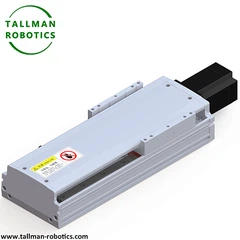


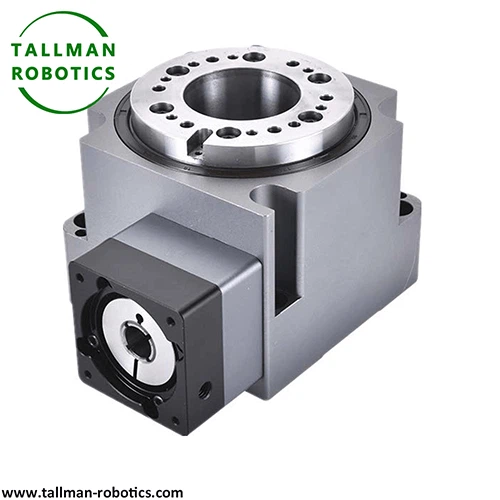


Hollow Axis Rotary Table is designed with a hollow axis structure as its core, providing great convenience for equipment integration. The hollow shaft runs through the center of the rotating table, allowing cables, air pipes, optical fibers and other pipelines to pass through the shaft, effectively solving the problems of winding and disorderly layout of traditional rotating equipment lines. Hollow Axis Rotary Table not only makes the overall structure of the equipment more compact, but also avoids faults caused by line friction and pulling, significantly improving system stability and reliability.
Here In this page, we introduce series of Hollow Axis Rotary Table,
you will see data sheet, production pictures,videos of test as follows:
Also You are welcome to watch more projects or visit our video gallery by Youtube: https://www.youtube.com/@tallmanrobotics
|
Hypoid Gear Hollow Rotary Platforms |
|||||||
|
Model No |
TMR60-30-S TMR60-30-B |
TMR120-30-S TMR120-30-B |
TMR165-30-S TMR165-30-/B |
TMR240-30-S |
|||
|
Motor type |
50/100 W servo 42 stepper motor |
200/400W servo motor 57/86 stepper motor |
750W/1000W servo motor 86/110 stepper motor |
1000/1500W servo motor |
|||
|
Ratio (i) |
30 |
30 |
30 |
30 |
|||
|
Bearing type |
Cross roller bearing |
Tapered roller bearing |
Tapered roller bearing |
Tapered roller bearing |
|||
|
Allowable axis torque (N.m) |
35 |
120 |
240 |
500 |
|||
|
Allowable moment torque (N.m) |
45 |
240 |
480 |
900 |
|||
|
Allowable Plate Speed (R/Min) |
200 |
200 |
200 |
200 |
|||
|
Max overturning torque (N.m) |
60 |
240 |
460 |
||||
|
Max radial force (N) |
400 |
9000 |
18000 |
||||
|
Max axial force (N) |
400 |
9000 |
18000 |
||||
|
Allowable axial load |
400 |
3000 |
7000 |
12000 |
|||
|
Torsion Rigidity |
21Nm/arcmin |
48 Nm/arcmin |
76 Nm/arcmin |
||||
|
Positioning Accuracy |
±0.5 arc/min |
±0.5 arc/min |
±0.5 arc/min |
±0.5 arc/min |
|||
|
Repeat Positioning |
≤10 arc/sec |
≤10 arc/sec |
≤10 arc/sec |
≤10 arc/sec |
|||
|
Platform Runout |
≤0.01mm |
≤0.01mm |
≤0.01mm |
≤0.01mm |
|||
|
Radial runout |
≤0.01mm |
≤0.01mm |
≤0.01mm |
≤0.01mm |
|||
|
Platform concentricity |
≤0.01mm |
≤0.01mm |
≤0.01mm |
≤0.01mm |
|||
|
Platform Parallelism |
≤0.01mm |
≤0.01mm |
≤0.01mm |
≤0.01mm |
|||
|
Backlash |
0 |
0 |
0 |
0 |
|||
|
Life (Hours) |
>20,000 |
>20,000 |
>20,000 |
>20,000 |
|||
|
Lubrication method |
Synthetic grease Lubricant |
||||||
|
Protection Grade |
IP50 |
IP50 |
IP50 |
IP50 |
|||
|
Installation method |
Any angle |
Any angle |
Any angle |
Any angle |
|||
|
Operating temperature |
-25℃-90℃ |
-25℃-90℃ |
-25℃-90℃ |
-25℃-90℃ |
|||
|
Weight (kg) |
0.6 |
5.15 |
13.5 |
||||
|
Options |
|
|
Driver and Cable |
Driver and cable for options, provided by Tallman Robotics Limited (Usaullay, we configure with Delta, Inovance; Pulse, EtherCat, Profinet are available ) |
|
Face rotating Plate |
Provided if needed.(Drawing provided by the clients) |
|
Sensors |
Ormon sensors, brackets, sensor plates, screws are for options. |


FAQ:
1. What is the rated speed range of the hollow rotating platform?
Rated speed typically ranges from 50 to 300 rpm for standard models. Precision platforms operate at 100–200 rpm. Heavy-duty or large-aperture units run slower, often 30–100 rpm. High-speed variants reach up to 500 rpm with special bearings. Always check the manufacturer's datasheet for exact values.
2. What is the relationship between maximum speed and reduction ratio?
Maximum speed is inversely proportional to the reduction ratio. Higher reduction lowers output speed. For example, a 10:1 ratio allows 300 rpm input, giving 30 rpm output. Lower reduction (e.g., 5:1) yields higher output speed but less torque. The formula is: output speed = motor speed / reduction ratio.
3. What is the adjustment range for acceleration time and deceleration time?
You can adjust acceleration and deceleration times from 0.05 to 2 seconds typically. Servo drives allow fine-tuning via software. Longer times reduce shock and improve stability. Shorter times increase cycle speed but risk overshoot. Set these times based on load inertia and available motor torque.
4. How to ensure the stability of the rotating platform during high-speed rotation?
Use precision-balanced components to minimize vibration. Select a platform with preloaded crossed roller bearings for high rigidity. Match the motor torque to the load inertia. Increase acceleration and deceleration times to reduce jerk. Mount the platform on a rigid base. Avoid operating near natural resonance frequencies.
5. What is the general range for controlling the speed fluctuation error?
Speed fluctuation error typically stays within ±1% to ±5% of the set speed. High-end servo-controlled platforms achieve ±0.1% to ±0.5%. Fluctuation arises from load variations, bearing friction, and motor ripple. Closed-loop control with an encoder reduces error significantly. For most automation tasks, ±2% is acceptable.
Hot Tags: hollow axis rotary table, China hollow axis rotary table manufacturers, suppliers, factory, Cam Roller Transmission Hollow Rotating Tables, Electric Driven Rotating Table, Heavy Duty Hollow Shaft Rotary Platform, Heavy Duty Industrial Hollow Shaft Rotary Stage, Hypoid Gear Hollow Shaft Actuator, Motor Driven Rotary Table


