
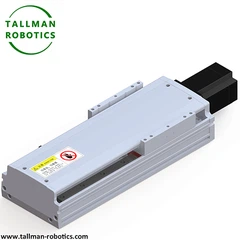


What is Hollow Rotary Motion System?
A hollow rotary motion system is a precision rotary actuator or reducer featuring a large-diameter through-bore in its center, allowing cables, pneumatic/hydraulic lines, optical fibers, shafts, or other utilities to pass directly through the rotating axis. This design eliminates the need for external cable management such as slip rings or rotary unions, simplifying integration in applications requiring continuous or indexed rotation with pass-through routing.
Structure
The system typically integrates a hollow-shaft planetary, cycloidal, or harmonic reduction stage with a large-bore output flange supported by cross-roller or four-point contact bearings capable of handling combined radial, axial, and moment loads. The central bore runs concentrically through the input, reduction stage, and output, while the housing is precision-machined to maintain rigidity and low runout despite the open core architecture.
Selection Considerations
Key factors include bore diameter (must accommodate all pass-through utilities with clearance), reduction ratio, torsional stiffness, backlash, rated/peak torque, permissible moment load, and repeatability. Since the hollow bore reduces available material for load-bearing structure compared to solid-shaft designs, load capacity and stiffness should be carefully verified against application demands.
Applications
Hollow rotary motion systems are used in robotic wrist and joint axes, rotary index tables, camera/sensor gimbals, semiconductor wafer handling, and machine tool rotary axes where routing cables or utility lines through the rotation center improves reliability and reduces wear from cable flexing.
Installation Considerations
Installers must verify all pass-through cables or lines have adequate clearance and strain relief to prevent chafing during rotation. Mounting flanges require cross-pattern torquing to specification. Alignment between input drive and output bore axis should be confirmed, and permissible moment/axial loads must not be exceeded to preserve bearing life and positioning accuracy.
Here In this page, we introduce series of Hollow Rotary Motion System,
you can see data sheet, production pictures,videos of test as follows:
Also You are welcome to watch more projects or visit our video gallery by Youtube: https://www.youtube.com/@tallmanrobotics


FAQ:
1. What are the core components of a Hollow Rotary Motion System?
A hollow rotating platform integrates several key components. It features a high-precision crossed roller bearing to support heavy loads and provide high rigidity. The core drive components are a precision cam indexer or a gear set for accurate indexing. The platform includes a hollow shaft or output flange for mounting loads and an input flange to connect a motor. An input shaft and a housing unit enclose these parts.
2. What is the typical material for the base of a Hollow Rotary Motion System?
Manufacturers typically make the base from cast iron or aluminum alloy. Cast iron provides high rigidity and excellent vibration damping for heavy-duty applications. Aluminum alloy offers a lightweight solution for high-speed precision tasks.
3. What are the material options for the rotating table of the hollow rotating platform?
Common material options for the rotating table include steel, aluminum alloy, and stainless steel. Steel provides high strength and durability for heavy loads. Aluminum alloy is lightweight and corrosion-resistant for high-speed or clean environments. Stainless steel offers superior corrosion resistance for harsh or sanitary conditions.
4. What are the characteristics of the protective structure design for the shell of the hollow rotating platform?
The shell design aims for high rigidity and effective sealing. It often uses integral casting of aluminum or cast iron for strength. The housing incorporates sealing mechanisms to prevent contaminant ingress. To achieve specific protection levels, such as IP54 or IP65, manufacturers use features like sealed cable glands, gaskets, and labyrinth seals.
5. How does the sealing structure of Hollow Rotary Motion System prevent dust/water vapor from entering?
The sealing structure uses a labyrinth design to create a long, tortuous path that blocks contaminants. It also includes an inner sealing gasket as a final dust barrier. A specially designed cavity acts as a buffer zone, and drainage holes in the housing allow any liquid that does get past the first barriers to safely exit the system.
Hot Tags: hollow rotary motion system, China hollow rotary motion system manufacturers, suppliers, factory, Through Hole Rotary Tables, Hypoid Gear Equipped Hollow Actuator, Large Aperture Rotary Tables, Pulsed Cam Indexing Device, Heavy Duty Hollow Rotary Work Platform, Electric Motor Driven Rotary Table

