




What is Gear Reducer?
A gear reducer is a mechanical power transmission device that decreases input rotational speed from a motor while proportionally increasing output torque, using one or more sets of meshing gears. Gear reducers are used whenever a driven load requires higher torque or slower speed than a motor's native output, and they come in various configurations including planetary, helical, worm, bevel, and cycloidal designs depending on load, ratio, and space requirements.
Structure
A typical gear reducer consists of an input shaft connected to the driving motor, one or more gear stages (spur, helical, bevel, worm, or planetary) housed within a rigid casing, and an output shaft or flange that transfers reduced-speed, increased-torque motion to the driven equipment. Bearings support the shafts to handle radial and axial loads, while seals and lubrication (oil bath or grease) protect internal components from contamination and wear.
Selection Considerations
Key factors include reduction ratio, rated and peak torque capacity, input speed limits, backlash class, efficiency, mounting configuration (foot-mounted, flange-mounted, shaft-mounted), thermal rating, and duty cycle. Gear type selection depends on application needs-helical gearboxes offer high efficiency and smooth operation, worm gearboxes provide compact right-angle drives with self-locking capability, and planetary units deliver high torque density in minimal space.
Applications
Gear reducers are used across conveyor systems, mixers, cranes, packaging machinery, mining equipment, agricultural machinery, and industrial automation lines where torque multiplication and speed control are essential for reliable equipment operation.
Installation Considerations
Correct shaft alignment between motor and reducer is critical to avoid vibration and premature bearing failure. Mounting bolts must be torqued to specification, and coupling concentricity verified. Oil levels should be checked and set per orientation (horizontal, vertical, inclined), and breather plugs should be installed correctly before commissioning to prevent pressure buildup.
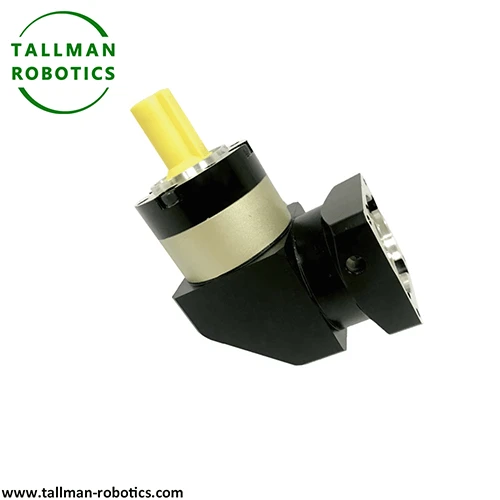
Here In this page, we introduce our PGCR serial Gear Reducer, you will see technical parameter,finished gearboxes,videos of test as follows:
|
High Precision Angle Straight Gear Series: PGCR |
|
|
|


Industrial automation use cases
CASE 01 · AGV SYSTEMS : Automated guided vehicle drive axle
Warehouse AGVs pair brushless DC motors with compact inline gear reducers (ratio 20:1–40:1) to achieve precise, torque-rich wheel drive at low speed. The reducer absorbs shock loads during acceleration and stop cycles, extending motor life while maintaining positioning accuracy of ±5 mm along programmed routes - critical for pallet-handling reliability in 24/7 logistics facilities.
CASE 02 · CONVEYOR LINE : Heavy-duty belt conveyor drive
Automotive stamping lines use helical shaft-mounted gear reducers on main conveyor drives to step down 1,450 RPM motor output to 35–50 RPM belt speed, generating several thousand Nm of output torque. The reducer's high service factor (SF 2.0+) handles start-stop cycling and occasional jam loads, ensuring consistent throughput without unplanned downtime on the production floor.
FAQs about Gear reducer
What is the difference between a gear reducer and a gearbox?
The terms are largely interchangeable. "Gear reducer" emphasizes the speed-reduction function, while "gearbox" describes the housing assembly. In practice, both refer to the same enclosed gear transmission unit mounted between a motor and a driven machine.
How do I calculate the output torque of a gear reducer?
Output torque = Input torque × Gear ratio × Efficiency. For example, a motor delivering 10 Nm into a 50:1 reducer at 97% efficiency produces 485 Nm at the output shaft. Always apply a service factor of 1.5–2× to account for peak and shock loads in your application.
Which gear reducer type offers the highest efficiency?
Helical and planetary gear reducers typically achieve 96–98% efficiency per stage. Worm gear reducers are less efficient (50–90%), especially at high reduction ratios, but their self-locking property and compact form make them preferred for specific vertical-load applications.
What causes backlash in a gear reducer, and why does it matter?
Backlash is the angular play between mating gear teeth when the drive direction reverses. In standard reducers it can reach 15–30 arcmin; precision-ground units achieve <3 arcmin. For positioning systems - robots, CNC axes, inspection equipment - minimizing backlash is essential to hit dimensional accuracy targets consistently.
How often should a gear reducer be serviced or lubricated?
Most manufacturers recommend an initial oil change after 300–500 operating hours, then every 3,000–5,000 hours or annually - whichever comes first. Grease-packed sealed units are maintenance-free for their rated service life. Always consult the OEM manual and factor in ambient temperature and load duty cycle.
Also You are welcome to watch more projects or visit our video gallery by Youtube: https://www.youtube.com/@tallmanrobotics
Hot Tags: gear reducer, China gear reducer manufacturers, suppliers, factory, Epicyclic Reduction Unit, Planetary Speed Reduction Gearhead, Epicyclic Gear Reduction Gearbox, Planetary Gearbox Reducer, Multi Stage Planetary Gearbox, Planetary Gear Reduction Drive


