
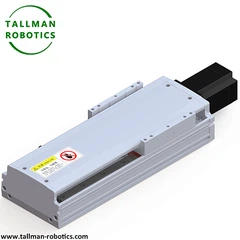


Linear Ball Screw Actuator is an electromechanical device that converts rotational motion into high-precision linear motion through ball screw transmission. Linear Ball Screw Actuator consists of a ball screw, nut, guide mechanism (such as guide rail), motor (servo/stepper), and housing. The core is integrated with a ball screw assembly and a drive unit (usually a motor), which combines high transmission efficiency, high-precision positioning, and strong load capacity. It is widely used in automation equipment that requires precision linear drive, precision positioning, high load, or high-speed linear motion.
Core structure and working principle of Linear Ball Screw Actuator
Its core components include:
Ball screw pair: composed of a screw, nut, and ball (rolling element in between). The outer surface of the screw and the inner surface of the nut are both machined with spiral raceways, and the ball circulates and rolls in the raceways (through a ball return device), converting traditional sliding friction into rolling friction.
Drive unit: usually a servo motor or stepper motor (partially equipped with a reducer), providing rotational power, connected to the screw through a coupling.
Guiding component: Linear guide rail or sliding bearing, matched with nut seat (the component connecting the load) to ensure stable movement of the nut in a straight direction and avoid rotational deviation.
Supporting structure: bearing seat and rigid base, fixing the two ends of the screw to ensure coaxiality and stability during rotation.
Working principle: When the motor drives the screw to rotate, the ball rolls in the raceway, driving the nut to make linear motion along the axial direction of the screw (when the screw is fixed) or the screw itself moves axially (when the nut is fixed), and then the load is driven by the nut seat to achieve precise linear displacement.
Key performance parameters of Linear Ball Screw Actuator
|
Parameter Description |
Typical Range |
Options |
|
lead |
The straight-line movement distance of the screw after one rotation |
is 2mm (high precision)~20mm (high speed) |
|
Accuracy level |
axial positioning error (such as C3 level ± 0.05mm/300mm) |
C1 (ultra precision)~C10 (ordinary) |
|
Rated load |
dynamic/static axial load (N or kgf) |
100N~50kN |
|
The maximum speed |
limited by the lead and motor speed (usually ≤ 1m/s), |
ranging from 0.1 to 2 m/s |
|
Protection level |
dustproof and waterproof capability (such as IP65) |
IP54~IP67 |
You are welcome to watch more projects or visit our video gallery by Youtube: https://www.youtube.com/@tallmanrobotics
Here, we introduce Linear Ball Screw Actuator by Fully Sealed Screw drive linear Modules for Clean Environment from Tallman Robot,with following series TMS-CR.


Core Features of Linear Ball Screw Actuator
High transmission efficiency: Due to the replacement of sliding friction with rolling friction, the efficiency can reach 90% -98% (traditional sliding screws only have 20% -40%), with low energy consumption and minimal heat generation.
Excellent positioning accuracy: Through precision machining (such as C3 and C5 precision levels) and closed-loop control (with encoders), the repeated positioning accuracy can reach ± 0.01mm level, meeting the requirements of precision manufacturing.
Strong load capacity: The multi-point contact of the ball can disperse the load, withstand axial large loads (from a few kilograms to tens of tons), and have high rigidity and are not easily deformed.
Good motion stability: The friction torque of rolling friction is small and stable, and there is no obvious crawling phenomenon during start-up and operation, suitable for smooth high-speed or low-speed motion.
Reversibility and self-locking controllability: By default, it can be driven in both directions (by motor or external force). If self-locking is required, it can be paired with a brake motor or reducer to prevent the load from slipping due to its own weight (such as in vertical application scenarios).
Typical applications of Linear Ball Screw Actuator
Precision machine tools: such as tool feed and worktable positioning of CNC machine tools;
Automation equipment: component push for assembly lines, probe movement for testing equipment;
Medical equipment: bed movement of CT machines, precise operating arms of surgical robots;
Aerospace: Position control of satellite attitude adjustment mechanisms and wind tunnel test benches;
Semiconductor manufacturing: Linear drive of wafer handling robotic arms, precise displacement of lithography machines.
Ball screw linear actuators have become the core transmission components in the field of precision automation due to their high precision, high rigidity, and long lifespan. When selecting, a comprehensive balance should be made based on load, speed, and accuracy budget - C1 level ultra precision models are preferred in the semiconductor/medical industry, while C5~C7 level economical solutions can be selected for general industrial scenarios. The modular design of Linear Ball Screw Actuator significantly reduces integration difficulty and is an ideal choice to replace hydraulic/pneumatic systems.
Hot Tags: linear ball screw actuator, China linear ball screw actuator manufacturers, suppliers, factory, Crossed Roller Stage, High dynamic Linear System, Linear Actuator, Linear Indexing Table, Linear Motion Table, Cartesian Slide
