
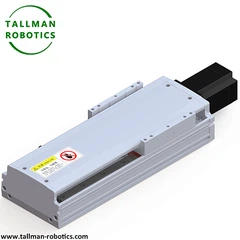


Linear Slide is a mechanical device used to achieve the movement of objects along a fixed linear trajectory. It provides stable guidance and support through structured design, and is a mechanical module that achieves high-precision linear motion. Linear Slide is usually composed of guide rails, sliders, drive mechanisms, and support structures. It can convert rotational motion (such as motor-driven) into linear motion, or directly drive through linear motors, and is widely used in automation equipment, precision machining, and detection systems.
Linear Slide is a modular component that integrates guide rails, sliders, and load-bearing platforms. Its core function is to constrain the direction of motion to a straight line while reducing friction to achieve smooth movement. It can be manually operated or combined with drive systems (such as motors and cylinders) to achieve automated motion.
Structure of Linear Slide: It mainly consists of four parts:
Guide rail: usually a rectangular metal body (such as aluminum profiles, steel guide rails), used as a reference for the motion trajectory, the surface may be machined with grooves or tracks;
Sliding block/slide seat: a moving part that cooperates with a guide rail, with built-in rolling elements (balls, rollers) or sliding contact parts (plastic, metal sliding blocks), directly connected to the load-bearing platform;
Load bearing platform: a flat structure for installing the object to be moved, rigidly connected to the slider;
Auxiliary components: such as limit blocks (to prevent overtravel), lubrication devices (grease fittings or oil grooves), dust covers (to protect guide rails), etc.
Working principle of Linear Slide:
Using the coordination between the guide rail and the slider to limit degrees of freedom - the slider can only move along the axis of the guide rail, while other directions (radial, rotational) are constrained. According to the type of friction, it can be divided into two categories: rolling friction type: by rolling balls/rollers between the guide rail and the slider, the sliding friction is converted into rolling friction, with a low friction coefficient (0.001~0.005), suitable for high-precision and low resistance scenarios;
Sliding friction type: The slider is in direct contact with the guide rail (such as using self-lubricating plastic sliders), with a simple structure but a high friction coefficient (0.1~0.3), suitable for low-cost, light load scenarios.
You are welcome to watch more projects or visit our video gallery by Youtube: https://www.youtube.com/@tallmanrobotics
Here, we introduce Linear Slide, TMS100-CM with data as follows:


Application of Linear Slide: Due to its compact structure, easy installation, and wide range of application scenarios:
Automation equipment: such as material conveying on assembly lines, sample movement of testing equipment;
Precision instruments: optical path adjustment for microscope stages and laser cutting equipment;
Office equipment: paper conveying mechanism for printers, nozzle slide for 3D printers;
Medical equipment: push devices for infusion pumps, linear adjustment mechanisms for rehabilitation equipment.
Compared to complex Linear Guide Actors, Linear Slide focuses more on basic guiding functions and typically require external driving devices. However, they have lower costs and more flexible structures, making them the fundamental components for achieving linear motion in industrial automation.
Application scenarios of Linear Slide
Industrial automation: robotic arms, assembly lines, material handling.
Semiconductor manufacturing: wafer cutting, chip packaging equipment.
Medical equipment : surgical robots, imaging scanners.
Detection and measurement : 3D scanner, optical detection platform.
3D printing/CNC machining: Control the precise movement of the print head or tool.
Application Cases of Linear Slide
1). Automated assembly line: Linear slide table is used to accurately locate parts and improve production efficiency.
2). Laser cutting machine: The slide table is driven by a servo motor and ball screw to achieve high-precision cutting.
3). Microscope autofocus system: Precise linear slide adjusts the lens position to enhance imaging clarity.
Maintenance matters of Linear Slide
Regular lubrication: Special lubricating grease should be used for the guide rail and screw to prevent wear (check every 3-6 months).
Cleaning and dust prevention: Install a protective cover or scraper to prevent metal shavings and dust from entering the guide rail.
Check fasteners: Ensure that screws and couplings are not loose to prevent movement deviation.
Monitor motors and drivers: avoid overloading or overheating, which may affect their service life.
Regular calibration (high-precision application): Use a laser interferometer or micrometer to check the positioning accuracy.
Linear slide table has become a core component of modern automation equipment due to its high precision, high rigidity, and modular design. Reasonable maintenance can significantly extend its service life.
Hot Tags: linear slide, China linear slide manufacturers, suppliers, factory, Linear Guide Actuator, Linear Indexing Table, Linear Motion Table, Linear Sliding Table, Mechanical Stage, Repeatable Positioning


