
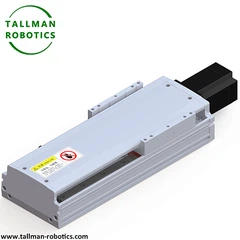


Linear Guide Actuator is a modular actuator that integrates linear guides and driving devices. Linear Guide Actuator is mainly used to achieve high-precision and high stability linear reciprocating motion and is widely used in automation equipment. Linear Guide Actuator is based on a linear guide and combines driving components such as screws, synchronous belts, or linear motors to convert rotational motion or electrical energy into controllable linear displacement. At the same time, the direction of motion is constrained by the guide rail to ensure operational accuracy.
Linear Guide Actuator consists of three parts:
Guidance system: usually a ball or roller linear guide, including a slider and a guide body, providing low friction, high rigidity guidance support;
Drive system: Common types include ball screws (for high-precision scenarios), synchronous belts (for high-speed scenarios), or linear motors (for high dynamic response scenarios);
Control system: including motor drivers, position sensors (such as photoelectric switches, grating rulers), to achieve closed-loop control of speed and position.
Working principle of Linear Guide Actuator:
After receiving control signals, the driving components generate power (such as the screw rotating to drive the nut to move in a straight line, and the synchronous belt rotating to pull the slider through the pulley). The guide rail restricts the movement of the slider to a fixed trajectory through rolling elements (balls/rollers), reducing frictional resistance while offsetting radial loads, ensuring the straightness and repeatability of the movement.
Application of Linear Guide Actuator: Due to its dual guiding and driving functions, it can replace traditional cylinders or hydraulic devices in multiple fields:
Automated production line: used for precise positioning of material handling and assembly stations;
Precision instruments: such as 3D printer nozzle movement and microscope stage adjustment;
Medical equipment: robotic arm movement of surgical robots, push mechanism of infusion pumps;
Logistics warehousing: sorting equipment's pushing device, stacker crane's lifting system.
Compared to independently assembled linear motion systems, Linear Guide Actuator modular design reduces installation and debugging time, and has higher overall rigidity, making it suitable for scenarios that require accuracy (positioning error ≤ 0.1mm) and response speed.
You are welcome to watch more projects or visit our video gallery by Youtube: https://www.youtube.com/@tallmanrobotics
Here, we introduce linear guide actuator, TMS100L-CM with data as follows:


The core differences between linear guides driven by linear motors and Linear Guide Actuator driven by ball screws are reflected in their driving principles, performance characteristics, and applicable scenarios. The specific differences are as follows:
1.Different driving principles
Ball screw drive of Linear Guide Actuator: It belongs to "indirect transmission", which drives the ball screw to rotate through a motor. The ball between the screw and the nut converts the rotational motion into linear motion of the nut (and the connected slider), relying on mechanical contact to transmit force.
Linear motor drive : belongs to "direct transmission", using the principle of "electromagnetic induction", the stator (fixed part) generates an alternating magnetic field, and the rotor (connected to the slider) directly moves in a straight line under the action of magnetic field force, without mechanical intermediate transmission parts (such as screws and nuts).
2.Core performance differences
|
Comparison Dimension |
Ball Screw Driven of Linear Guide Actuator |
Linear Motor Drive |
|
Accuracy and repeatability |
The positioning accuracy is moderate (usually ± 0.01~0.05mm), but it is affected by the reverse clearance of the screw and elastic deformation, and the clearance needs to be reduced by pre tightening; The repeated positioning accuracy is ≤± 0.005mm. |
The positioning accuracy is higher (usually ± 0.001~0.01mm), with no reverse clearance or mechanical deformation. When combined with the closed-loop control of the grating ruler, the repeated positioning accuracy can reach ± 0.0001mm. |
|
Speed and acceleration |
The upper limit of speed is relatively low (generally ≤ 1m/s), limited by the critical speed of the screw (which is prone to resonance during rotation) and mechanical friction; Acceleration ≤ 5m/s ². |
Higher speed (up to 5-10 m/s), no mechanical contact friction, and greater acceleration (up to 50-100 m/s ²), suitable for high dynamic response scenarios. |
|
Load capacity |
Strong axial load capacity (up to several tons), screw spiral structure can withstand large radial forces, suitable for heavy-duty scenarios. |
The load capacity is relatively weak (usually ≤ 500kg), mainly relying on the electromagnetic force between the rotor and stator. Overloading can lead to insufficient magnetic field force, and additional consideration should be given to cooling (to avoid overheating and demagnetization). |
|
Friction and wear |
There is mechanical friction between the ball and screw, which will wear out during long-term operation and requires regular lubrication; The frictional resistance increases with the increase of load. |
No mechanical contact friction (only rolling friction between the slider and the guide rail), low energy loss, smoother operation, and no "crawling" phenomenon (shaking at low speeds). |
|
Maintenance and lifespan |
Regular lubrication of the ball screw is required to prevent wear and tear, and its lifespan is limited by mechanical fatigue (usually 1-3 million hours). After wear and tear, the screw or ball should be replaced. |
No mechanical transmission component wear, only maintenance of guide rail lubrication is required, with a longer lifespan (over 50000 hours), and the main risk of failure comes from overheating (requiring cooling system). |
|
Cost |
Low cost (screw+motor+reducer account for about 30% of the system cost), suitable for mass application. |
High cost (linear motor+high-precision grating ruler accounts for about 60% of the system cost), and the complexity of electromagnetic design and cooling system increases. |
3.Applicable scenarios vary
Ball screw drive of Linear Guide Actuator: suitable for medium to low speed, heavy load, and cost sensitive scenarios, such as machine tool feed shafts, material handling in automated production lines, elevator lifting mechanisms, etc. Its mechanical structure is stable and easier to maintain in environments with high dust and humidity (with a dust cover).
Linear motor drive: suitable for high-speed, high-precision, and high dynamic response scenarios, such as semiconductor wafer handling equipment, precision testing instruments (such as laser measuring instruments), high-speed surface mount machines in the 3C industry, etc. But it has higher requirements for the environment (dust prevention, anti magnetic interference), and requires a supporting cooling system to suppress electromagnetic heating.
Summarize
The core difference between the two lies in the essential difference between "mechanical transmission" and "electromagnetic direct drive": ball screws of Linear Guide Actuator have the advantage of "low cost and high load", while linear motors have the core of "high precision and high speed", and the selection needs to be comprehensively judged based on load, speed, accuracy requirements, and budget.
Hot Tags: linear guide actuator, China linear guide actuator manufacturers, suppliers, factory, High dynamic Linear System, High Load Capacity, Linear Guide Actuator, Linear Indexing Table, Motorized Lead Screw Assembly, Repeatable Positioning


