
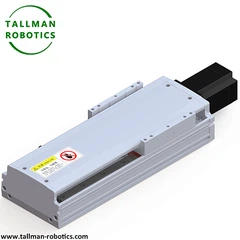


What are Outdoor Waterproof Linear Actuators?
Outdoor waterproof linear actuators are rugged motion execution devices for external industrial automation deployment. They adopt full outdoor-grade waterproof structures to adapt open-air working environments. They convert motor rotation into stable linear push-and-pull motion output. They sustain reliable operation under variable outdoor weather interference.
Core Structural Composition
First, weather-resistant alloy shells resist outdoor aging and corrosion. Second, multi-layer sealing rings block rainwater and dew penetration. Third, built-in precision drive cores ensure steady linear displacement. Moreover, sealed wiring ports prevent moisture invasion at connection points. Lastly, reinforced end caps enhance overall outdoor structural tightness.
Here, we introduce belt driven IP65 Waterproof Linear Modules,TMBF220, with data as follows:
You are welcome to watch more projects or visit our video gallery by Youtube: https://www.youtube.com/@tallmanrobotics


Technical Functions & Core Advantages
This actuator adapts to all-weather outdoor automation operation. Furthermore, it avoids structural damage from rain and humid outdoor air. It also maintains consistent motion output under temperature changes. In addition, it eliminates frequent failure of outdoor motion equipment.
|
Item |
Outdoor Waterproof Linear Actuator |
Indoor Waterproof Linear Actuator |
|
Environmental Adaptability |
Adapts rain, dew and outdoor temperature fluctuation |
Only suits stable indoor wet workshop conditions |
|
Structural Durability |
Anti-aging shell resists long outdoor exposure |
Shell prone to aging under open-air conditions |
|
Sealing Performance |
Full-directional sealing for complex outdoor weather |
Basic sealing for simple splash prevention only |
How to choose outdoor waterproof linear actuators suitable for specific outdoor application scenarios?
The selection of outdoor waterproof linear actuators suitable for specific outdoor application scenarios requires a multidimensional system evaluation based on the environmental characteristics, functional requirements, and long-term reliability requirements of the scenario. The following are the key selection steps and core considerations:
1.Clarify the core challenges of outdoor environment
The core difference in outdoor scenes lies in the corrosiveness of the environment, and it is necessary to first identify the "environmental pressure source" of the scene and match the protective capabilities accordingly
Degree of liquid invasion:
If facing only rainwater splashing (such as outdoor sunshades), IP65 protection level (preventing low-pressure water spray) is sufficient;
If short-term immersion is involved (such as terminal equipment and rainstorm prone areas), IP67/IP68 is required (IP67 can be immersed for a short time and IP68 can operate underwater for a long time);
If there is high-pressure water flushing (such as agricultural greenhouse disinfection), additional confirmation of "anti high-pressure water impact" certification (such as compliance with ISO 20653 high-pressure water spray test) is required.
Corrosive media:
Seaside/Ship Scene (Salt Spray Corrosion): Priority should be given to stainless steel (316 material) transmission components+aluminum alloy shell (surface hard anodizing+fluorocarbon coating), avoiding carbon steel or ordinary aluminum alloy;
Agricultural scenario (pesticide/fertilizer erosion): Choose chemical resistant sealing materials (such as EPDM rubber sealing rings instead of nitrile rubber);
Industrial outdoor scenes (oil/dust): It is necessary to use dust-proof scraper and labyrinth seal to prevent the wear of components after the mixing of particles and liquids.
Temperature and UV radiation:
High temperature areas (such as deserts): Choose high-temperature resistant motors (working temperature -20 ℃~80 ℃ or above) to avoid ordinary plastic shells from becoming brittle due to UV aging (glass fiber reinforced nylon or ASA material is preferred);
Low temperature areas (such as cold regions): Ensure that lubricants are resistant to low temperatures (such as silicon-based grease) and motor windings are resistant to freezing (to avoid insulation failure due to icing).
2. Matching functional requirements: load, motion, and control
According to the mechanical action requirements of the scene, clarify the "performance parameter baseline" of the actuator:
Load capacity of Outdoor Waterproof Linear Actuators:
Need to calculate the "actual load+safety redundancy" of the scenario. For example, when driving an outdoor sunshade, in addition to the self weight of the canopy, an additional load generated by the maximum wind force needs to be added (usually adding 20% -30% redundancy); If it is a vertical lifting scenario (such as monitoring gimbal lifting), it is necessary to confirm the "static load" (load-bearing during hovering) and "dynamic load" (inertial force during movement) to avoid overloading causing the push rod to bend or the motor to burn out.
Motion parameters of Outdoor Waterproof Linear Actuators:
Travel length: determined based on the amplitude of the scene's actions (such as opening and closing the greenhouse skylight requiring 500mm travel, and extending and retracting the ship's gangway requiring 2000mm travel), paying attention to reserving 10% -15% of additional travel to avoid "top dead";
Speed and acceleration: In high-speed scenarios (such as rapid flipping of outdoor billboards), a high-speed motor and lightweight transmission structure should be selected; Low speed precision scenarios (such as precision irrigation valve control) need to ensure smooth operation at low speeds (without crawling);
Response time: In emergency situations (such as rapid angle adjustment of security equipment), low inertia motors (such as brushless DC motors) should be selected to avoid startup delays of asynchronous motors.
Control method of Outdoor Waterproof Linear Actuators:
Simple scenario (such as manual button control of greenhouse sunroof): Choose the basic model with relay interface, supporting dry contact signal;
Intelligent scenarios (such as outdoor devices linked to the Internet of Things): require bus communication function (RS485/Modbus or wireless Bluetooth/WiFi), and waterproof connectors that support outdoor wiring (such as M12 circular waterproof plugs, IP68 rating);
Scenarios with high safety requirements (such as ship gangways): Limit switches (mechanical limit+electronic limit dual protection)+overload protection (automatic power-off in case of motor stalling) are required to avoid accidental jamming and burning.
3.Consider installation and maintenance convenience
The installation and maintenance difficulty of outdoor scenes is much higher than that of indoor scenes, and it is necessary to avoid "hidden costs" in advance:
Installation adaptability of Outdoor Waterproof Linear Actuators:
Space limited scenarios (such as narrow monitoring pole spaces): Choose a compact design (such as a folding push rod instead of a straight rod), or customize a short machine body length stroke model;
Vibration scenarios (such as dock machinery): shock-absorbing mounting seats (rubber shock-absorbing pads) are required to prevent bolt loosening and seal failure;
Multi axis linkage scenarios (such as outdoor robotic arms): Ensure standardized installation hole positions for actuators (such as ISO 15552 interfaces) for easy assembly with other components.
Maintenance cost of Outdoor Waterproof Linear Actuators:
Remote scenarios (such as outdoor base stations): Prioritize maintenance free designs (such as lifetime lubricated bearings, sealed motors, no need to regularly add lubricants);
High frequency usage scenarios (such as outdoor gates that open and close more than 100 times a day): Pay attention to the "cycle life" parameter (≥ 100000 cycles required) to avoid premature wear of belts or screws (ball screws have a better lifespan than trapezoidal screws, and synchronous belts should be made of polyurethane material instead of rubber).
4.Verify scenario specificity: adaptation to extreme cases
For some special outdoor scenarios, additional evaluation of "non-standard requirements" is required:
Explosion proof requirements: For outdoor equipment in oil and gas fields, actuators with explosion-proof certification (ATEX II or IECEx) should be selected to prevent motor sparks from igniting flammable gases;
Underwater scenario: such as underwater gate drive, IP69K protection+all stainless steel structure is required, and the cable needs to be equipped with waterproof joints (such as PG type thread+O-ring seal);
Lightweight requirements: For outdoor detection equipment carried by drones, an aluminum alloy/carbon fiber body (with a weight controlled within 1kg) should be selected while meeting the load requirements.
Summary: Three step screening method
1. List the scenarios: clarify the environment (liquid/corrosion/temperature and humidity), actions (load/stroke/speed), and special requirements (explosion-proof/lightweight, etc.);
2. Mark the parameter red line: the protection level, load redundancy, and material corrosion resistance need to meet the standards, rather than just looking at the price;
3. Test validation: Prioritize brands that provide sample testing (such as high-pressure water spray and salt spray testing in simulated scenarios) to avoid relying solely on parameter tables.
Through the above dimensions, it can be ensured that the selected Outdoor Waterproof Linear Actuators achieve "long-term stable operation" in specific outdoor scenarios, rather than just meeting short-term waterproof requirements.
Frequently Asked Questions
Q1: What outdoor automation scenarios use these actuators?
They apply to outdoor industrial gates, solar tracking equipment, outdoor monitoring adjustment frames and open-air automated sorting devices. They serve all unmanned outdoor linear motion automation scenes.
Q2: What structural designs support outdoor waterproof performance?
Weather-resistant outer shells, multi-layer elastic sealing rings and fully sealed wiring structures form core protection. These parts jointly isolate rain, dew and humid air from internal drive components.
Q3: Can the actuator work stably in rainy outdoor conditions?
Yes. Its comprehensive sealing structure blocks rain penetration effectively. It keeps normal linear motion output without short circuit or jitter during continuous rainy weather.
Q4: How does it differ from ordinary waterproof linear actuators?
It adds anti-aging and temperature-resistant designs for open-air use. Ordinary waterproof actuators only resist indoor water splash and lack outdoor weather adaptation ability.
Q5: Do outdoor resistant designs affect actuator motion precision?
No. All outdoor protective structures adopt precision matching technology. They never interfere with internal drive operation or reduce linear motion accuracy.
Hot Tags: outdoor waterproof linear actuators, China outdoor waterproof linear actuators manufacturers, suppliers, factory, IP67 Rated Linear Actuators, Waterproof Ball Screw Linear Actuator, Airproof Linear Translation Stage, IP65 Sealed Linear Slide, Hermetically Sealed Linear Drives, Sealed IP65 Linear Actuator


