
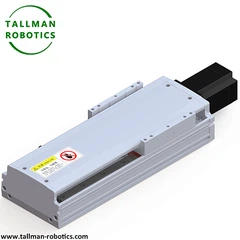


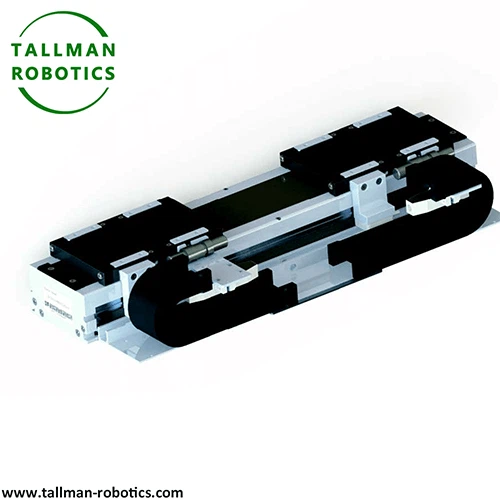

Force Controlled Smart Linear Motor is a linear motor system that combines force control technology and intelligent algorithms, capable of accurately adjusting output force (thrust or tension), achieving high dynamic response, adaptive adjustment, and intelligent motion control. Force Controlled Smart Linear Motor is widely used in scenarios that require precise force control or interactive operation, such as robots, precision manufacturing, medical equipment, etc.
|
Principle |
Based on the linear motor and combined with force control technology, the force control intelligent linear motor detects the output force in real time through sensors, and transmits the force feedback signal to the controller. The controller compares the set force value with the feedback force value, adjusts the input current and other parameters, and achieves precise control of the output force. TM-LM linear motor module from TallMan Robotics utilizes force position hybrid control algorithm, constant force control algorithm, etc. to achieve precise control of force. |
|
Structural characteristics |
Usually composed of a linear motor body, force sensor, controller, etc. The linear motor generates linear motion driving force; Real time measurement of output force by force sensors, commonly including strain gauges, piezoelectric sensors, etc; The controller is the core component responsible for processing force feedback signals and issuing control commands. In order to improve performance and integration, some force controlled intelligent linear motors adopt a drive control integrated design, which integrates the driver and controller, reduces volume and wiring, and improves system stability and reliability. |
|
Performance advantages |
1).High force control accuracy: It can achieve high force control accuracy. For example, after adding precision force control function to the intelligent TM-LM linear motor module, the pushing force control accuracy can reach ± 0.01N. Fast response speed: able to quickly respond to changes in force, adjust output force in real time, and adapt to dynamic force control requirements. Due to the absence of an intermediate transmission mechanism, mechanical inertia and hysteresis are reduced, improving system response speed and sensitivity. 2).High positioning accuracy: In addition to high force control accuracy, the positioning accuracy is also excellent. Some products have a repeated positioning accuracy of ± 0.001mm, which can meet the requirements of high-precision positioning and force control. 3).Flexible control mode: Supports multiple control modes, such as force position hybrid control, constant force control, etc. Suitable control methods can be selected according to different application requirements to achieve precise force control and position control. |
Force Controlled Smart Linear Motor uses force sensors and intelligent control to not only accurately position the linear motor, but also achieve high dynamic and adaptive force control operations. It has significant value in high-end manufacturing, medical robotics, scientific research testing, and other fields. In the future, with the development of AI and sensing technology, its application scope will further expand.
Here, we introduce Linear motor, Model TML170-CR for clean environment, with data sheet as follows:
You are welcome to watch more projects or visit our video gallery by Youtube: https://www.youtube.com/@tallmanrobotics


Force Controlled Smart Linear Motor, with its high-precision force control, fast response, and flexible adjustment characteristics, plays a key role in scenarios that require precise control of force and position, and is widely used in multiple fields such as precision manufacturing, electronic semiconductors, medical health, and scientific research experiments. The following is a detailed explanation of specific application scenarios:
1. Electronics and Semiconductor Manufacturing
The electronics industry has extremely high precision requirements for assembly and testing. Force controlled intelligent linear motors can avoid component damage caused by excessive force, while ensuring consistent operation.
|
Chip packaging and testing |
During the wire bonding process, it is necessary to accurately control the contact force between the solder wire and the chip pins (usually within ± 0.1N) to prevent chip damage or poor contact; During chip testing, controlling the contact force between the probe and the chip solder joints can prevent probe bending or chip breakdown. |
|
PCB board assembly |
Control the placement force of small components such as resistors and capacitors during the SMT and plug-in processes to prevent component detachment or pad damage; In the lamination process of flexible circuit boards (FPCs), constant force control is used to ensure uniform adhesion and avoid wrinkles or cracks. |
|
Display screen manufacturing |
During the assembly of LCD or OLED screens and backlight modules, control the pressure force to prevent the glass substrate from shattering; During the bonding process of touch screen sensors, pressure is adjusted through force feedback to ensure stable conductivity of the sensing layer. |
2. Precision assembly of 3C products
3C products (mobile phones, computers, smart devices) have small and fragile components, and force control technology can improve assembly efficiency and yield.
|
Mobile phone assembly |
The pressing of the camera module and battery cover requires pressure control to prevent deformation of the casing or damage to internal components; In the assembly of SIM card slots and buttons, force feedback is used to determine whether they are installed properly, avoiding over tightening or loosening. |
|
Connector insertion and removal |
During the insertion and removal process of USB interfaces and ribbon connectors, the insertion and removal force should be precisely controlled (such as Micro USB insertion and removal force usually requires 5-30N) to prevent pin bending or interface wear, and to determine whether the assembly is qualified through force curves. |
|
Wearable devices such as watches/headphones |
The assembly of micro gears and batteries requires millinewtons (mN) force control to avoid deformation of precision components; When tightening the connecting screws between the watch strap and the watch case, force feedback is used to prevent slipping or breakage. |
3. Medical Equipment and Bioengineering
The control of force in the medical field is directly related to operational safety and experimental accuracy, and force controlled motors can achieve minimally invasive and precise movements.
|
Minimally invasive surgical robot |
In laparoscopic surgery, when instruments (such as forceps, scissors) come into contact with tissue, the clamping force (usually<1N) is adjusted in real time through force feedback to avoid damaging blood vessels or organs; During orthopedic surgery, pressure should be controlled to prevent bone fractures during bone drilling or screw implantation. |
|
Drug development and biological experiments |
In microfluidic chip operation, control the injection or extraction force of trace liquids (μ L level) to avoid chip channel rupture; In cell culture, grasping and pressing of cells (such as cell mechanics experiments assisted by atomic force microscopy) require control of nanonewtons (nN) force to prevent cell death. |
|
Rehabilitation equipment |
The limb training module of the rehabilitation robot senses the patient's force state through force feedback, adjusts the auxiliary force in real time, and avoids muscle damage caused by excessive traction. |
4. Precision testing and quality control
In the product testing process, the force controlled motor can simulate the force state in the usage scenario, or judge the product performance through force curve analysis.
|
Material Mechanics Testing |
When conducting tensile and bending tests on materials such as metal sheets, plastic films, and fibers, the rate and magnitude of the loading force are precisely controlled (such as continuously adjustable from 0.1N to 100N) to obtain parameters such as yield strength and elastic modulus of the material. |
|
Button/Switch Life Test |
Simulate the force of users pressing phone buttons, keyboards, and car buttons (usually 1-5N), and determine the durability of the product through changes in force values during tens of thousands of cycles of testing. |
|
Sealing performance testing |
Conduct pressure tests on the sealing rings of water cups and pressure vessels, control the squeezing force and monitor changes in force to determine if there is any leakage (abnormal decrease in force may indicate seal failure). |
5. Research and Special Equipment
In cutting-edge research or special environments, force controlled intelligent linear motors provide stable force output for high-precision experiments.
|
Space experimental equipment |
precise control of the forces acting on experimental samples (such as crystal growth and material welding) in spacecraft ground simulations or microgravity environments, eliminating gravitational interference. |
|
Nano level operating platform |
In scanning probe microscopy (SPM) and nanoindentation instruments, the contact force between the probe and the sample surface is controlled by a force controlled motor (up to μ N or even nN level), achieving atomic level surface morphology observation or material hardness testing. |
|
Robot assisted operation |
When assembling precision instruments with the end effector of a collaborative robot (such as a gripper), "compliant control" is achieved through force feedback to adapt to small positional deviations of the workpiece and avoid rigid collisions. |
The core value of force controlled intelligent linear motors lies in the precise and coordinated control of force and position. Their application scenarios require a balance between "force magnitude" and "operational accuracy", especially suitable for scenarios that require "force sensitivity", "susceptibility to damage", and "high consistency". With the development of industrial automation towards "flexibility" and "intelligence", its application scope is constantly expanding, such as emerging fields such as welding of new energy battery electrodes and stacking of photovoltaic modules.
Hot Tags: force controlled smart linear motor, China force controlled smart linear motor manufacturers, suppliers, factory, Direct Drive Electromagnetic Motor System, Direct Drive Linear Motor Stage System, Direct Drive Linear Servo Motor Stage, Linear Servo Positioner with Motor Drive, Linear Synchronous Drive Motor, Direct Linear Drive Motor

