
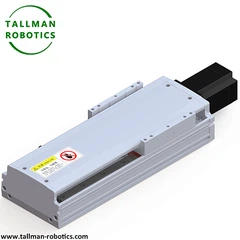


What is Linear Induction Motor?
Linear Induction Motor is a Contact-Free Inductive Linear Motion Motor.
A linear induction motor is a contact-free electromagnetic drive device for industrial linear motion. It generates traveling magnetic fields to induce eddy currents on conductive secondary plates. Unlike synchronous linear motors, it relies on inductive electromagnetic interaction to produce linear thrust. Moreover, it needs no permanent magnet layout for motion output. It delivers durable non-contact linear actuation for harsh automation environments.
Core Structural Composition
First, the motor adopts a laminated primary core with three-phase winding groups. It generates steady traveling magnetic fields after AC power energization. Meanwhile, it matches a simple conductive secondary reaction plate for induction reaction.
In addition, it integrates gap calibration structures to stabilize magnetic operation. Furthermore, it equips protective casings to shield internal winding components. Lastly, it reserves standard drive interfaces for quick system integration.
Here, we introduce Linear motor, Model TML135-CR for clean environment, with data sheet as follows:
You are welcome to watch more projects or visit our video gallery by Youtube: https://www.youtube.com/@tallmanrobotics


Technical Features & Functional Advantages
|
Item |
Technical Feature |
Core Function |
Application Advantage |
|---|---|---|---|
|
Drive Principle |
Eddy current electromagnetic induction drive |
Produce contact-free linear thrust steadily |
Zero mechanical wear during long-cycle operation |
|
Structural Design |
Magnet-free secondary conductive structure |
Simplify movable component layout |
Adapt high-dust and corrosive working scenes |
|
Motion Characteristic |
Continuous dynamic linear traveling |
Support long-stroke reciprocating displacement |
Meet large-range industrial motion layout demands |
|
Environmental Adaptation |
Fully enclosed anti-interference structure |
Stabilize electromagnetic operation state |
Extend service life in harsh automation workshops |
Frequently Asked Questions
Q1: What differentiates linear induction motor from linear synchronous motor?
It uses inductive eddy current drive without permanent magnet configuration. It features simpler secondary structure and stronger environmental adaptability. Synchronous motors rely on magnetic synchronization, while this motor sacrifices partial positioning precision for higher durability and lower maintenance needs.
Q2: Does contact-free induction drive eliminate mechanical failure risks?
Yes. It has no gear, belt or guide contact friction. It removes common mechanical wear and jamming faults. It maintains stable continuous operation in high-frequency cyclic working states.
Q3: What industrial scenarios fit linear induction motor best?
It fits long-stroke logistics conveying, heavy-load shuttle movement, dust-proof industrial production, corrosive environment automation and all scenarios prioritizing durability and stability over ultra-high precision.
Q4: Does magnetic gap deviation affect motor operation stability?
No. The reserved gap calibration structure adapts tiny installation deviations. The traveling magnetic field maintains stable induction effect. It keeps consistent thrust output during normal operational fluctuations.
Q5: What are the core limitations of linear induction motor?
It produces minor speed slip during dynamic operation. It cannot reach the micro-positioning accuracy of synchronous linear motors. It does not suit semiconductor and optical ultra-precision automation scenarios.
Hot Tags: linear induction motor, China linear induction motor manufacturers, suppliers, factory, Linear Induction Motor, Force Regulated Smart Linear Motor, Smart Linear Motor with Force Control Capability, Electric Operated Linear Actuator, Linear Induction Drive Motor, Linear Synchronous Propulsion Motor

