
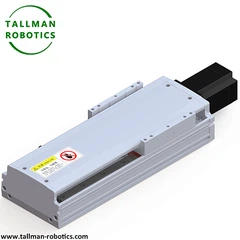


Linear Electric Motor Actuator is an electromechanical integrated device that uses a linear motor as the core driving component, integrates the functions of a linear motor and an actuator, and directly converts electrical energy into linear mechanical motion. The core feature of Linear Electric Motor Actuator is that it does not require traditional rotating motors and transmission mechanisms (such as screws, gears, etc.), but directly achieves linear motion output through the electromagnetic driving force of the linear motor, and realizes high dynamic linear motion with zero contact and zero backlash through electromagnetic principles
Core composition of Linear Electric Motor Actuator
|
Component |
Functions |
Typical Configuration |
|
Linear motor stator |
Generates electromagnetic field |
Permanent magnet array (with iron core) or winding track (without iron core) |
|
Linear motor rotor |
Output linear thrust |
With moving parts including coils (directly connected to load) |
|
High precision guide |
Load-bearing |
Air bearings (nanometer level), ball guides (industrial grade) |
|
Position feedback system |
Real time closed-loop control |
Grating ruler (± 0.1 μ m) and magnetic grating ruler (± 1 μ m) |
|
Cooling System |
Cooling Management |
Natural Cooling (<500W), Water Cooling (High Power) |
|
Controller |
Controller motion |
Dedicated servo drive (supports EtherCAT/CANopen |
Difference from related equipment
|
Device type |
Core driving mode |
Transmission characteristics |
Typical application scenarios |
|
Linear Electric Motor Actuator |
Direct Drive of Linear Motor |
No Mechanical Transmission, Direct Output of Linear Motion |
High Precision Positioning (such as Semiconductor Equipment) |
|
Linear Electric Actuator |
Rotary Motor+Mechanical Transmission (Screw, etc.) |
Rotary Motion → Linear Motion Conversion |
General Industrial Automation (such as Valve Control) |
|
Linear Motor |
Refers only to the linear motor body |
Requires additional guidance/control system |
Integrated as a core component into the equipment| |
Key Features of Linear Electric Motor Actuator
|
1 |
High precision and high response |
Without mechanical transmission clearance and elastic deformation, the positioning accuracy can reach ± 1 μ m level, and the dynamic response speed is 10-100 times faster than traditional actuators, suitable for 2high-frequency and high-precision actions (such as laser cutting and chip detection). |
|
Efficient and Low Loss |
By eliminating transmission components such as gears and screws, the energy conversion efficiency can reach over 90% (traditional actuators usually have 60% -80%), and there is no mechanical wear, resulting in a longer lifespan. |
|
|
3 |
High thrust and high speed |
The thrust can range from a few newtons to tens of thousands of newtons (achieved through multi-stage stator splicing), and the speed can reach 5-10m/s, far exceeding that of screw driven actuators (usually<1m/s). |
|
4 |
Compact structure |
There is no need to accommodate space for rotating motors and transmission mechanisms, especially in long-distance scenarios such as large logistics sorting lines, making the layout more flexible. |
Linear Electric Motor Actuator is essentially an engineering integrated form of linear motor, integrating drive, guidance, and control functions into one. It is designed specifically for scenarios that require "high-precision+high dynamic" linear motion, with high cost but significant performance advantages.
Linear Electric Motor Actuator represents the highest level of technology in linear motion control, with its direct drive, ultra-high dynamic performance, and nanometer level accuracy making it irreplaceable in the fields of semiconductors, ultra precision machining, and cutting-edge research. Despite the high cost, with technological progress, it is gradually penetrating into high-end medical equipment, new energy equipment and other fields, which is the core driving technology for future intelligent manufacturing and precision engineering.
Here, we introduce Linear Motor, Model TML135-CM for genearl environment, with data sheet as follows:
You are welcome to watch more projects or visit our video gallery by Youtube: https://www.youtube.com/@tallmanrobotics


Linear Electric Motor Actuator, with their core advantages of high precision, high response speed, no mechanical transmission clearance, and high thrust, is widely used in scenarios that require precise linear motion control, especially in fields that require strict requirements for speed, positioning accuracy, and dynamic performance. The following are its main application areas and typical scenarios:
|
No. |
Industry |
Core requirements |
Typical Applications |
|
1 |
Semiconductor and Microelectronics Manufacturing |
Nano level positioning accuracy, high-speed start stop, and pollution-free environment. |
Wafer handling and inspection: In lithography machines and ion implantation machines, the wafer worktable is driven to achieve precise positioning at the micrometer or even nanometer level, ensuring precise exposure of chip circuit patterns. Chip packaging: Control the linear motion of the soldering head or probe station to complete high-precision operations such as wire bonding and chip testing. |
|
2 |
Precision machine tools and processing equipment |
High dynamic response, micrometer level positioning, and stable cutting force output. |
High speed milling/grinding machine: Drive the worktable directly to achieve linear feed, avoiding the gap error of traditional screw transmission, and improving the surface smoothness and shape accuracy of machining (such as mold processing). Laser processing equipment: controls the linear motion of the laser head to achieve high-speed and high-precision cutting, engraving, or marking on materials such as metal and glass. |
|
3 |
Medical Devices and Life Sciences |
Low vibration, high stability, and precise control of small displacements. |
Medical imaging equipment: In CT and magnetic resonance imaging (MRI), the detector or bed is driven to perform smooth linear scanning to ensure imaging clarity. Surgical robot: controls the linear advancement of surgical instruments (such as laparoscopic instruments) to achieve millimeter level operations and reduce surgical trauma. Laboratory automation: Drive pipettes, sample racks, etc. to achieve precise pipetting and localization for high-throughput drug screening or gene sequencing. |
|
4 |
Rail Transit and Transportation System |
High thrust, high-speed operation, and long stroke stability. |
Maglev train: It uses the electromagnetic thrust of a linear motor to directly drive the train to move in a straight line along the track, without the need for wheel rail contact, achieving high-speed (above 500km/h) and low-noise operation. High speed conveyor line: In airport luggage sorting and logistics warehousing, it drives sorting carts or conveyor belts to achieve high-speed and accurate cargo transfer (such as automated sorting systems in e-commerce warehouses). |
|
5 |
Automation and Industrial Robots |
Fast response, multi axis collaboration, high repeatability positioning accuracy. |
Surface mount robot: In SMT (Surface Mount Technology) production lines, it drives the nozzle module to move quickly and accurately mount electronic components onto PCB boards. Coordinate robot: In the 3C industry (mobile phone, computer manufacturing), it realizes the handling, assembly or inspection of components, and cooperates with vision systems to complete high-precision operations. |
|
6 |
Aerospace and Defense |
Extreme environmental adaptability, high reliability, high-precision servo control. |
Wind tunnel test: Drive the model aircraft to perform linear reciprocating motion in a wind tunnel, simulating the aerodynamic characteristics at different speeds. Radar and satellite antenna: Control the linear displacement of the antenna feed source to achieve precise beam pointing and tracking. Weapon system: In shipborne or vehicle mounted weapons, it drives the pitch/translation of the gun barrel or launcher to achieve rapid aiming. |
|
7 |
New Energy and Precision Testing |
Low interference, high resolution, and continuous stable operation. |
Solar panel production: Drive the cutting head of the laser cutting machine to draw high-precision grid lines on the silicon wafer, improving the battery conversion efficiency. Precision measuring instruments: In coordinate measuring machines and laser interferometers, the driving probe achieves ultra precision detection of workpiece dimensions (with an accuracy of up to 0.1 μ m). |
The core application of linear motor actuators lies in their ability to replace the traditional "rotary motor+mechanical transmission" structure, especially in scenarios that require high precision, high speed, seamless operation, and long lifespan, which have irreplaceable advantages. With the upgrading of industrial automation and precision manufacturing, its application fields are still expanding to more segmented industries (such as autonomous driving testing equipment, quantum computing experimental platforms, etc.).
Hot Tags: linear electric motor actuator, China linear electric motor actuator manufacturers, suppliers, factory, Direct Drive Electromagnetic Motor System, Direct Drive Linear Motor Stage System, Direct Drive Linear Servo Motor Stage, Linear Induction Motor, Linear Synchronous Drive Motor, Linear Electromagnetic Actuator


