
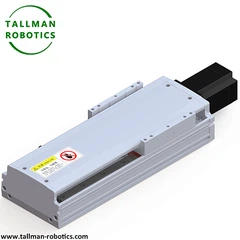


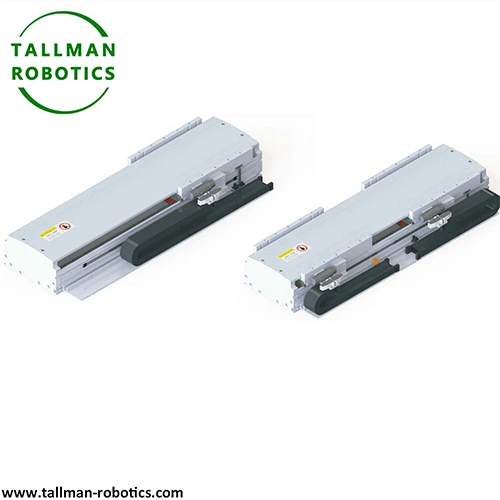


What is Linear Drive Motor?
It is a Direct-Drive Linear Motion Motor for Automation.
A linear drive motor is a universal direct-drive power unit for modern industrial automation. It converts electric energy into straight-line mechanical force via electromagnetic interaction. Meanwhile, it abandons traditional intermediate transmission structures for pure linear motion output. Unlike rotary drive motors, it eliminates motion conversion links to simplify system layout. It acts as a core power source for diverse precision linear motion equipment.
Core Structural Composition
First, the motor adopts a fixed magnetic track as the stationary foundation. It pairs a movable coil forcer to generate interactive driving force. Moreover, it integrates auxiliary linear guides to stabilize moving trajectories.
In addition, it embeds built-in sensing elements for real-time motion feedback. Furthermore, it uses an integrated protective shell to shield internal electric components. Lastly, it reserves standard electric ports for quick system integration.
Here, we introduce Linear motor, Model TML170-CM for general environment, with data sheet as follows:
You are welcome to watch more projects or visit our video gallery by Youtube: https://www.youtube.com/@tallmanrobotics


Technical Features & Functional Advantages
|
Item |
Technical Feature |
Core Function |
Application Advantage |
|---|---|---|---|
|
Drive Mode |
Transmission-free direct electromagnetic drive |
Output original linear mechanical force |
Remove mechanical backlash and motion lag completely |
|
Motion Performance |
Smooth continuous linear traveling |
Support flexible dynamic displacement adjustment |
Adapt variable-speed and frequent start-stop tasks |
|
Structural Property |
Simplified integrated motor layout |
Reduce redundant mechanical accessories |
Lower equipment assembly and maintenance difficulty |
|
Operational Adaptability |
Universal linear power output mode |
Match multiple automation motion demands |
Fit diversified industrial precision motion scenarios |
Frequently Asked Questions
Q1: What advantages does linear drive motor have over rotary drive motors?
It outputs linear force directly without screw or belt conversion structures. It removes transmission backlash and motion delay. It features simpler structure, smoother motion and higher positioning consistency for linear automation tasks.
Q2: Can linear drive motor adapt frequent start-stop cyclic operation?
Yes. It has no mechanical transmission wear parts. Electromagnetic drive enables sensitive start and stop responses. It keeps stable motion performance during long-term high-frequency cyclic work.
Q3: What mainstream industrial scenarios use linear drive motors?
It widely applies to electronic precision testing, automated material sorting, miniature workpiece processing, intelligent handling equipment and various precision linear motion automation stations.
Q4: Does the integrated structure affect the motor's heat dissipation performance?
No. The optimized shell structure reserves effective heat dissipation space. The coil and magnetic track layout avoids concentrated heat accumulation. It maintains stable working temperature during continuous operation.
Q5: What are the main usage limitations of linear drive motor?
It cannot bear ultra-heavy industrial loads compared with rack and pinion drive systems. It also needs professional drive debugging. It does not suit low-precision and super heavy-load transmission scenarios.
Hot Tags: linear drive motor, China linear drive motor manufacturers, suppliers, factory, Linear Induction Motor, Force Regulated Smart Linear Motor, Smart Linear Motor with Force Control Capability, Electric Operated Linear Actuator, Linear Induction Drive Motor, Linear Synchronous Propulsion Motor


