
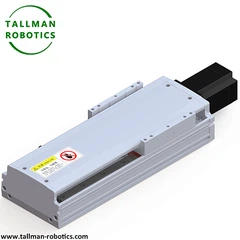


Linear Motor is an electromagnetic drive device that directly converts electrical energy into linear motion mechanical energy, without the need for intermediate transmission mechanisms such as gears or screws to achieve linear displacement of the load.
Unlike traditional rotary motors (such as servo motors) that require mechanical structures to convert rotational motion into linear motion, the direction of motion of linear motor is inherently linear. Linear Motor is a linear version of the structure of rotary motors, which achieves non-contact driving through electromagnetic force. It has significant characteristics such as compact structure, fast response, ultra-high speed, high precision, and zero backlash.
Here We introduce our Linear Motors with data as follows:
You are welcome to watch more projects or visit our video gallery by Youtube: https://www.youtube.com/@tallmanrobotics
|
Technical parameters of Linear Motors: High Thrust Series for Clean Environment |
|||||||
|
Model Number |
TML135-CR-PM090 |
TM135-CR-PM130 |
TML170-CR-PM250 |
TML170-CR-PM400 |
TML220-CR-PM750 |
||
|
Positioning Repeatability(mm) |
±0.002 |
±0.002 |
±0.002 |
±0.002 |
±0.002 |
||
|
Continuous Thrust(N) |
90 |
130 |
250 |
400 |
750 |
||
|
Max Thrust(N) |
270 |
390 |
750 |
1200 |
2250 |
||
|
Continuous Load(kgs) |
20 |
30 |
50 |
80 |
150 |
||
|
Max Acceleration Speed (G) |
3 |
3 |
3 |
3 |
3 |
||
|
Max Speed(mm/s) |
2500 |
2500 |
2500 |
2500 |
2500 |
||
|
Standard Stroke(mm) |
0-5500 |
0-5500 |
0-5500 |
0-5500 |
0-5500 |
||
|
Feedback Ruler Manufacturer |
Germany siko / Spain FAGOR |
||||||
|
Reading Head |
MSK200-1-0107 / EXA |
||||||
|
Feedback Ruler Resolution(mm) |
0.0005/0.001 |
||||||
|
Linear Guide Rail (mm |
15×12.5-2 |
15×12.5-2 |
15×12.5-2 |
15×12.5-2 |
20×15.5-2 |
||
|
Technical parameters of Linear Motors: Low Thrust Series for Clean Environment |
||||||||
|
Model Number |
TML100-CR-PM050 |
TML100-CR-PM100 |
TML100-CR-PM120 |
TML135-CR-PM080 |
TML135-CR-PM150 |
TML135-CR-PM210 |
||
|
Positioning Repeatability(mm) |
±0.002 |
±0.002 |
±0.002 |
±0.002 |
±0.002 |
±0.002 |
||
|
Continuous Thrust(N) |
50 |
100 |
120 |
80 |
150 |
210 |
||
|
Max Thrust(N) |
150 |
300 |
360 |
240 |
450 |
630 |
||
|
Continuous Load(kgs) |
10 |
25 |
30 |
20 |
40 |
55 |
||
|
Max Acceleration Speed (G) |
3 |
3 |
3 |
3 |
3 |
3 |
||
|
Max Speed(mm/s) |
2500 |
2500 |
2500 |
2500 |
2500 |
2500 |
||
|
Standard Stroke(mm) |
0-5500 |
0-5500 |
0-5500 |
0-5500 |
0-5500 |
0-5500 |
||
|
Feedback Ruler Manufacturer |
Germany siko / Spain FAGOR |
|||||||
|
Reading Head |
MSK200-1-0107 / EXA |
|||||||
|
Feedback Ruler Resolution(mm) |
0.0005 |
|||||||
|
Linear Guide Rail (mm |
15×12.5-1 |
15×12.5-2 |
||||||
|
Model Number |
TML170-CR-PM120 |
TML170-CR-PM220 |
TML170-CR-PM320 |
TML220-CR-PM160 |
TML220-CR-PM300 |
TML220-CR-PM430 |
||
|
Positioning Repeatability(mm) |
±0.002 |
±0.002 |
±0.002 |
±0.002 |
±0.002 |
±0.002 |
||
|
Continuous Thrust(N) |
120 |
220 |
320 |
160 |
300 |
430 |
||
|
Max Thrust(N) |
360 |
660 |
960 |
480 |
900 |
1290 |
||
|
Continuous Load(kgs) |
30 |
60 |
90 |
40 |
85 |
120 |
||
|
Max Acceleration Speed (G) |
3 |
3 |
3 |
3 |
3 |
3 |
||
|
Max Speed(mm/s) |
2500 |
2500 |
2500 |
2500 |
2500 |
2500 |
||
|
Standard Stroke(mm) |
0-5500 |
0-5500 |
0-5500 |
0-5500 |
0-5500 |
0-5500 |
||
|
Feedback Ruler Manufacturer |
Germany siko / Spain FAGOR |
|||||||
|
Reading Head |
MSK200-1-0107 / EXA |
|||||||
|
Feedback Ruler Resolution(mm) |
0.0005 |
|||||||
|
Linear Guide Rail (mm |
15×12.5-2 |
20×15.5-2 |
||||||


What are the Core structure and working principle of Linear Motor?
The working principle of linear motor is based on the law of electromagnetic induction, which can be regarded as the product of "cutting and flattening the rotating motor radially":
Stator (primary) : It is usually composed of an iron core and windings, and generates a traveling wave magnetic field when an alternating current is applied.
Motive (secondary): Composed of permanent magnets or conductive materials (such as copper and aluminum), it is subjected to electromagnetic force in the magnetic field generated by the stator and moves in a straight line direction.
When three-phase AC power is applied to the stator winding, a traveling magnetic field that moves along the axial direction is formed. The rotor moves synchronously with the magnetic field under the drive of electromagnetic force (Lorentz force), thereby achieving continuous displacement in the linear direction.
What are the Main types of Linear Motor?
|
Linear Motors |
Ironless linear motor |
Iron Core Linear Motor |
Tubular Linear Motor |
Induction Linear Motor (LIM) |
|
Structural features |
Coil without iron core, lightweight design |
The coil is wound on a laminated iron core |
Compact cylindrical design |
No permanent magnet, secondary conductor plate |
|
Advantages |
Zero cogging effect, ultra smooth motion (nanoscale control) |
High thrust (up to several tons), good heat dissipation |
High thrust density, dust-proof |
Low cost, high temperature resistance |
|
Disadvantages |
poor heat dissipation, low thrust |
There is tooth slot force (requiring compensation control) |
Limited travel time |
Low efficiency |
|
Applications |
Semiconductor lithography machines, precision measuring equipment |
CNC machine tools, maglev trains |
Medical equipment, automated valve control |
Logistics sorting, elevator drive |
What are the Key selection points of linear motor?
|
Calculation of thrust demand |
Need to consider load quality, frictional resistance, and acceleration requirements Formula: F=m • a+Ffriction |
|
Cooling method selection |
Natural cooling (<500W) Water cooling (for high power density applications) |
|
Feedback system configuration |
Grating ruler (ultra-high precision) Magnetic grid ruler (economical solution) |
|
Protection level |
IP65 (dustproof and waterproof) suitable for harsh environments Vacuum compatible type for semiconductor equipment |
What are the advantages of Linear Motors?
Compared with traditional rotary motors (which usually require transmission mechanisms such as gears, screws, belts, etc. to achieve linear motion), linear motor has significant advantages in performance, structure, and application scenarios, which can be summarized into the following core aspects:
1. Eliminating intermediate transmission links to improve efficiency and response speed
|
No mechanical loss |
The rotational motion of traditional rotary motors needs to be converted into linear motion through mechanisms such as gears and screws, which involves friction, clearance, and elastic deformation, resulting in energy loss (usually only 60% -80% efficiency); And the linear motor directly outputs linear motion, eliminating intermediate links, and the transmission efficiency can reach over 90%. |
|
High dynamic response |
The inertia and hysteresis of the intermediate transmission mechanism will delay the motion response, while linear motors have lighter mass and smaller inertia, and stronger acceleration capability (acceleration can reach 100m/s ² or more, far exceeding the traditional solution's 10-20m/s ²), which can quickly achieve start stop and speed switching, suitable for high-frequency reciprocating motion scenarios (such as semiconductor wafer handling). |
2. Higher positioning accuracy and repeatability
|
No Return Error |
The backlash and pitch errors of traditional transmission mechanisms (such as lead screws) can lead to "empty stroke" (return error) during reverse motion, while linear motors can achieve positioning accuracy of ± 1 μ m or even nanometer level through direct driving and feedback devices such as high-precision grating rulers, with repeat positioning accuracy controlled within ± 0.1 μ m. |
|
Better motion stability |
avoids periodic vibration of gear meshing or interference from screw threads, with small speed fluctuations during operation (speed fluctuation rate<0.1%), suitable for scenarios with high stability requirements (such as laser cutting and precision welding). |
3. Simplified structure and reduced maintenance costs
|
Reduce the number of components |
No need for transmission parts such as gears, screws, guides, etc., resulting in a more compact system structure and saving installation space (especially in long-distance scenarios, with obvious advantages). |
|
Reduce maintenance requirements |
The wear and lubrication of intermediate transmission components are the main maintenance points of traditional systems (such as the need for regular lubrication of lead screws and the susceptibility of gears to failure due to meshing wear), while linear motors have no contact wear (non-contact electromagnetic drive), longer maintenance cycles, and lower failure rates. |
4. Significant advantages of long travel and high speed
|
Theoretical infinite travel |
The stator of a linear motor can be segmented and spliced, and the rotor moves along the length direction of the stator. Theoretically, the travel is not limited (such as large logistics sorting lines and long-distance rail transit); The stroke of traditional screw is limited by its own length (too long can easily cause deflection deformation). |
|
High speed operation capability |
The speed of linear motors is only limited by the power supply frequency and heat dissipation conditions, with a maximum speed of 5-10m/s, far exceeding the speed limits of lead screws (usually<1m/s) and gear racks (usually<2m/s), suitable for high-speed conveying, rapid detection and other scenarios. |
5. More stable output characteristics
|
Good uniformity of thrust |
The thrust of traditional transmission mechanisms fluctuates due to changes in frictional resistance (such as changes in the preload force of the lead screw and gear tooth profile errors), while the electromagnetic thrust output of linear motors is more stable, especially at low speeds, without "crawling phenomenon" (low-speed shaking caused by static friction in traditional systems). |
|
Strong overload capacity |
It can output 1.5-2 times the rated thrust in a short period of time, adapting to sudden load changes, while traditional transmission components (such as gears) are prone to tooth surface damage due to overload. |
The core advantage of linear motor comes from the characteristic of "direct drive" - skipping intermediate transmission links, fundamentally solving the mechanical losses, accuracy limitations, and maintenance problems of traditional solutions. However, due to its higher cost (especially for high-precision models) and stricter requirements for installation environment (such as dust prevention and anti magnetic interference), linear motor is more suitable for scenarios with high precision, high speed, long stroke, and high-frequency motion (such as semiconductor manufacturing, precision machine tools, and maglev trains). Traditional rotating motors still have competitiveness in low-cost and low precision demand scenarios.
Real Quantified Industrial Case Studies of Linear Motor Deployment
All cases cite verified equipment test data from automation OEM mass production lines, no hypothetical simulation data.
Case 1 12-inch Semiconductor Wafer Inspection Linear Motor Stage
A semiconductor equipment manufacturer integrates ironless brushless linear motor for wafer scanning axes. The linear motor encoder uses 0.1nm resolution optical grating for closed-loop position lock. Tested technical outputs: 500mm effective stroke, ±50nm repeat positioning accuracy, 0.3 m/s constant scanning speed. Wafer surface defect detection rate rises due to vibration-free linear motor smooth travel. The linear motor stage operates 22 hours daily without position calibration correction for 90 consecutive days.
Case 2 Lithium Battery Electrode Winding Linear Gantry Motor
An energy equipment brand deploys dual iron core linear motor movers for electrode fast transfer axes. Each linear motor delivers 1200N peak thrust to drive 35kg electrode carrying fixtures. Measured cycle performance: 1.5m reciprocating stroke completes one full cycle within 0.35s, 2.8g stable acceleration. Traditional ball screw transfer units required 0.48s per cycle with obvious thermal expansion drift. Linear motor direct-drive structure removes heat accumulation from friction transmission parts.
Case 3 5-Axis CNC Machining Center Linear Servo Motor Drive
Machine tool OEM equips X/Y/Z feed axes with water-cooled iron core linear motor modules. Peak linear motor thrust hits 3100N to support heavy metal cutting payloads. Dynamic test result: Rapid traverse speed reaches 110 m/min, contour tolerance controlled at ±0.002mm. Multi-axis synchronous linear motor control reduces surface ripple on precision aerospace alloy parts. The linear motor system sustains 85% duty cycle continuous cutting without accuracy degradation.
Application Segments of Linear Motor Across Industrial Automation
Different linear motor types target segmented manufacturing process requirements.
Semiconductor & Electronic Assembly: Ironless linear motor stage for die bonding, wafer inspection, mini LED sorting Zero particle generation and nanometer positioning match cleanroom process standards.
New Energy Production: Iron core linear gantry motor for lithium electrode transfer, solar panel laser scribing High thrust and fast acceleration shorten single-piece processing cycle times.
Precision CNC & Laser Machining: Water-cooled linear servo motor for multi-axis feed axes Stable high-speed contour motion improves finished workpiece surface flatness.
Medical Automated Testing Equipment: Micro ironless linear motion module for reagent probe positioning Low vibration linear motor movement avoids micro liquid sample shaking errors.
Automated Optical Inspection (AOI): Dual synchronous linear motor cross tables for high-speed panel scanning Uniform linear motor velocity eliminates uneven image capture distortion.
Every segment selects linear motor models based on thrust, stroke, precision and environmental standards. Equipment designers prioritize linear motor direct-drive architecture when traditional actuators fail process targets.
Hot Tags: linear motor, China linear motor manufacturers, suppliers, factory, Linear Induction Motor, Force Regulated Smart Linear Motor, Smart Linear Motor with Force Control Capability, Electric Operated Linear Actuator, Linear Induction Drive Motor, Linear Synchronous Propulsion Motor
