
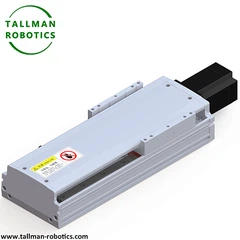


Linear Servo Motor Positioner is an automation device that integrates linear servo motors, precision guides, position feedback systems, and control modules. It is mainly used to achieve high-precision and high dynamic response positioning and motion control of loads in the linear direction. It uses closed-loop control of the servo system to correct position errors in real time, ensuring motion accuracy of micrometer or even nanometer level, and is widely used in industrial and scientific research scenarios that require precise positioning.
Linear Servo Motor Positioner is a single degree of freedom (1-DOF) automated motion system based on linear motor drive, specializing in high-precision and high-speed linear positioning tasks. It directly drives the load to move in a single direction through electromagnetic force, without the need for traditional mechanical transmission components such as screws, belts, etc. It is widely used in industrial scenarios that require fast response, nanometer level accuracy, or clean environments.
Core components and working principle of Linear Servo Motor Positioner
1. Linear servo motor
As a driving source, permanent magnet synchronous linear motors (with coils in the rotor and permanent magnets in the stator) are usually used to directly convert electrical energy into linear motion, without the need for intermediate transmission components such as screws and gears (* * "direct drive" * *), reducing mechanical clearance and friction losses, and improving response speed.
2. Precision guide rails and slide tables
Provide guiding support to ensure that the moving object (or load) moves smoothly in a straight line. Common types include cross roller guide rails, linear guide rails, etc. Combined with pre tensioning design, it can reduce shaking and ensure the straightness of motion.
3. Position feedback system
High precision grating rulers, magnetic gratings, or encoders are often used to detect the position of the moving element in real time and provide feedback to the controller, forming a closed-loop control system (comparing the commanded position with the actual position and adjusting the output force in real time), which is the core of achieving high-precision positioning.
4. Servo controller and drive module
Receive instructions from the upper computer (such as position, velocity, acceleration parameters), adjust the motor current through algorithms (such as PID control), drive the rotor to move along a preset trajectory, and process feedback signals to correct errors.
Key Features of Linear Servo Motor Positioner
High precision positioning: relying on closed-loop feedback and precision mechanical design, the positioning accuracy can usually reach ± 1 μ m to ± 0.1 μ m, with higher repeatability accuracy.
High dynamic response: No intermediate transmission components, faster start, stop, and acceleration processes (response time in milliseconds), suitable for high-frequency, fast switching positioning tasks.
Stability of Motion: By using servo control to suppress vibration, the speed fluctuation is small, making it suitable for scenarios such as scanning and cutting that require high smoothness of motion.
Long stroke and large load compatibility: Different strokes (from a few millimeters to several meters) can be designed according to requirements, and larger loads (from kilograms to tons) can be supported by optimizing the structure.
Compared with traditional positioning mechanisms such as screw slide tables and belt drives, the core advantages of linear servo motor positioning platforms are "no transmission error" and "high responsiveness". However, the cost is higher and the installation environment (such as dust prevention and demagnetization) is more stringent, making it suitable for high-end applications with extreme precision and speed requirements.
Here, we introduce Linear motor, Model TML170-CR for clean environment, with data sheet as follows:
You are welcome to watch more projects or visit our video gallery by Youtube: https://www.youtube.com/@tallmanrobotics


Linear Servo Motor Positioner, with its core advantages of high precision, high dynamic response, and smooth motion, has been widely used in multiple fields that require strict positioning accuracy and motion control. The following is a detailed classification of its typical application scenarios:
1. Semiconductor and Microelectronics Manufacturing
This is one of the core application areas of the linear servo motor positioning platform, as semiconductor manufacturing requires precision at the micrometer or even nanometer level, and requires high-frequency and high stability motion control.
Wafer Processing:
Arm positioning of wafer handling robots (such as transferring from wafer boxes to lithography tables, avoiding wafer collisions or contamination).
The movement of the lithography machine worktable (the core component of the lithography machine, the "dual workpiece table," needs to achieve nanometer level synchronous positioning, which directly affects the chip process accuracy).
Chip packaging and testing:
Pin alignment during wire bonding of chips (accuracy needs to be controlled within ± 1 μ m to ensure precise connection between gold wires and chip pads).
The probe positioning of the wafer probe station (the probe needs to make precise contact with the test point on the wafer, with an error of less than 1 μ m).
2. Precision machining and laser technology
In machining scenarios that require high-speed and high-precision trajectory control, the high dynamic response and motion smoothness of linear servo motors can significantly improve machining quality.
Laser Processing :
Laser cutting/welding (such as fine cutting of mobile phone glass and PCB boards, the positioning platform needs to follow the laser beam to achieve high-speed movement along complex paths, ensuring smooth cutting and precise size).
Laser marking and engraving (achieving high-precision pattern engraving on the surface of small workpieces such as jewelry and electronic components, relying on micro level positioning of the platform).
Precision CNC machine tool :
Replacing traditional screw feed shafts for feed motion in high-speed milling, grinding, and other machining processes (such as precision forming of complex surfaces in mold processing, improving machining efficiency and surface smoothness).
3. Testing and measuring equipmen
In the fields of metrology, quality inspection, etc., the accuracy of the positioning platform directly determines the reliability of the detection results.
Coordinate Measuring Machine (CMM):
As the moving axis of the measuring machine, it drives the measuring head to perform high-precision scanning of the dimensions and positional tolerances of the workpiece (such as three-dimensional contour measurement of automotive parts, with a positioning accuracy of ± 0.5 μ m).
Optical detection equipment:
Microscope stage (in the microscopic observation of biological samples and electronic components, the platform needs to achieve a smooth "step stop" motion to avoid vibration affecting imaging clarity).
Sample stage for spectrometer and ellipsometer (precise control of the position of the sample on the optical path is required to ensure the repeatability of the detection data).
4. Medical and Life Sciences
Medical equipment has extremely high requirements for motion accuracy and stability, especially in scenarios involving micro operations or patient safety.
Medical testing equipment:
The sample stage of the gene sequencer (the sample needs to be moved according to the preset trajectory to ensure accurate correspondence between the laser and the detection point, with an error of less than 5 μ m).
Reagent allocation and positioning for blood analyzers (to avoid reagent waste or cross contamination).
Precision surgical equipment :
Drill positioning of orthopedic surgical robots (such as in spinal surgery, the precision of drill movement needs to be controlled within ± 0.1mm to avoid nerve damage).
5. Electronics and 3C Manufacturing
In the assembly and testing of consumer electronics such as mobile phones and computers, linear servo motor positioning platforms are used to improve production efficiency and product consistency.
Component assembly:
The fitting and positioning of the mobile phone camera module (the alignment accuracy between the lens and sensor needs to reach ± 2 μ m, otherwise it will affect the imaging quality).
Connector insertion (such as automatic insertion of USB interfaces and cables to avoid pin damage).
Screen detection:
Defect detection of LCD/OLED screens (the platform drives the screen or detection lens to move, scanning every pixel and identifying defects such as bright and dark spots).
6. Aerospace and Defense
In high-end equipment manufacturing and testing, it is necessary to deal with high-precision motion control in extreme environments.
Inertial Navigation System Testing:
Calibration platform for gyroscope and accelerometer (to simulate high-precision linear motion and detect the error coefficient of the device).
Satellite component manufacturing:
Precision welding of satellite solar panels (welding point size is small, requiring a positioning platform to achieve sub millimeter level control).
7. Automated warehousing and precision conveying
In scenarios that require precise sorting or material positioning, the platform can replace traditional belt/screw drives to improve efficiency.
Micro material sorting:
Automated sorting line for electronic components (such as resistors and capacitors) (accurately feeding components into corresponding material boxes according to size and model, with a positioning error of less than 0.5mm).
Precision assembly line:
Transfer of small parts between workstations (such as gear assembly of watch movements, which requires maintaining stable part posture during movement).
The core commonality of the application scenarios for linear servo motor positioning platforms is that they have strict requirements for positioning accuracy (micrometer level and above), motion response speed (millisecond level), and stability (low vibration, low error). Its high cost and sensitivity to environmental factors such as dust prevention, demagnetization, and temperature control make it more suitable for high-end manufacturing, scientific research instruments, and other "precision first" fields, rather than ordinary civilian or low precision demand scenarios.
Hot Tags: linear servo motor positioner, China linear servo motor positioner manufacturers, suppliers, factory, Direct Drive Linear Motor Stage System, Direct Drive Linear Servo Motor Stage, Linear Induction Motor, Linear Servo Positioner with Motor Drive, Linear Synchronous Drive Motor, Linear Synchronous Servo Motor


