
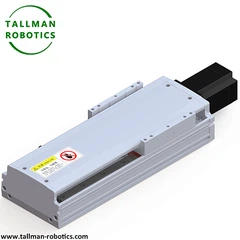


Linear Servo Motor is a high dynamic response linear motion actuator that integrates high-precision position feedback and closed-loop servo control. Linear Servo Motor can accurately control the position, velocity, and acceleration of linear motion in real time according to instructions and is the core component for achieving high-precision linear drive in industrial automation. It is widely used in automation fields that require fast response, precise positioning, and efficient conversion.
Core Composition and Working Principle of Linear Servo Motor
The structure of a linear servo motor can be disassembled into two parts:
|
Linear motor body |
Usually designed based on the principles of linear synchronous motor (LSM) or linear asynchronous motor (LIM) (with LSM as the main method due to higher accuracy), |
|
it consists of a stator (primary, including windings) and a rotor (secondary, including permanent magnets or conductors), which directly generate linear motion through electromagnetic force. |
|
|
Servo control system |
Position feedback device, such as grating ruler, magnetic grating encoder, linear encoder, etc., detects the actual position of the moving object in real time and feeds it back to the controller. |
|
Servo driver: receives instructions from the upper computer (such as PLC, motion controller), compares the feedback position with the target position, dynamically corrects the motion state of the rotor by adjusting the frequency, phase or amplitude of the stator current, and achieves closed-loop control (real-time error compensation). |
Key Features of Linear Servo Motor
|
Ultra high precision and repetitive positioning accuracy |
By relying on closed-loop control and high-precision feedback, the positioning accuracy can reach micron level (μ m) or even nanometer level (nm) , and the repeated positioning error can be controlled within 0.1 μ m, meeting the requirements of precision scenarios such as semiconductor manufacturing and optical processing. |
|
High dynamic response |
Without mechanical transmission components (such as screws and belts), it eliminates hysteresis caused by clearance, elastic deformation, and friction, and can accelerate up to 10-50g (traditional screws usually<1g), allowing for quick start stop and speed change. |
|
Stability of Motion |
The thrust output is uniform, without the "crawling" phenomenon of mechanical transmission (vibration at low speeds), suitable for scenarios that require high smoothness of motion (such as laser cutting and surface polishing). |
|
Control flexibility |
Supports multiple control modes (position mode, speed mode, torque mode), which can be communicated through pulse signals, analog signals, or buses (such as EtherCAT, Profinet) for easy integration into automation systems. |
|
Limitations |
High cost (motor body+high-precision feedback+servo drive); Sensitive to installation environment (avoid dust and vibration affecting feedback accuracy); The stator cost significantly increases during long-distance applications. |
Differences from related concepts
|
Concept |
Core Differences |
Typical Application Scenarios |
|
Linear servo motor |
Includes closed-loop servo control+high-precision feedback, emphasizing "controllability" |
Semiconductor wafer stage, precision coordinate measuring machine |
|
Linear synchronous motor (LSM) |
Refers only to the motor body, may not have feedback or control |
Maglev train (open-loop or semi closed-loop control) |
|
Traditional linear actuator |
relies on mechanical transmission (screw+servo motor), low accuracy |
Push mechanism of ordinary automated assembly line |
Linear servo motor is an integrated solution of "linear motor body+servo control+feedback system", and its core value lies in the combination of "linear motion" and "precise controllability". It is a key technology for achieving high-precision and high dynamic motion in high-end manufacturing industry. With the increasing demand for precision and efficiency in industrial automation, its application areas are expanding from high-end scenarios such as semiconductors and aerospace to more precision manufacturing fields.
Here, we introduce Linear motor, Model TML135-CM for general environment, with data sheet as follows:
You are welcome to watch more projects or visit our video gallery by Youtube: https://www.youtube.com/@tallmanrobotics


Linear Synchronous Motor (LSM) is widely used in fields with strict requirements for motion performance due to its advantages of high speed, high precision, large thrust, and no mechanical contact loss. The following are its main application areas and specific scenarios:
|
1 |
Rail Transit and High Speed Transportation |
Maglev train |
This is one of the most representative applications of LSM. For example, Shanghai Maglev trains and Japan Superconducting Maglev (L0 series) generate traveling magnetic fields through stators (long stator windings laid on the track), which interact with the magnetic fields of the moving elements (permanent magnet arrays) at the bottom of the train, directly generating linear thrust and achieving train suspension (without wheel rail contact). Its speed can reach over 400km/h, and it runs smoothly with low noise. |
|
Urban Rail Transit Auxiliary System |
Partial subway or light rail sections, as well as airport rapid transit systems, utilize LSM to achieve short distance high-speed traction and improve transportation efficiency. |
||
|
2 |
Precision manufacturing and high-end machine tools |
High speed precision machining equipment |
In scenarios such as semiconductor wafer cutting, optical component processing, and precision mold manufacturing, LSM is used to drive machine tool workbenches or cutting tools, achieving micro - or even nano level positioning accuracy and high acceleration (such as 10g or more), meeting the requirements of high-precision and high-speed processing. |
|
Electronic manufacturing industry |
The wire bonding platform of chip packaging equipment and the mobile mechanism of PCB board inspection equipment rely on the fast response and positioning accuracy of LSM to improve production efficiency and product yield. |
||
|
3 |
Logistics and Automated Sorting |
High speed sorting system |
In e-commerce warehousing and express distribution centers, LSM driven independent sliders can move at high speeds along the track (up to 5m/s or more), achieving rapid sorting of goods (such as processing tens of thousands of packages per hour) by precisely controlling the start stop and turning of each slider. |
|
Intelligent warehousing and handling |
In the automated three-dimensional warehouse, the horizontal/vertical drive mechanism of the stacker crane adopts LSM to reduce mechanical transmission clearance, improve the speed and positioning accuracy of goods storage and retrieval. |
||
|
4 |
Aerospace and Simulation Testing |
Flight/Aerospace Simulator |
The LSM driven linear motion platform is used to simulate dynamic scenarios such as acceleration, diving, and weightlessness of aircraft. It can provide high thrust and fast response (in milliseconds), reproducing real flight conditions. |
|
Wind tunnel test auxiliary equipment |
In the aerodynamic performance testing of aircraft, LSM controls the linear motion trajectory of the model to accurately simulate the airflow effects at different speeds. |
||
|
5 |
Medical and high-end equipment |
Medical imaging equipment |
The bed drive mechanism for magnetic resonance imaging (MRI) and CT scanning uses LSM to achieve millimeter level precise positioning of patients and reduce scanning errors; The radiation source mobile system of radiotherapy equipment ensures high-precision control of the radiation irradiation position through LSM. |
|
Rehabilitation equipment |
The limb traction mechanism of high-end rehabilitation robots utilizes the smooth thrust and precise speed control of LSM to assist patients in gait training and other rehabilitation movements. |
||
|
6 |
Research and Special Equipment |
Materials Science Experiment |
LSM can provide stable loading force and precise displacement control for material tensile/compression testing equipment under high temperature and high pressure environments, and obtain material mechanical performance data. |
|
Particle Accelerator |
The particle beam linear acceleration section of some accelerators uses the electromagnetic structure of LSM principle to control the motion trajectory and velocity of particles. |
The application core of linear synchronous motors is concentrated in the scenario of "high speed+high precision+large load", especially when traditional mechanical transmissions (such as screws and gears) cannot meet performance requirements, Linear Servo Motor becomes the key driving solution. With the development of industrial automation and high-end equipment, its application fields are still expanding to more precision manufacturing and intelligent transportation scenarios.
Hot Tags: linear servo motor, China linear servo motor manufacturers, suppliers, factory, Direct Drive Electromagnetic Motor System, Direct Drive Linear Motor Stage System, Linear Induction Motor, Linear Servo Positioner with Motor Drive, Linear Synchronous Drive Motor, Linear Synchronous Servo Motor


