
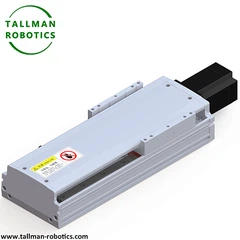


Rack and Pinion Linear actuators are mechanical devices that convert rotational motion into linear motion through the meshing transmission of gears and racks. They are mainly used to achieve precise linear pushing, pulling, positioning, or reciprocating motion and are widely used in industrial automation, mechanical manufacturing, and other fields.
Basic components of Rack and Pinion Linear actuators
|
Rack |
Usually a long straight toothed component fixed on a base or guide rail, serving as a "track" for linear motion. The material is mostly high-strength steel (such as quenched steel) to ensure wear resistance and rigidity. |
|
Pinion |
A small gear that meshes with a rack and is driven to rotate by a driving source (such as a motor, pneumatic motor, etc.). The tooth profile needs to match the rack (commonly straight or helical teeth, which can reduce impact and noise). |
|
Drive unit |
A component that provides rotational power, mainly consisting of servo motors or stepper motors (which can be paired with reducers to adjust torque and speed). Some models include encoders to achieve position feedback, forming a closed-loop control. |
|
Guidance and support structures |
Such as linear guides, sliders, or bearings, ensure the smoothness of gear movement along the rack, avoiding offset or jamming. |
|
Shell/frame |
Protects internal components and enhances overall rigidity, mostly made of aluminum alloy or steel, balancing lightweight and structural strength. |
Working mechanism of Rack and Pinion Linear actuators
The driving unit drives the gear to rotate, and the gear tooth surface meshes with the rack tooth surface, transmitting power through friction: if the rack is fixed, the gear will move in a straight line along the rack; If the gear position is fixed, the rack will be pushed into linear motion. This transmission method directly converts rotational motion into linear output, with fast response speed and flexible stroke expansion (achieved through the splicing of racks for ultra long distances).
Comparison with similar actuators
|
Type |
Rack and Pinion Linear actuators |
Ball screw linear actuator |
Pneumatic/hydraulic linear actuator |
|
Core advantages |
Long stroke, high speed, moderate cost |
High precision, high load |
Simple structure, high output force |
|
Main limitations |
Medium accuracy, presence of backlash |
Limited stroke, low speed |
Low control accuracy, requiring air/hydraulic sources |
|
Typical application scenarios |
Logistics handling, large machine tools |
Precision assembly, testing equipment |
Simple push-pull actions (such as gates, fixtures) |
Rack and Pinion Linear Actors are the ideal choice for achieving large-scale linear motion in industrial scenarios, with long travel, high speed, and cost-effectiveness as their core competitiveness. They are particularly suitable for applications that require medium precision but cover large workspaces.
Here, in this page, we introduce model TMG135CM, and TMG135CR with technical parameter as follows:
You are welcome to watch more projects or visit our video gallery by Youtube: https://www.youtube.com/@tallmanrobotics
|
Model No |
TMG135CM |
TMG135CR |
||||
|
Motor Power (W) |
400 |
|||||
|
Repeatability (mm) |
±0.01/±0.02 |
|||||
|
Gear Teeth |
22 |
|||||
|
Gear Pitch |
5 |
|||||
|
Reduction Ratio |
1:5 |
|||||
|
Lead (mm) |
22 |
|||||
|
Max Speed(mm/s) |
1100 |
|||||
|
Motor Speed 3000(rpm/min) |
||||||
|
Max Load |
Acceleration Deceleration |
Horizontal |
0.3G |
25 |
||
|
Vertical |
0.3G |
5 |
||||
|
Rated Thrust |
56 |
|||||
|
Linear guide (mm) |
15*12.5-2 |
|||||
|
Origin Sensor |
Out plug |
EE-SX672(NPN-SX672P(PNP) |
||||
|
Inside |
E2S-W13 |
|||||
|
Closed type |
Open |
Fully-closed |
||||

Rack and Pinion Linear actuators are widely used in industrial manufacturing, automotive, aerospace and other fields due to their advantages of high load and long stroke. The following are some specific application cases:
|
Industrial automation production line |
In a certain automotive parts processing production line, a truss robot with gear rack transmission reduces power transmission loss by 40% compared to a synchronous belt scheme. The rigidity advantage of gears and racks enables them to ensure uniform stress distribution in the contact area between teeth and avoid plastic deformation when the robotic arm carries a 2-ton workpiece moving at a speed of 2m/s. |
|
CNC machine tools |
Rack and Pinion linear actuators can be used to drive the worktable or tool of CNC machine tools for linear feed motion. If a high-end CNC machine tool's loading and unloading robot adopts a 25 ° helical angle inclined rack, the transmission stability is improved by 60%, and the tooth surface wear rate is reduced to 1/8 of the straight tooth scheme, which can meet the high-precision machining requirements. |
|
Automobile manufacturing |
Rack and Pinion linear actuators steering gear is a common steering mechanism in modern automobiles. The driver rotates the steering wheel to drive the gear to rotate, thereby driving the rack to move and achieve the steering of the wheels, providing precise steering control for the driver. |
|
Aerospace |
In the drive system of aircraft flaps, ailerons, and other control surfaces, gear rack linear actuators are used to achieve precise position control of the control surfaces, ensuring the stability and controllability of aircraft flight. |
|
Medical equipment |
In minimally invasive surgery, some surgical robots use gear rack transmission to drive surgical instruments, which can achieve precise movement, improve the accuracy and safety of surgery. |
|
Logistics and warehousing |
In the automatic sorting equipment of logistics centers, gear rack linear actuators can be used to drive conveyor belts or sorting carts, achieving rapid sorting and transportation of goods, and efficiently processing large quantities of goods. |
|
Construction and engineering machinery |
Gear rack linear actuators are commonly used in construction elevators to drive the up and down movement of the lifting platform, which can carry heavy personnel and goods, and can work stably in various complex construction environments. |
|
Energy industry |
In industries such as chemical, pharmaceutical, water treatment, and oil and gas, gear rack actuators can be used for automated operation of rotary valves such as butterfly valves, ball valves, and plug valves, providing reliable torque to achieve valve opening and closing. |


Rack and Pinion Linear actuators, with their unique transmission principles and structural design, have significant advantages among numerous linear motion solutions, especially suitable for industrial scenarios that require long-distance and efficient transmission. The following is a detailed analysis of its core advantages:
1. Long range travel capability, suitable for large-scale sports needs
The meshing transmission mode of gears and racks naturally supports infinite splicing and extension: by connecting multiple segments of racks at the beginning and end, it is easy to achieve linear travel of several meters or even tens of meters, far exceeding the travel limitations of actuators such as ball screws (limited by screw length and deflection) and synchronous belts (easy to relax over long distances).
Typical scenarios: worktable movement of large gantry machine tools, horizontal tracks of automated warehouse stackers, long-distance handling of photovoltaic panel production lines, etc.
2. High speed and fast response to improve work efficiency
The rigid meshing of gears and racks reduces elastic deformation in energy transmission, and when combined with high-speed motors (such as servo motors), it can achieve high linear motion speeds (usually 0.1-5m/s, some models can reach 10m/s or more), and the acceleration/deceleration response is rapid, effectively improving the device's cycle time.
Comparative advantage: The speed is significantly higher than that of ball screws (usually ≤ 1m/s), and it can maintain stable high speed even under long stroke, avoiding resonance problems when the screw rotates at high speed.
3. Simple structure and low maintenance cost
Simplified composition: The core components are only gears, racks, drive motors, and guide structures, without complex transmission pairs or hydraulic/pneumatic pipelines, making assembly and debugging difficult.
Convenient maintenance: The main maintenance requirement is to regularly lubricate the meshing surfaces of gears and racks (to reduce wear), and the replacement cost of vulnerable parts (such as gears) is low. Compared to components such as ball screws nuts and synchronous belts, it is more durable.
Strong environmental adaptability: high tolerance to dust and temperature fluctuations (common from -20 ℃ to 80 ℃), suitable for complex working conditions such as industrial workshops and outdoor environments (such as metallurgy, logistics and warehousing).
4. High load capacity and rigidity, stable output power
The gear rack is made of high-strength materials (such as quenched steel and alloy cast iron), with a large contact area on the meshing surface, which can withstand high radial and axial loads (usually ranging from hundreds of newtons to tens of thousands of newtons), and has good rigidity during transmission, making it difficult to deform and able to stably drive heavy workpieces or equipment.
Advantage scenarios: Heavy duty applications such as feeding mechanisms for heavy machinery, opening and closing devices for hydraulic gates, and translation systems for large-scale stage scenery.
5. Controllable cost and outstanding cost-effectiveness
Manufacturing cost: Gears can be produced in bulk through processes such as rolling and cutting, and the difficulty of gear machining is lower than that of precision ball screw spiral groove machining. The overall cost is significantly lower than that of high-precision ball screw actuators.
Long stroke economy: In ultra long stroke scenarios, there is no need to significantly increase costs due to length increase like ball screws (the longer the screw, the higher the requirements for processing and installation accuracy, and the cost increases exponentially), and the cost increase of rack and pinion splicing is more gradual.
6. High installation flexibility and adaptability to various scenarios
Flexible layout: It can be designed in two modes according to needs: "fixed rack, gear movement" or "fixed rack, gear movement", to adapt to the spatial layout of different equipment (such as horizontal, vertical or inclined installation).
Modular design: Some models integrate components such as linear guides, motors, encoders, etc., forming standardized modules that users can directly integrate into the equipment, reducing the workload of secondary design.
7. Direct power transmission with low energy loss
The direct meshing transmission of gears and racks reduces energy loss in intermediate links such as pulleys, chains, etc. The transmission efficiency can usually reach 85% -95%, higher than belt transmission (60% -80%), close to ball screws (90% -98%), and can maintain efficient power output under high loads.
The core advantages of rack and pinion linear actuators can be summarized as "long stroke, high speed, strong load, low cost, and easy maintenance", especially in industrial scenarios that require coverage of a large working space and are sensitive to efficiency and cost. Its comprehensive performance far exceeds other linear actuators, making it an efficient solution for connecting rotational power and linear motion.
Hot Tags: rack and pinion linear actuators, China rack and pinion linear actuators manufacturers, suppliers, factory, Linear motion actuator with rack and pinion, rack and pinion linear modules


