
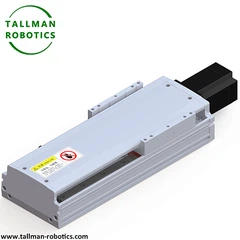


Enclosed Belt Drive Actuator is an integrated linear transmission device that encapsulates the synchronous belt drive system, guide components, and drive device within a closed housing. Compared to an open structure, Enclosed Belt Drive Actuator can operate stably under harsh conditions such as high dust, humidity, and splashes due to its sealed protection design, effectively improving the reliability and service life of the transmission system.
Structurally, Enclosed Belt Drive Actuator mainly consists of the following parts:
1).Enclosed shell, which is often made of aluminum alloy material through anodizing treatment, and the front and rear end caps are matched to form a closed space. The outer shell is equipped with guide rail installation slots and pulley bearing seats, which not only provide structural support but also isolate external pollutants.
2).Belt transmission system, which uses high-strength polyurethane synchronous belts reinforced with built-in steel wires, paired with aluminum alloy pulleys that have undergone hard anodizing treatment. The driven end adjusts the tension of the belt through an eccentric bearing seat to prevent gear jumping during operation.
3).Dual guide system, which symmetrically installs two sets of precision ball linear guides on both sides of the belt. The slider is rigidly connected to the belt clamp to ensure the straightness of the motion (straightness error ≤ 0.1mm/m).
4).Integrated drive device, where the servo motor or stepper motor is directly installed on the end cover of the housing through a flange, and connected to the active pulley with a zero backlash coupling to reduce transmission errors. The fifth is protective accessories. Felt scraper is equipped at both ends of the slider to clean the surface of the guide rail. The cable is led out through the drag chain inside the shell to avoid interference with external objects. Some parts can also be equipped with built-in magnetic grid rulers or photoelectric encoders to achieve closed-loop control, with positioning accuracy up to ± 0.05mm.
The working principle of Enclosed Belt Drive Actuator is based on the mechanism of "sealed transmission+dual guidance".
The motor drives the active pulley to rotate through a coupling, and the synchronous belt achieves slip free transmission through tooth meshing, converting the rotational motion into linear motion of the slider. Double guide rails constrain the slider's degrees of freedom in both radial and circumferential directions, ensuring that the load moves strictly along the axis of the housing. The enclosed shell of Enclosed Belt Drive Unit prevents dust, water mist, cutting fluid, etc. from entering the transmission system, and the internal heat generated during operation is dissipated through the aluminum alloy shell. The control system achieves precise control of the load movement speed (up to 3m/s) and stroke by adjusting the motor speed and rotation angle.
In terms of application, Enclosed Belt Drive Actuator is suitable for various scenarios.
In the metal processing workshop, the feeding mechanism can be used for CNC lathes and grinders, which can resist cutting fluid splashing and iron chip pollution. Compared with open structures, the maintenance cycle is extended by three times. In the food packaging production line, for the secondary packaging of snacks and beverages, stainless steel shell models are selected to meet the requirements of frequent cleaning and disinfectant corrosion resistance. The tracking mechanism of outdoor equipment such as solar panels reaches IP65 protection level (with waterproof joints added), which can effectively resist wind, rain, sand and dust, ensuring long-term stable operation. In the battery production process, the coating and cutting process of lithium-ion battery electrodes can prevent belt wear and debris from contaminating the electrodes, and the cleanliness meets the 1000 level standard.
Compared to closed ball screw units, Enclosed Belt Drive Actuator has the advantages of faster speed and lower cost; Compared to open belt modules, it has stronger environmental adaptability. This makes it a cost-effective transmission choice for medium precision requirements and complex operating scenarios
You are welcome to watch more projects or visit our video gallery by Youtube: https://www.youtube.com/@tallmanrobotics
Here, we introduce Enclosed Belt Drive Actuator, TMB145-CM for general environment with data as follows:


The differences between Enclosed Belt Drive Actuator and open belt drive actuator are mainly reflected in applicable scenarios, cost maintenance, etc. The following comparative analysis is conducted from the advantages, disadvantages, and typical application scenarios:
Detailed analysis of advantages and disadvantages of Enclosed Belt Drive Actuator
Advantages of Closed Belt Drive Unit
1. Strong adaptability to harsh environments
In metal processing scenarios, Enclosed Belt Drive Unit can be directly used for loading and unloading workpieces on machining centers to avoid cutting fluid splashing and causing belt slippage or guide rail corrosion;
In the food packaging line, the stainless steel shell model can pass FDA certification, withstand cleaning agent rinsing, and meet hygiene standards.
2. Long lifespan and low maintenance
Sealed structure isolates dust, reducing synchronous belt wear rate by 60% (open belts are prone to wear due to dust entering the tooth gap);
Built in tension automatic compensation device reduces manual adjustment frequency and is suitable for continuous operation of automated production lines for 7 × 24 hours.
3. High precision and high rigidity
Double rail symmetrical layout (spacing ≥ 50mm) enhances anti overturning moment (twice as high as open type), suitable for scenarios with load center of gravity offset (such as grasping eccentric workpieces);
The closed-loop feedback system of Enclosed Belt Drive Unit (such as magnetic grid ruler) can correct the elastic deformation error of the belt, and the positioning accuracy is close to that of the ball screw module (± 0.05mm vs ± 0.02mm).
Limitations of Enclosed Belt Drive Actuator
Lack of flexibility: It is difficult to change the stroke after the shell is fixed, and the open module can quickly extend the stroke by splicing the belt;
High installation threshold: Use a torque wrench to tighten the shell bolts in diagonal order (torque error ≤± 5%), and the open module can be installed by hand.
Advantages of Open Belt Drive Unit
1). Low cost and lightweight
In scenarios such as desktop 3D printers and small sorting machines, the cost can be controlled within 2000 yuan, making it suitable for startups or experimental equipment;
The weight is only one-third of that of a closed type (such as a 1m stroke module weighing about 2kg), making it suitable for load sensitive scenarios such as mobile robots.
2). Convenient maintenance and renovation
Can quickly replace worn synchronous belts (replacement time<10 minutes), suitable for testing equipment that requires frequent adjustments;
The open structure facilitates the integration of sensors, cameras, and other peripherals (such as adding markers on the belt for visual positioning).
Limitations of Open Belt Drive Unit
Poor environmental tolerance: In dusty environments such as woodworking workshops and flour processing plants, it is necessary to clean the guide rails daily, otherwise they may get stuck due to dust accumulation;
High speed noise: Without shell sound insulation, the operating noise can reach 75dB (about 65dB for enclosed systems), which is not suitable for quiet scenarios such as medical and laboratory settings.
Selection Decision Suggestions for Enclosed Belt Drive Actuator
Prioritize closed type: If the application scenario meets the following conditions
Poor environment (with dust, liquid splashes, oil stains);
Long term continuous operation is required (annual operating time>5000 hours);
Heavy load or center of gravity offset (such as end effector of a robotic arm).
Prioritize open: If the application scenario meets the following conditions
Clean and dry environment (such as office, laboratory);
Short term temporary use (such as exhibition equipment, test prototypes);
Limited budget and sufficient maintenance manpower (such as small business production lines).
Through comparison, it can be seen that the two are not simply "advantages and disadvantages substitution", but differentiated solutions for different working conditions. For example, the long-term stable operation of an automotive welding line requires the use of a closed type, while prototype development by university research teams is more suitable for an open type.
Hot Tags: enclosed belt drive actuator, China enclosed belt drive actuator manufacturers, suppliers, factory, Belt Pulley Linear Transmission System, Belt driven Linear Motion System, Belt Powered Positioning Assembly, CNC Linear Motion Drive Unit, Non Enclosed Belt Driven Linear Slide, Pulley Belt Actuated Linear Mechanism


