
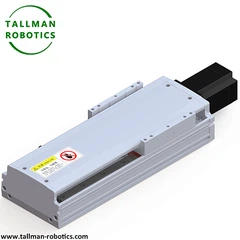


What is High Speed Belt Actuator?
A high speed belt actuator is a linear motion system that turns rotary motor output into fast, controlled linear travel. A servo motor drives a toothed synchronous belt, and the belt pulls a carriage along a fixed guide rail. Engineers choose this belt-driven linear actuator when a station needs rapid point-to-point movement across a long stroke. Unlike a ball screw axis, the belt itself carries almost no rotating mass along its length.
As a result, the moving carriage accelerates and decelerates quickly without overloading the drive motor. The synchronous belt also absorbs light shock during rapid direction changes. So the linear guide module runs smoothly at speed. For this reason, plant engineers rely on the high speed belt actuator wherever throughput and travel distance both matter. In short, the design trades a small amount of stiffness for a large gain in velocity and stroke length.
Structural Design and Core Components
Every belt-driven linear actuator shares a common structural layout. Each part plays a defined role. The extruded aluminum profile forms the housing and sets the axis straightness reference. Inside that housing, a linear guide rail and recirculating carriage bearing carry the load. Together they resist moment forces during fast travel.
A steel-reinforced or fiberglass-reinforced synchronous belt loops around a drive pulley and an idler pulley at each end. The servo motor connects to the drive pulley directly, or through a reduction gearbox for higher torque. A spring-loaded or screw-adjusted tensioner keeps belt tension constant. This prevents tooth skipping under rapid acceleration.
Meanwhile, a cable carrier routes motor power and feedback wiring along the moving carriage without tangling. Limit switches and a home sensor complete the assembly. As a result, the control system always knows carriage position at power-up. Together, these components form a compact, self-contained linear guide module ready for direct mounting on a machine frame.
You are welcome to watch more projects or visit our video gallery by Youtube: https://www.youtube.com/@tallmanrobotics
Here, we introduce High Speed Belt Actuator, TMB170-CM for general environment with data as follows:


How the Drive Train Achieves High Speed?
Belt drive speed comes from a simple mechanical relationship, not from a larger motor alone. The belt wraps a small-diameter pulley. One motor revolution produces a fixed linear travel distance, set by belt pitch and pulley tooth count. Therefore, a higher pulley tooth count raises linear speed at the same motor RPM.
A brushless servo motor supplies the acceleration profile. It typically ramps the carriage to full speed within a few hundred milliseconds. Because belt drives carry low reflected inertia, the servo motor reaches top speed faster than on an equivalent ball screw axis. Consequently, cycle time drops even when the stroke length grows.
Many high speed belt actuator models reach linear speeds beyond 3 m/s. Some open-profile designs exceed 5 m/s on longer strokes. However, top speed always depends on stroke length, mounting orientation, and payload mass. So engineers verify the full motion profile before final selection.
Engineering Considerations for Sustained High-Speed Operation
Running an actuator at high speed brings challenges a slow-speed axis rarely faces. First, belt tension must stay within the range set by ISO 5295 performance calculations. A loose belt skips teeth, and a tight belt overloads the pulley bearings. Additionally, engineers check the belt's natural frequency against the motion profile to avoid resonance. Resonance shows up as audible belt slap at certain speeds.
Guide rail rigidity also matters at speed. A flexible rail lets the carriage oscillate during rapid stops. For that reason, longer high speed belt actuator strokes often use dual guide rails or a wider rail profile.
Thermal growth is another factor. Sustained high-cycle operation raises housing temperature. So designers add ventilation slots or select low-friction wiper seals. Finally, positioning repeatability depends on belt stretch under load. Manufacturers address this by specifying low-elongation steel cord belts for precision axes. Pulley and belt quality follow ISO 17396 tooth-profile tolerances and ISO 254 pulley finish requirements. Together, these standards keep tooth engagement consistent across the full travel range.
Positioning Repeatability and Feedback Control
Positioning repeatability defines how closely the carriage returns to the same point on every cycle. A rotary or linear encoder mounted on the servo motor reports carriage position back to the drive. Higher encoder resolution supports tighter repeatability, typically in the range of plus or minus 0.03 mm to 0.1 mm for a well-tensioned belt axis. Belt stretch, pulley runout, and guide rail clearance all affect this number over the actuator's service life.
Therefore, engineers re-check belt tension at scheduled intervals rather than after a failure occurs. A pre-tensioned steel-cord belt holds its length better than a fiberglass-reinforced belt under repeated high-speed cycling. As a result, steel-cord construction remains the standard choice for precision, high-cycle stations.
Maintenance and Service Life
A high speed belt actuator needs less routine maintenance than a hydraulic or pneumatic alternative, but scheduled checks still matter. Technicians inspect belt tension, tooth wear, and pulley bearing play at fixed service intervals set by the equipment manufacturer. A packaging line running three shifts a day can cycle the actuator several million times per year, so tensioner condition directly affects uptime.
In addition, dust and moisture accelerate belt wear in unsealed housings. For that reason, plants in food, beverage, or outdoor environments often specify a fully-closed linear guide module with wiper seals along the carriage slot. Replacing a worn belt takes far less time than rebuilding a ball screw nut assembly, since the belt and pulleys mount as accessible external components rather than an enclosed precision assembly.
Technical Reference Table
The table below lists representative technical parameters for a high speed belt actuator platform. These figures reflect common industrial specifications and support early-stage axis sizing.
|
Parameter |
Typical Range / Value |
Notes |
|
Drive type |
Steel-cord or fiberglass-reinforced synchronous belt |
Tooth profile per ISO 17396 |
|
Maximum linear speed |
Up to 3 m/s (standard); up to 5 m/s (open-profile) |
Depends on stroke and payload |
|
Maximum acceleration |
Up to 20 m/s² |
Set by servo motor sizing |
|
Stroke length |
Up to 6 m (single axis) |
Longer strokes via multi-span rail |
|
Positioning repeatability |
±0.03 mm to ±0.1 mm |
Depends on belt tension and encoder resolution |
|
Guide rail type |
Recirculating ball or roller linear guide rail |
Dual-rail option for heavy or offset loads |
|
Motor interface |
NEMA or metric-flange servo motor mount |
Direct-drive or gearbox-reduced |
|
Housing options |
Open-profile or fully-closed with wiper seal |
Sealed housing for dust or washdown areas |
|
TallMan Robotics belt-driven linear guide module |
Steel-cord belt, sealed or open housing, servo-ready |
Matched pulley and tensioner sets available |
Application Areas
A high speed belt actuator fits naturally into any process that moves parts quickly over a moderate to long distance. In automotive battery assembly, the actuator transfers battery modules between stations while a vision system checks alignment. In e-commerce sortation centers, belt-driven linear actuators push parcels from a main conveyor onto branch chutes at high cycle rates.
Food and beverage packaging lines use the same actuator type to erect cartons and place filled containers into shipping trays. Warehouse robotics also rely on this linear motion system for pick arms that travel across wide gantry spans. Because the actuator handles long strokes without added rotating mass, integrators favor it for X-axis travel on large-format gantry systems. A ball screw axis, meanwhile, often handles the shorter, higher-force Z-axis.
Across these industries, the shared requirement stays the same. Plants need fast, repeatable linear travel that keeps pace with upstream and downstream automation. As throughput targets rise, the belt-driven linear actuator remains the practical choice for long-stroke, high-speed transfer tasks within a broader industrial automation cell.
Belt Actuator vs Ball Screw vs Linear Motor at High Speed
Selecting the right linear drive technology means comparing belt, ball screw, and linear motor options against the same speed and stroke targets. The table below lines up these three technologies side by side, covering typical speed range, stroke limit, and positioning repeatability. A linear motor axis wins on raw speed and accuracy, but it needs a linear encoder scale and forced cooling on long strokes. A ball screw axis wins on stiffness and holding force. However, screw whip limits its practical speed once the stroke passes a few meters. The high speed belt actuator sits between these two options, favoring stroke length and velocity over maximum stiffness.
|
Criterion |
Belt-Driven Linear Actuator |
Ball Screw Actuator |
Linear Motor Actuator |
|
Typical top speed |
Up to 5 m/s |
Up to 1 m/s |
Up to 10 m/s |
|
Practical stroke limit |
Several meters, long-stroke friendly |
Limited by screw whip past a few meters |
Several meters, needs magnetic track length |
|
Positioning repeatability |
±0.03 to ±0.1 mm |
±0.01 to ±0.02 mm |
±0.005 mm or tighter |
|
Holding force / stiffness |
Moderate |
High |
Requires active current to hold position |
|
Reflected inertia |
Low |
Moderate to high |
Very low |
|
Feedback requirement |
Rotary or linear encoder |
Rotary encoder standard |
Linear encoder scale required |
Selection Guidelines for a High Speed Belt Actuator
Choosing the correct belt-driven linear actuator starts with the motion profile, not the catalog page. First, define the required stroke length, top speed, and acceleration. These three values set the minimum pulley size and belt width. Next, calculate the payload mass and its center of gravity. An off-center load increases moment loading on the guide rail.
In addition, confirm the duty cycle. Continuous high-speed operation calls for a larger belt cross-section and a more robust tensioner than occasional indexing use. Environmental conditions also guide the housing choice. A dusty or washdown area calls for a sealed, fully-closed linear guide module rather than an open-profile design.
Finally, match the servo motor and drive to the required positioning repeatability. Confirm the feedback resolution supports the target accuracy. Working through these steps in order keeps the final actuator selection matched to the actual application, not just to a headline speed rating.
Frequently Asked Questions
What is the difference between a high speed belt actuator and a ball screw actuator?
A high speed belt actuator moves the carriage with a toothed synchronous belt, which carries almost no rotating mass along the stroke. A ball screw actuator moves the carriage with a rotating screw shaft, which limits practical speed on long strokes due to screw whip. As a result, the belt-driven linear actuator reaches higher speeds over longer travel distances, while the ball screw axis holds a stiffness and force advantage.
What top speed can a belt-driven linear actuator reach?
Most industrial belt-driven linear actuators reach linear speeds between 2 m/s and 3 m/s. Open-profile designs with a lightweight carriage can exceed 5 m/s. Actual top speed depends on stroke length, payload mass, mounting orientation, and the servo motor's acceleration capability.
How accurate is a high speed belt actuator?
Positioning repeatability typically falls between ±0.03 mm and ±0.1 mm. Belt tension, pulley quality, and guide rail clearance all affect this figure. A pre-tensioned steel-cord belt combined with a high-resolution encoder delivers the tightest repeatability within this range.
How often does the belt need replacement in a high-speed application?
Belt life depends on duty cycle, tension setting, and environmental exposure to dust or moisture. Plants running continuous multi-shift cycles inspect belt tension and tooth wear at scheduled service intervals set by the actuator manufacturer, rather than waiting for a failure to occur.
Can a high speed belt actuator run in a dusty or washdown environment?
Yes, provided the actuator uses a fully-closed housing with wiper seals along the carriage slot. This sealed linear guide module configuration protects the belt and guide rail from dust, debris, and washdown moisture, which extends service life in food, beverage, and outdoor installations.
Hot Tags: high speed belt actuator, China high speed belt actuator manufacturers, suppliers, factory, Belt Pulley Linear Traverse System, Linear Belt Drive, Timing toothed belt linear actuator, Pulley Belt Linear Propulsion Assembly, Totally Enclosed Belt Drive System, Linear Sliding Rail System


