
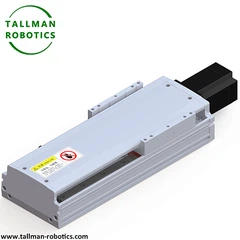


A Linear Motion Belt Drive converts motor rotation into controlled linear movement. The system uses a toothed belt, drive pulley, guide rail, carriage, idler pulley, and tensioning mechanism.
Together, these components form a complete mechanical transmission for industrial automation. The motor turns the drive pulley. Then, the pulley moves the timing belt along the linear axis. The belt carries the carriage to the required position.
Therefore, a belt driven linear actuator provides a practical motion axis for equipment that needs long travel, rapid movement, and repeated positioning.
What Is a Linear Motion Belt Drive?
A Linear Motion Belt Drive is a mechanical system that transfers rotary motor motion into straight-line carriage movement. Unlike a friction belt, a timing belt uses teeth that engage with matching pulley teeth.
This engagement creates a controlled relationship between pulley rotation and belt travel. Therefore, engineers can integrate the belt drive with servo motors, stepper motors, encoders, and motion controllers.
The carriage attaches to the belt and travels along a guide system. Meanwhile, the guide supports the payload and controls the movement direction.
As a result, the complete assembly becomes a linear belt drive system for automated handling, inspection, assembly, packaging, and Cartesian motion.
You are welcome to watch more projects or visit our video gallery by Youtube: https://www.youtube.com/@tallmanrobotics
Here, we introduce Linear Motion Belt Drive, TMB85-CM for general environment with data as follows:


Main Functions of a Linear Motion Belt Drive
A linear belt drive performs several functions within an automated machine.
| Function | Mechanical Action | Automation Function |
|---|---|---|
| Motion conversion | Pulley drives timing belt | Converts rotary motion to linear motion |
| Load transportation | Carriage follows guide | Moves products or tooling |
| Direction control | Motor reverses pulley rotation | Provides forward and reverse travel |
| Position control | Motor follows controller commands | Places tooling at defined locations |
| Long-axis movement | Belt circulates between pulleys | Supports extended linear travel |
| Tool movement | Carriage carries equipment | Positions grippers, cameras, or heads |
| Multi-axis motion | Axes operate together | Creates Cartesian mechanisms |
| Process movement | Carriage follows programmed path | Supports assembly and inspection |
Frequently Asked Questions
1. What does the timing belt do in a linear actuator?
The timing belt transfers motor movement from the drive pulley to the carriage. Its teeth engage with matching pulley teeth and maintain mechanical synchronization.
2. Can a Linear Motion Belt Drive use a servo motor?
Yes. A servo motor can drive the pulley through a suitable motor interface. An encoder can also provide feedback for closed-loop motion control.
3. How should engineers select a belt-driven linear actuator?
Engineers should consider payload, stroke, velocity, acceleration, external moments, belt tension, pulley size, guide capacity, motor torque, duty cycle, and environmental conditions.
4. When should engineers choose a belt drive instead of a screw drive?
A belt drive can suit applications that require long travel, rapid movement, and frequent reciprocation. However, engineers should compare the complete motion requirements before selecting the transmission.
Hot Tags: linear motion belt drive, China linear motion belt drive manufacturers, suppliers, factory, Belt Pulley Linear Traverse System, Linear Belt Drive, Timing toothed belt linear actuator, Pulley Belt Linear Propulsion Assembly, Totally Enclosed Belt Drive System, Linear Sliding Rail System


