
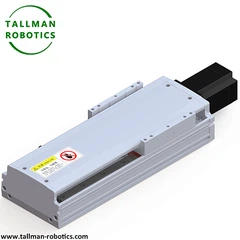


What Is Long Stroke Linear Motion?
Long stroke linear motion describes a motion axis built to travel well beyond the range a standard actuator handles in one run. Engineers generally apply this label once travel distance passes roughly five meters. Both belt drive and ball screw systems face distinct physical limits at that scale. A ball screw begins to whip at high rotation speed once its unsupported length grows, so raw material constraints cap a single screw section around six meters. This effect, known as screw whip, is a central design concern in industrial automation. Belt drive systems avoid that whip problem entirely, but they introduce a different challenge: as the loop grows longer, sag and reduced tension consistency start to affect positioning accuracy.
Structural Approach for Extended Travel
Extending a ball screw axis past its natural length limit requires joining two precision-ground screws end to end. Even a small lead deviation between sections creates positioning error. Therefore, manufacturers machine the joint carefully and secure it with a high-strength coupling. Intermediate support blocks keep the screw from sagging under its own weight between the fixed ends. Spacing typically falls between half a meter and one meter along the stroke length.
A belt drive system takes a different structural path. Instead of joining sections, it extends the same pulley-and-belt loop across a longer aluminum extrusion. The carriage still rides on linear bearings inside the profile. Meanwhile, the belt still closes the loop between a drive pulley and an idler pulley. However, tensioning becomes more critical over distance. A belt that sags mid-span loses the consistent grip needed for accurate carriage tracking.
You are welcome to watch more projects or visit our video gallery by Youtube: https://www.youtube.com/@tallmanrobotics
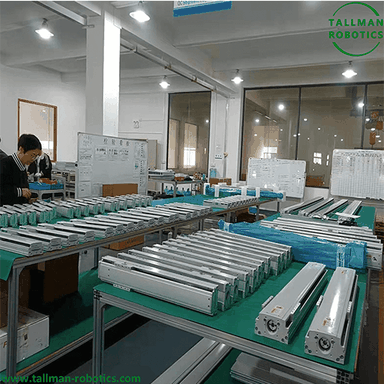
Here, we introduce Long Stroke Linear Motion, Fully Sealed TMB100-CR for clean environment with data as follows:


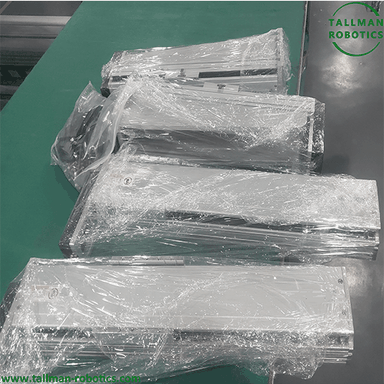
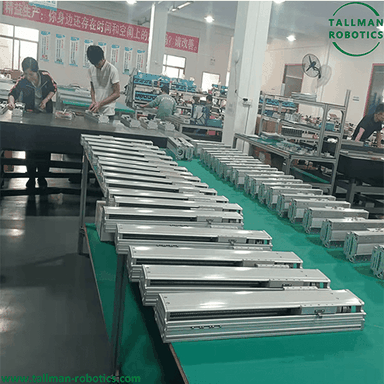
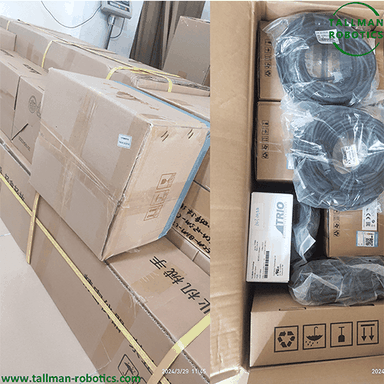
Purpose and Application Areas
Automotive welding and machine-tending lines rely on long stroke linear motion to move six-axis robots along a shared rail. This approach positions the robot at successive workstations rather than duplicating the robot at each station (Assembly Magazine, 2014). Speed matters less than reach in this configuration. Therefore, a screw-driven axis with intermediate supports often serves welding cells well. Warehouse shuttle systems and material transfer lines favor belt drive instead, since they need fast, repeated travel across long spans rather than heavy thrust force.
Technical Reference Table
|
Parameter |
Ball Screw (Long Stroke) |
Belt Drive (Long Stroke) |
|
Typical stroke length |
Up to 6 m per section, longer when joined |
Up to 10 to 12 m |
|
Maximum speed |
Roughly 1.5 to 2.5 m/s |
Up to 4 to 5 m/s, higher with cam-roller guides |
|
Positioning accuracy |
Higher, screw-limited by joint precision |
Lower, belt-limited by sag and stretch |
|
Failure behavior |
Load generally holds position on failure |
Belt failure can allow uncontrolled drop |
|
Support requirement |
Intermediate bearing blocks every 0.5 to 1 m |
Tensioning hardware across the full span |
Installation Guidelines
Installation begins with leveling the full length of the mounting structure, since even a slight bow over several meters throws off carriage travel at the far end. For a screw-driven axis, technicians install intermediate support blocks at the spacing the manufacturer specifies. They then verify the screw spins freely before coupling the motor. For a belt drive axis, the team threads the belt across the full span. Tension then comes up gradually, with checks for sag at the midpoint rather than only at the ends. Afterward, the carriage should travel the entire stroke length under no load, since a long axis hides misalignment more easily than a short one does. Finally, homing sensors at both extremes let the controller reference an accurate zero point before the line enters production.
Frequently Asked Questions
Q1: How long can a single ball screw axis run without joining sections?
A single precision-ground screw typically tops out around six meters. Raw material and manufacturing constraints limit longer continuous lengths.
Q2: What causes belt sag on a long stroke axis, and how is it prevented?
Sag develops when tension cannot stay consistent across a long span. Distributed tensioning hardware and periodic mid-span checks keep the belt taut along its full length.
Q3: Is a long stroke linear motion axis safe for vertical applications?
Screw-driven axes generally hold position if the drive fails. Belt-driven axes, by contrast, can allow the load to drop, so vertical long-stroke work often favors a screw or adds a brake.
Q4: How many support blocks does a long ball screw axis need?
Spacing usually falls between 0.5 and 1 meter. A six-meter axis typically needs several intermediate supports to prevent sag and screw whip.
Q5: Which drive type suits a robot-carrying rail axis better?
Screw-driven axes with intermediate supports typically fit welding and machine-tending rails well, since reach and stability matter more than raw speed in that application.
Hot Tags: long stroke linear motion, China long stroke linear motion manufacturers, suppliers, factory, Belt Pulley Linear Traverse System, Linear Belt Drive, Timing toothed belt linear actuator, Pulley Belt Linear Propulsion Assembly, Totally Enclosed Belt Drive System, Linear Sliding Rail System


