
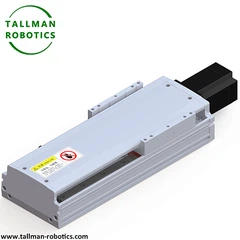


Linear modules are a precision electromechanical integrated devic that can convert rotational motion into linear motion. Linear modules are an integrated linear motion system that integrates transmission, guidance, and drive components into modular units through standardized design, enabling precise linear displacement control.
You are welcome to watch more projects or visit our video gallery by Youtube: https://www.youtube.com/@tallmanrobotics
Ball Screw Linear Modules for General Environment from Tallman Robot have following series:
|
Model No |
Body Width (mm) |
Max Payload (kgs) |
Max Stroke (mm) |
Repeatability (mm) |
Drive |
Motor Power (W) |
Application Environment |
|
TM-S45-CM |
45 |
10 |
800 |
±0.01/±0.005 |
screw |
50/100 |
General |
|
TM-S62-CM |
62 |
20 |
1050 |
±0.01/±0.005 |
screw |
100/200/400 |
General |
|
TM-S65-CM |
65 |
30 |
800 |
±0.01/±0.005 |
screw |
50/100 |
General |
|
TM-S85-CM |
85 |
50 |
1050 |
±0.01/±0.005 |
screw |
100/200/400 |
General |
|
TM-S100-CM |
100 |
65 |
1050 |
±0.01/±0.005 |
screw |
100/200/400 |
General |
|
TM-S100L-CM |
100 |
80 |
1050 |
±0.01/±0.005 |
screw |
100/200/400 |
General |
|
TM-S135-CM |
135 |
110 |
1250 |
±0.01/±0.005 |
screw |
200/400/750 |
General |
|
TM-S150-CM |
150 |
120 |
1500 |
±0.01/±0.005 |
screw |
400/750 |
General |
|
TM-S170-CM |
170 |
130 |
1500 |
±0.01/±0.005 |
screw |
400/750 |
General |
|
TM-S220-CM |
220 |
150 |
1500 |
±0.01/±0.005 |
screw |
750 |
General |
Lead Screw Linear Module for Clean Environment from Tallman Robot have following series TM-S-CR
|
Model No |
Body Width (mm) |
Max Payload (kgs) |
Max Stroke (mm) |
Repeatability (mm) |
Drive |
Motor Power (W) |
Application Environment |
|
|
TM-S45-CR |
45 |
10 |
800 |
±0.01/±0.005 |
screw |
50/100 |
Clean environment |
|
|
TM-S62-CR |
62 |
20 |
1050 |
±0.01/±0.005 |
screw |
100/200/400 |
Clean environment |
|
|
TM-S65-CR |
65 |
30 |
800 |
±0.01/±0.005 |
screw |
50/100 |
Clean environment |
|
|
TM-S85-CR |
85 |
50 |
1050 |
±0.01/±0.005 |
screw |
100/200/400 |
Clean environment |
|
|
TM-S100-CR |
100 |
65 |
1050 |
±0.01/±0.005 |
screw |
100/200/400 |
Clean environment |
|
|
TM-S135-CR |
135 |
110 |
1250 |
±0.01/±0.005 |
screw |
200/400/750 |
Clean environment |
|
|
TM-S150-CR |
150 |
120 |
1500 |
±0.01/±0.005 |
screw |
400/750 |
Clean environment |
|
|
TM-S170-CR |
170 |
130 |
1500 |
±0.01/±0.005 |
screw |
400/750 |
Clean environment |
|
|
TM-S220-CR |
220 |
150 |
1500 |
±0.01/±0.005 |
screw |
750 |
Clean environment |
|
Long Stroke Screw Linear Module for General Environment TM-SL-CM
|
Model No |
Body Width (mm) |
Max Payload (kgs) |
Max Stroke (mm) |
Repeatability (mm) |
Drive |
Motor Power (W) |
Application Environment |
|
TM-SL135-CM |
135 |
80 |
2200 |
±0.01/±0.005 |
screw |
200/400/750 |
General |
|
TM-SL170-CM |
170 |
110 |
2200 |
±0.01/±0.005 |
screw |
400/750 |
General |
|
TM-SL220-CM |
220 |
150 |
2400 |
±0.01/±0.005 |
screw |
750 |
General |
Organ Cover Water proof Lead Screw Linear Module TM-SF
|
Model No |
Body Width (mm) |
Max Payload (kgs) |
Max Stroke (mm) |
Repeatability (mm) |
Drive |
Motor Power (W) |
Application Environment |
|
|
TM-SF100-CR |
140 |
65 |
1050 |
±0.01/±0.005 |
Screw |
100/200/400 |
Water-proof/Dust-proof |
|
|
TM-SF135-CR |
171 |
80 |
1250 |
±0.01/±0.005 |
Screw |
200/400/750 |
Water-proof/Dust-proof |
|
|
TM-SF170-CR |
206 |
110 |
1500 |
±0.01/±0.005 |
Screw |
400/750 |
Water-proof/Dust-proof |
|
|
TM-SF220-CR |
256 |
150 |
1500 |
±0.01/±0.005 |
Screw |
750 |
Water-proof/Dust-proof |
|
Timing Belt Linear Module for General Environment TM-B-CM
|
Model No |
Body Width (mm) |
Max Payload (kgs) |
Max Stroke (mm) |
Repeatability (mm) |
Drive |
Motor Power (W) |
Application Environment |
|
TM-B45-CM |
45 |
4 |
800 |
±0.04 |
belt |
50/100 |
General |
|
TM-B62-CM |
62 |
16 |
2000 |
±0.04 |
belt |
100/200/400 |
General |
|
TM-B65-CM |
65 |
4 |
800 |
±0.04 |
belt |
50/100 |
General |
|
TM-B85-CM |
85 |
16 |
2000 |
±0.04 |
belt |
100/200/400 |
General |
|
TM-B100-CM |
100 |
40 |
3500 |
±0.04 |
belt |
100/200/400 |
General |
|
TM-B135-CM |
135 |
42 |
3500 |
±0.04 |
belt |
200/400 |
General |
|
TM-B150-CM |
150 |
75 |
3500 |
±0.04 |
belt |
400/750 |
General |
|
TM-B170-CM |
170 |
75 |
3500 |
±0.04 |
belt |
400/750 |
General |
|
TM-B220-CM |
220 |
75 |
3500 |
±0.04 |
belt |
750 |
General |
Timing Belt Linear Module for Dust-proof Environment TM-B-CR
|
Model No |
Body Width (mm) |
Max Payload (kgs) |
Max Stroke (mm) |
Repeatability (mm) |
Drive |
Motor Power (W) |
Application Environment |
|
TM-B45-CR |
45 |
4 |
800 |
±0.04 |
belt |
50/100 |
Clean environment |
|
TM-B62-CR |
62 |
16 |
2000 |
±0.04 |
belt |
100/200/400 |
Clean environment |
|
TM-B65-CR |
65 |
4 |
800 |
±0.04 |
belt |
50/100 |
Clean environment |
|
TM-B85-CR |
85 |
16 |
2000 |
±0.04 |
belt |
100/200/400 |
Clean environment |
|
TM-B100-CR |
100 |
40 |
3500 |
±0.04 |
belt |
100/200/400 |
Clean environment |
|
TM-B135-CR |
135 |
42 |
3500 |
±0.04 |
belt |
200/400 |
Clean environment |
|
TM-B150-CR |
150 |
75 |
3500 |
±0.04 |
belt |
400/750 |
Clean environment |
|
TM-B170-CR |
170 |
75 |
3500 |
±0.04 |
belt |
400/750 |
Clean environment |
|
TM-B220-CR |
220 |
75 |
3500 |
±0.04 |
belt |
750 |
Clean environment |
Organ Cover water proof Timing Belt Linear Module TM-BF
|
Model No |
Body Width (mm) |
Max Payload (kgs) |
Max Stroke (mm) |
Repeatability (mm) |
Drive |
Motor Power (W) |
Application Environment |
|
TM-BF100-CR |
140 |
40 |
3500 |
±0.04 |
Belt |
100/200/400 |
Water-proof/Dust-proof |
|
TM-BF135-CR |
171 |
40 |
3500 |
±0.04 |
Belt |
100/200/400 |
Water-proof/Dust-proof |
|
TM-BF170-CR |
206 |
75 |
3500 |
±0.04 |
Belt |
750 |
Water-proof/Dust-proof |
|
TM-BF220-CR |
256 |
75 |
3500 |
±0.04 |
Belt |
750 |
Water-proof/Dust-proof |
European dustproof Timing Belt Module TM-EB
|
Model No |
Body Width (mm) |
Max Payload (kgs) |
Max Stroke (mm) |
Repeatability (mm) |
Drive |
Motor Power (W) |
Application Environment |
|
TM-EB65 -CR |
65 |
65 |
5500 |
±0.1 |
Belt |
200/400/750 |
Clean environment |
|
TM-EB80-CR |
80 |
80 |
5500 |
±0.1 |
Belt |
200/400/750 |
Clean environment |


FAQ:
1. What are the core structural components of the linear modules?
The core components include a base profile, linear guides, a transmission mechanism, and a moving carriage. The base provides structural rigidity and mounting surfaces. Linear guides consist of rails and sliders that support and direct motion. The transmission uses either a ball screw for precision or a belt for speed. The carriage carries the load and connects to the transmission via a nut or belt clamp. End plates, motor mounts, and limit switches complete the assembly.
2. What are the structural differences and applicable scenarios between closed and open linear modules?
Closed linear modules incorporate a stainless steel sealing strip or cover that fully encloses the internal components. This design prevents dust, debris, and moisture from entering the guide and screw areas. Open linear modules leave the rails and transmission exposed for easier access and maintenance. Closed modules suit harsh environments like machining, woodworking, or food processing where contaminants exist. Open modules work best in clean settings such as laboratories, electronics assembly, or inspection equipment where heat dissipation matters.
3. Where has the structure of the high-precision linear modules been optimized?
Manufacturers optimize high-precision modules through backlash-free ball screw assemblies with preloaded nuts. They integrate direct-measuring optical or magnetic encoders for closed-loop position feedback. The base uses stress-relieved aluminum or steel to minimize thermal and mechanical deformation. Engineers apply finite element analysis to optimize rib structures for maximum stiffness-to-weight ratio. The guide system features preloaded linear bearings that eliminate clearance entirely. Some designs integrate the screw nut directly with the carriage for improved rigidity.
4. Where are the structural reinforcement points of the heavy-duty linear modules?
Reinforcement occurs in the base profile through thicker walls and internal ribbing to resist bending and torsion. The carriage utilizes steel construction instead of aluminum to handle higher loads. Dual guide rails with roller-type bearings distribute forces across a wider footprint. Mounting flanges feature multiple bolt holes to secure the module firmly to support structures. The screw end supports use larger bearings with greater axial load capacity. Reinforced coupling connections prevent slippage under high acceleration or shock loads.
5. What are the special features of the structural design of micro linear modules?
Micro linear modules feature ultra-compact dimensions with profiles as narrow as 15 mm in width. They employ miniature linear guides with recirculating balls in a single rail design. Some models use dry-running sliding bearings that eliminate lubrication requirements entirely. The carriage integrates directly with the transmission nut to minimize overall height. Manufacturers design these modules with reduced mass components for rapid acceleration. They incorporate integrated cable management channels to maintain compact packaging.
Hot Tags: linear modules, China linear modules manufacturers, suppliers, factory, Precision Positioning, Cross Roller Stage, Linear Feed Platform, Miniature Linear Actuator, Ball Screw Driven Linear Stage, Linear Material Transfer Unit


