
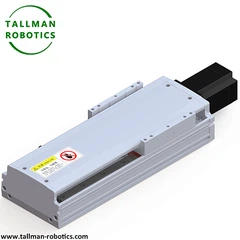


Hey there! As a supplier of Rotating Electric Grippers, I often get asked about how accurate the rotation of these nifty tools is. So, I thought I'd take a deep dive into this topic and share some insights with you all.


First off, let's talk about what a Rotating Electric Gripper is. It's a type of Electric Grippers that not only can grip objects but also rotate them. This functionality makes it super useful in various industrial applications, like assembly lines, pick - and - place operations, and more. You can check out our Rotating Electric Gripper for more details.
Accuracy in rotation is crucial for these grippers. In industrial settings, even a small deviation in rotation can lead to big problems. For example, in an assembly line where parts need to be precisely aligned, an inaccurate rotation can cause misfits, which might result in defective products or even machine breakdowns.
So, how do we measure the accuracy of a rotating electric gripper? Well, there are a few key factors to consider.
1. Angular Resolution
Angular resolution refers to the smallest angle by which the gripper can rotate. A higher angular resolution means the gripper can make more precise rotations. For instance, if a gripper has an angular resolution of 0.1 degrees, it can rotate in increments as small as 0.1 degrees. This is really important when you need to position an object with extreme precision. Our MultiFunctional Electric Gripper is designed to have a high angular resolution, which allows for very accurate rotations.
2. Repeatability
Repeatability is another vital aspect. It measures how consistently the gripper can rotate to the same angle over multiple cycles. Let's say you set the gripper to rotate 90 degrees. If it has good repeatability, it will rotate very close to 90 degrees every single time. In our experience, a high - quality rotating electric gripper should have a repeatability of within a few tenths of a degree. This ensures that the same operation can be carried out accurately over and over again, which is essential for mass production.
3. Backlash
Backlash is the amount of play or free movement in the mechanical components of the gripper. When there's backlash, the gripper might not rotate exactly as commanded. For example, if you tell the gripper to rotate clockwise, the backlash could cause a small delay or an over - or under - rotation before the actual movement starts. Minimizing backlash is a key challenge in designing a rotating electric gripper. We use advanced engineering techniques and high - quality materials to reduce backlash in our grippers, thus improving the overall rotation accuracy.
4. Control System
The control system of the gripper also plays a huge role in rotation accuracy. A good control system can precisely calculate the required rotation angle and send accurate signals to the motor. Our grippers are equipped with state - of - the - art control systems that use advanced algorithms to ensure accurate rotation. These systems can also compensate for any minor errors that might occur during the rotation process.
Now, let's talk about some real - world applications and how rotation accuracy matters in them.
In the automotive industry, rotating electric grippers are used for tasks like installing engine components. The components need to be rotated to the exact right angle for proper installation. If the rotation is inaccurate, it can lead to issues like poor engine performance or even safety hazards.
In the electronics industry, where components are getting smaller and more delicate, rotation accuracy is even more critical. For example, when placing microchips on a circuit board, a small mis - rotation can cause the chip to be misaligned, resulting in a non - functional product.
So, how do we ensure that our rotating electric grippers are as accurate as possible?
We start with the design phase. Our engineers use the latest CAD (Computer - Aided Design) software to design the grippers with precision in mind. They carefully select the materials and components to minimize any factors that could affect rotation accuracy, such as backlash and friction.
During the manufacturing process, we have strict quality control measures in place. Every gripper goes through a series of tests to ensure that it meets our high standards for angular resolution, repeatability, and other accuracy - related parameters.
We also offer continuous support and maintenance services. If you encounter any issues with the rotation accuracy of our grippers, our technical team is always ready to help. We can provide software updates, calibration services, and other solutions to keep your grippers performing at their best.
If you're in the market for a rotating electric gripper, you need to consider the accuracy of the rotation. A high - accuracy gripper might cost a bit more upfront, but it can save you a lot of money in the long run by reducing product defects and increasing productivity.
If you're interested in learning more about our Rotating Electric Grippers or have any questions about rotation accuracy, don't hesitate to reach out. We're always happy to have a chat and discuss how our products can meet your specific needs. Whether you're a small - scale manufacturer or a large industrial enterprise, we have the right solution for you. So, let's start a conversation and see how we can work together to improve your operations.
References
- Industrial Robotics Handbook: Covers general principles of robotics and end - effectors.
- Journal of Manufacturing Technology: Contains research on the accuracy and performance of robotic grippers.


