




What Is a Chain Drive Circular Conveyor
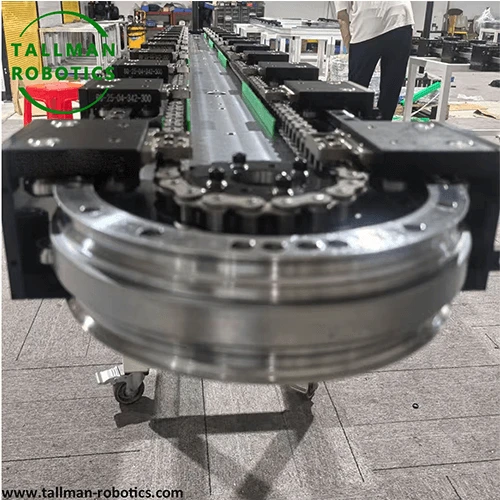
A chain drive circular conveyor moves parts and containers along a closed loop track using a driven roller chain instead of a belt or a roller bed. The chain wraps around a set of sprockets mounted at fixed points on the frame, and it pulls carriers or slats around a circular or oval path at a controlled pace.
Plants running high-mix beverage or confectionery lines often pick this format when a straight-line return conveyor would eat too much floor space. A drive chain gives positive tooth-to-roller engagement rather than friction contact. Slip stays low even under a fully loaded carrier array, and multiple stations stay in step around a curve at one steady pace. That combination of curved layout, sustained load, and washdown tolerance is where a chain drive circular conveyor earns its place over belt-driven alternatives.
Core Structural Components of Chain Drive Circular Conveyor
Six parts form the working loop of a chain drive circular conveyor. The drive chain carries every carrier attachment around the track. A sprocket set meshes with the chain at the drive station and at each idler point. The curve rail supports the chain through every bend and keeps the load path smooth, while a wear plate lines the rail surface and absorbs contact friction from the chain rollers. A chain tensioner keeps the loop taut and removes slack from the return run. Last, the drive motor supplies rotary torque to the main sprocket shaft.
Plant teams that treat these six parts as one matched system, rather than sizing each part in isolation, get more consistent results over the conveyor's service life. A chain sized correctly to an undersized sprocket, for example, still wears faster than a properly matched pair.
Here In this page, we introduce Chain Drive Circular Conveyor Lines, you will see pictures,videos of test as follows:
|
Chain Drive Circular Conveyor |
|
|
|


Also You are welcome to watch more projects or visit our video gallery by Youtube: https://www.youtube.com/@tallmanrobotics
Pakcing and Delivery for Circular Conveyor Systems:


Curve Rail and Wear Plate Design of Chain Drive Circular Conveyor
The curve rail guides the chain through every turn on the circular path, and engineers shape it to match the chain pitch and roller diameter closely. A loose match lets the chain rollers ride unevenly against the rail, which raises noise and accelerates wear at the curve.
A wear plate sits along the inside face of the curve rail and takes the direct rubbing load. Hardened polymer strips and coated steel plates both serve this role, and the choice usually depends on the operating environment: polymer plates run quieter in dry indoor cells, while coated steel holds up better under repeated washdown. Because the wear plate is a separate, replaceable component, plant teams can swap it out without pulling the full curve rail assembly, which keeps unplanned downtime shorter during maintenance.
Curve geometry also matters here. A sharper curve radius concentrates more chain tension at that section of the loop, so engineers typically widen the wear plate contact area at tight bends to spread the added load across more surface.
Chain Tensioning and Catenary Control
Chain tension control keeps the loop stable across changing load conditions. A chain tensioner applies steady force to the slack side of the loop, removing catenary sag and keeping the chain rollers seated on the rail.
Two tensioner types cover most applications. Spring-loaded tensioners adjust automatically as the chain stretches over its service life, which suits lines running continuous shifts with limited maintenance windows. Screw-type tensioners hold a fixed setting instead and suit lines with steady, predictable loads where manual periodic adjustment is acceptable.
Both extremes carry a cost. Excess slack lets the chain jump teeth on the sprocket under a sudden load change, while excess tension raises bearing load at every idler point and shortens component life well before the chain itself wears out. Getting the setting right means matching tensioner type to chain weight, loop length, and load profile together, not selecting a tensioner off a catalog default.
Sprocket Engagement and Chain Pitch
The sprocket transfers torque from the drive motor into the chain loop. Chain pitch, the distance between roller centers, sets the tooth spacing on every sprocket in the system. Common roller chain designations such as ANSI 60 (19.05 mm pitch) and ANSI 80 (25.4 mm pitch), or their ISO 606 equivalents (12B and 16B), cover most light- to medium-duty circular conveyor applications; heavier carrier loads typically move to ANSI 100 or larger.
A correct pitch match spreads load evenly across several teeth instead of concentrating stress on one tooth-and-roller pair. Wrap angle at the drive sprocket plays a similar role: a wider wrap keeps more teeth engaged at once, which improves torque transfer and reduces the chance of slip under peak load. Idler sprockets carry no drive torque, but engineers still size them to the same pitch as the drive sprocket. A pitch mismatch anywhere in the loop shows up quickly as uneven wear and audible noise at the mesh point.
Multi-Strand Chain and Load Distribution
Heavier carriers or long carrier arrays push single-strand chain past its practical load range. A multi-strand chain spreads that load across two or three parallel rows instead, so peak stress on any single chain drops even as total carrier weight rises.
This arrangement does more than add capacity. Multi-strand chain resists carrier tipping on wide platforms, and matched-tooth sprockets keep every strand synchronized so carriers stay level rather than twisting along the track. Selecting strand count comes down to two factors working together: carrier weight and platform width. A single-strand chain remains the right choice for light-duty product handling on tight-radius layouts, where the added mass and cost of extra strands would work against the design rather than for it.
Drive Motor and Speed Synchronization
The drive motor sets the pace for the entire loop. Most installations pair the motor with a gearmotor reduction stage, which delivers steady torque at low output speed rather than relying on the motor's raw shaft speed. That torque turns the main sprocket shaft and pulls the full chain loop forward at a consistent rate.
Encoder feedback on the drive shaft becomes important wherever the conveyor interfaces with other automated equipment. A robot arm reading carrier position for a pick-and-place operation, for instance, depends on repeatable speed control through both curves and straight runs. Without that synchronization, product orientation on open carriers can drift enough to throw off downstream vision or gripping systems. The drive motor and sprocket set, in this sense, function as one matched torque path rather than as independent components selected separately.
Lubrication and Chain Elongation Management
Chain elongation builds up gradually as the pins and bushings inside each link wear against one another under repeated load cycles. Left unmanaged, this wear eventually lets the chain ride high on the sprocket teeth, which raises noise and accelerates wear on both parts at once.
Two lubrication approaches address this differently. A central lubrication system delivers oil to the chain at fixed intervals along the loop, which works well in dry, enclosed environments. Dry-running chain designs with self-lubricating bushings suit food-grade or washdown environments instead, where standing oil would create contamination risk. Whichever approach a plant uses, tracking elongation against the sprocket manufacturer's tooth tolerance and replacing the chain before that limit is reached protects the rest of the drivetrain from accelerated wear.
Typical Industrial Applications of Chain Drive Circular Conveyor
Carbonated beverage lines route bottles or cans through filling, capping, and inspection stations on a chain drive circular conveyor because the format returns product to the start point without a long straight run back through the plant floor. Confectionery and snack food lines use the same layout principle to move trays through wrapping and packing cells in a continuous loop.
Frozen food and meat processing plants lean on this drivetrain for a different reason: washdown tolerance. A corrosion-resistant chain paired with a durable wear plate holds up under daily cleaning cycles that would degrade a friction-driven belt system faster. Pharmaceutical and medical device manufacturers apply the same underlying mechanics at a smaller physical scale, running tablet inspection or capsule sorting cells where carrier spacing accuracy matters as much as throughput.
Across every one of these settings, the drive chain, sprocket set, curve rail, and chain tensioner still work as one system. Engineers size each part against the full loop and the specific duty cycle, not against a generic conveyor spec sheet.
Chain Drive vs. Belt Driven Circular Conveyor
Plant engineers weighing a chain drive circular conveyor against a belt driven circular conveyor are really comparing two different engagement mechanisms, not just two conveyor styles. The table below lines up both drivetrains against the factors that typically decide the choice.
|
Attribute |
Chain Drive Circular Conveyor |
Belt Driven Circular Conveyor |
|
Drive engagement |
Positive tooth-to-roller mesh at the sprocket |
Friction contact between belt and pulley |
|
Load capacity |
Suited to heavy carriers and long carrier arrays |
Suited to light and medium product loads |
|
Curve handling |
Curve rail and wear plate guide the chain through bends |
Idler pulleys guide the belt through curves |
|
Tension management |
Chain tensioner controls catenary sag directly |
Tensioning unit maintains belt wrap grip |
|
Wash-down duty |
Wear plate and corrosion-resistant chain support frequent cleaning |
Belt material selection governs wash-down tolerance |
|
Typical fit |
Beverage, meat processing, frozen food, heavy accumulation lines |
Electronics, light packaging, low-noise indoor lines |
Configuration Reference
The table below summarizes the six drivetrain elements covered above alongside common chain pitch and standard references engineers use during selection. Roller chain sizing generally follows ANSI B29.1M or the equivalent ISO 606 standard; sprocket tooth counts and wrap angle are then set to match the selected chain.
Related reading: for lighter, friction-driven applications, see our Belt Driven Circular Conveyor page; for curved layouts requiring directional changes rather than a closed loop, see Curve Circular Belt Conveyor.
|
Drivetrain Element |
Function |
Design Consideration |
|
Drive chain |
Carries carrier attachments around the closed loop |
Chain pitch and roller diameter set overall load path |
|
Sprocket set |
Meshes with the chain at drive and idler points |
Tooth pitch must match chain pitch across the full loop |
|
Curve rail |
Guides the chain through every bend on the circular path |
Rail radius shaped to chain pitch for seated rollers |
|
Wear plate |
Absorbs rubbing contact between chain and rail |
Replaceable independent of the curve rail structure |
|
Chain tensioner |
Removes catenary slack from the return run |
Spring-loaded or screw-type, selected by load profile |
|
Drive motor / gearmotor |
Supplies rotary torque to the main sprocket shaft |
Paired with encoder feedback for synchronized operation |
|
TallMan Robotics Chain Drive Circular Conveyor |
Integrates all six elements above into one matched drivetrain assembly |
Multi-strand chain options and food-grade wear plate materials available |
Frequently Asked Questions
What makes a chain drive circular conveyor different from a belt driven circular conveyor?
A chain drive circular conveyor uses a driven chain and a sprocket set instead of a friction-driven belt. The chain gives positive tooth engagement, so it holds heavier loads around a curve without slip. A belt driven system relies on pulley friction and suits lighter, cleaner-running applications instead.
How does chain pitch affect sprocket selection?
Chain pitch sets the tooth spacing on every matching sprocket. Engineers select sprockets with a pitch that matches the chain exactly. A mismatch causes uneven tooth loading and shortens the life of both the chain and the sprocket.
How often should a plant check chain tension?
Plant teams typically check chain tension during routine preventive maintenance rounds. A chain tensioner reduces the need for manual adjustment, but operators should still confirm tensioner travel and catenary sag on a set schedule.
When does a project need a multi-strand chain instead of a single strand?
A multi-strand chain suits heavy carriers, wide platforms, or long carrier arrays. Multiple strands share the load and add resistance to carrier tipping. A single-strand chain remains suitable for lighter, narrower carrier formats.
What causes chain elongation over time?
Chain elongation results from wear between the pins and bushings inside each chain link. Regular lubrication and scheduled inspection slow this wear. Plant teams replace the chain once elongation approaches the sprocket tooth tolerance to protect the drivetrain.
Hot Tags: chain drive circular conveyor, China chain drive circular conveyor manufacturers, suppliers, factory, Circular Oval Conveyor, Belt Driven Loop Conveyor, Circular Conveyor Sections, Vertical Circular Transport Conveyor, Circular Conveyor Units, Belt Drive Circular Conveyor


