


What Is a Belt Drive Circular Conveyor
A belt drive circular conveyor moves parts and containers along a closed loop track using a continuous belt instead of a chain or a roller bed. A drive motor turns a drive pulley, and friction between the pulley face and the belt carries that rotation into forward motion around the curve.
That friction-based engagement is what sets a belt drive circular conveyor apart from a chain drive system, which relies on positive tooth-to-roller contact instead. Because the belt grips through friction rather than mechanical interlock, engineers pay close attention to pulley surface design, wrap angle, and tension whenever they size this type of conveyor. Get those three factors right, and the belt drive circular conveyor runs quietly and holds its speed even as carrier load shifts around the loop. Get them wrong, and slip announces itself first as noise, then as belt tracking that drifts toward one edge of the curve guide rail.
What is the difference from other transmission ring conveyors?
|
Features |
Belt driven circular conveyor |
Chain driven circular conveyor |
Roller driven circular conveyor |
|
Transmission medium |
Flexible belt (rubber, PU, etc.) |
Metal chain (roller chain, plate chain, etc.) |
Multiple independent rollers (linked by motors or chains) |
|
Type of Material Conveyed |
Light, medium, small, fragile or clean materials |
Heavy, block or high-temperature materials |
Medium, regular shaped goods (such as cardboard boxes, pallets) |
|
Noise level |
Low (low friction noise) |
High (chain and gear meshing noise) |
Medium (drum rotation and material friction noise) |
|
Cleanliness |
High (no lubrication pollution, easy to clean) |
Low (requires lubrication, prone to dust accumulation) |
Medium (gaps are prone to material accumulation, requiring regular cleaning) |
|
Maintenance difficulty |
Simple (belt replacement is easy, no lubrication required) |
More complex (requires regular lubrication and adjustment of chain tension) |
Medium (drum bearings require regular maintenance) |
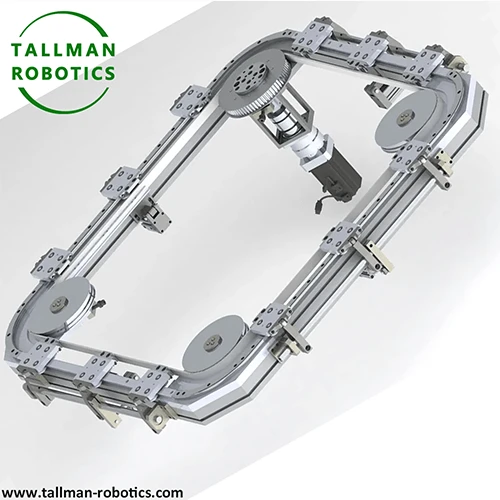
Here In this page, we introduce series Belt Drive Circular Conveyor Lines, you will see production pictures,videos of test as follows:
|
Belt Drive Circular Conveyor |
|
|
|


Also You are welcome to watch more projects or visit our video gallery by Youtube: https://www.youtube.com/@tallmanrobotics
Packing and Delivery for Circular Conveyor Systems:


Core Structural Components
A belt drive circular conveyor combines a handful of core parts into one continuous loop. The drive pulley sits at the point where the drive motor injects torque into the system, while idler pulleys support and redirect the belt at every other point around the track. Pulley lagging, a rubber or polyurethane covering bonded to the drive pulley face, raises the coefficient of friction between pulley and belt so torque transfers without slip.
A curve guide rail runs along the inside and outside edges of the loop, keeping the belt centered as it moves through the bend. A belt tensioner applies steady pull to the return side of the loop, and the belt itself, joined by a splice at one point in the loop, forms the continuous surface that carries product. Each part depends on the others. A well-lagged pulley still slips if belt tension runs low, and a properly tensioned belt still drifts off center if the curve guide rail is out of alignment.
Drive Pulley Design and Wrap Angle
Torque transfer at the drive pulley depends on two things working together: pulley lagging and wrap angle. Lagging material choice sets the base friction coefficient. Rubber lagging against a rubber-backed belt typically runs in the 0.35 to 0.4 coefficient-of-friction range under dry conditions. Diamond-grooved rubber lagging trades away some of that peak grip - often settling closer to 0.25 to 0.3 - in exchange for channels that clear moisture in wet or washdown environments, where a smooth lagging surface would otherwise lose traction. Smooth rubber or urethane lagging suits dry indoor operation instead, and runs quieter against a smooth belt back.
Wrap angle, the portion of the pulley circumference the belt actually contacts, matters just as much as the lagging material itself. A single drive pulley typically holds the belt across roughly 180 degrees of wrap. A shallow wrap angle limits how much torque the drive pulley can transfer before the belt starts to slip, regardless of how good the lagging is. Engineers increase effective wrap by adding a snub pulley just before the drive pulley, which pulls the belt into deeper contact with the drive face - usually pushing the contact arc out to somewhere in the 210 to 230 degree range. This snub-and-drive pairing shows up often on belt drive circular conveyor lines that carry heavier carrier loads around a tight curve. A single drive pulley alone would not hold enough torque there without slipping.
Curve Guide Rail and Belt Edge Support
A curve guide rail does more than keep the belt from wandering off the frame. Along the curved section of a belt drive circular conveyor, the belt naturally wants to travel in a straight line, and the guide rail is what continuously redirects it into the curve. Rail material and profile shape both affect how smoothly this redirection happens.
Formed steel channels handle heavy carrier loads and abrasive environments, while extruded aluminum channels run lighter and suit cleaner indoor cells. The rail profile itself typically includes a low-friction wear strip along the contact face, separate from the structural channel. That separation matters in the field: edge wear becomes a simple strip replacement rather than a full rail swap. Curve radius also plays into rail design directly. A tighter radius increases the lateral force pushing the belt against the rail, so tighter curves generally call for a wider or reinforced wear strip to spread that added load.
Belt Construction and Material Selection
Belt construction on a circular conveyor has to balance two competing needs: enough flexibility to bend around the curve without cracking, and enough stiffness to hold its shape under load. Fabric-reinforced belts use woven polyester or nylon plies bonded into a rubber or PVC cover, giving predictable strength along the belt length. Monolithic thermoplastic belts, often polyurethane, skip the fabric ply entirely and rely on the base material itself for both strength and flexibility.
Modular plastic belting takes a different approach, building the belt from interlocking hinged sections rather than a continuous sheet. This construction handles tight curve radii well, since each module pivots independently instead of stretching the way a continuous belt must. Plant teams weigh curve tightness, washdown exposure, and carrier weight together when choosing between these options.
Belt Tensioning and Elongation Behavior
Belt tension keeps the loop seated against the drive pulley and every idler pulley around the track. Unlike a chain, which elongates through metal wear at the pins and bushings, a belt stretches differently: it creeps slowly, extending under sustained load as the belt material itself gives way over time. This elongation builds up gradually. The belt tensioner needs enough travel range to take up slack over months of continuous operation, not just at initial installation.
Screw-type tensioners work well for belts with predictable, slow elongation rates, giving a fixed adjustment point that plant staff can reset periodically. Spring-loaded or pneumatic tensioners take up slack automatically instead, which suits lines where elongation happens faster or less predictably. Either way, correct tension keeps wrap angle at the drive pulley consistent. A loose belt effectively reduces that wrap angle by lifting away from the pulley face under load - cutting torque transfer exactly when the conveyor needs it most.
Belt Splice Design
Every continuous belt needs a splice where the two ends join into a closed loop, and splice type affects both belt strength and how smoothly the belt runs through the drive pulley and every curve. A finger splice interlocks tapered fingers from each belt end and bonds them under heat and pressure, producing a joint nearly as strong as the belt body itself. This splice type suits belts under continuous heavy load, where a weaker joint would become the failure point long before the belt material does.
Mechanical fasteners join belt ends with metal or plastic clips instead, trading some joint strength for a splice that plant teams can open and reclose without specialized bonding equipment. This approach suits lines needing fast belt replacement, since a fastened splice takes far less downtime than a heat-bonded finger splice. Splice strength versus serviceability generally guides which type an engineer specifies.
Drive Motor and Speed Zoning
The drive motor sets the pace for a belt drive circular conveyor much as it does for a chain-driven system. But the friction-based connection at the drive pulley adds one more variable: available torque has a ceiling set by lagging friction and wrap angle, not just by motor size. Oversizing the motor without addressing pulley grip just moves the failure point from the motor to the belt-pulley interface.
Longer circular conveyor loops sometimes use more than one drive pulley, each handling a section of the loop instead of pulling the full belt length from a single point. This multi-drive approach reduces peak tension in the loop and allows independent speed zones for accumulation sections. Encoder feedback at each drive point keeps these zones synchronized, so carriers move at a consistent pace across the transition between drive sections.
Typical Industrial Applications
Food processing and packaging cells are the most common home for a belt drive circular conveyor, and the reason comes down to noise: a friction drive skips the mechanical clatter that a chain-and-sprocket system carries into a wrapping or inspection line. Bakery, snack, and confectionery packers route trays and cartons through these loops precisely because the belt surface won't mark or dent delicate product the way a hard roller bed can.
Move into electronics and light assembly, and the priority shifts slightly. Noise reduction still matters, but so does keeping the drivetrain compact enough to sit close to a workstation where an operator or a robot reaches directly onto the belt. Pharmaceutical packaging borrows the same drivetrain logic at a smaller footprint, threading cartons through labeling and inspection loops where a speed hiccup means a rejected batch rather than just a cosmetic flaw.
Across these three verticals, belt speeds typically sit in the 0.1 to 1.0 m/s range (roughly 20 to 200 ft/min) - slow enough for gentle product handling, fast enough that the conveyor doesn't become the bottleneck on the line.
None of the six elements above works in isolation. A pulley only delivers its full torque rating when tension and wrap angle are both dialed in, and a wear strip only earns its keep if the guide rail alignment behind it is correct. Specifying a belt drive circular conveyor is less about picking parts off a list and more about getting that whole chain of dependencies right at once.
Belt Drive vs. Chain Drive Circular Conveyor
Plant engineers weighing a belt drive circular conveyor against a chain drive circular conveyor are really comparing two different torque-transfer mechanisms. The table below lines up both drivetrains against the factors that typically decide the choice.
|
Attribute |
Belt Drive Circular Conveyor |
Chain Drive Circular Conveyor |
|
Drive engagement |
Friction contact between drive pulley and belt |
Positive tooth-to-roller mesh at the sprocket |
|
Load capacity |
Suited to light and medium product loads |
Suited to heavy carriers and long carrier arrays |
|
Curve handling |
Curve guide rail keeps the belt centered through bends |
Curve rail and wear plate guide the chain through bends |
|
Tension management |
Belt tensioner maintains pulley wrap grip |
Chain tensioner controls catenary sag directly |
|
Noise and vibration |
Quiet friction drive suits sensitive product handling |
Positive engagement runs louder under heavy load |
|
Typical fit |
Food packaging, electronics, light assembly, pharma lines |
Beverage, meat processing, frozen food, heavy accumulation lines |
Configuration Reference
The table below summarizes the core drivetrain elements covered above. Belt selection generally follows manufacturer strength ratings and CEMA or DIN 22101 design guidance for pulley sizing and belt tension, while pulley lagging and wrap angle are set to match the selected belt and carrier load.
Related reading: for heavier, positive-engagement applications, see our Chain Drive Circular Conveyor page; for curved layouts requiring frequent directional changes, see Curve Circular Belt Conveyor; for TallMan's modular round belt and timing belt product line, see Timing and Round Belt Conveyors.
|
Drivetrain Element |
Function |
Design Consideration |
|
Drive pulley |
Injects motor torque into the belt through friction contact |
Lagging material and wrap angle set available torque |
|
Idler pulley |
Supports and redirects the belt around the loop |
Alignment governs belt tracking through the curve |
|
Pulley lagging |
Raises the friction coefficient at the drive pulley face |
Diamond-groove for washdown duty, smooth for dry indoor use |
|
Curve guide rail |
Keeps the belt centered through every bend |
Wear strip width scales with curve tightness |
|
Belt tensioner |
Maintains wrap grip and takes up belt elongation |
Screw-type for steady loads, spring or pneumatic for variable duty |
|
Drive motor / gearmotor |
Supplies rotary torque to the drive pulley shaft |
Torque ceiling set by lagging friction and wrap angle, not motor size alone |
|
TallMan Robotics Belt Drive Circular Conveyor |
Integrates all six elements above into one matched drivetrain assembly |
TallMan's friction-driven round belt line runs solid-cross-section PU belts over grooved drive and idler wheels, rated up to 50 kg per carrier, for food, pharmaceutical, and light-part handling where quiet operation and easy sanitization matter |
Frequently Asked Questions
What makes a belt drive circular conveyor different from a chain drive circular conveyor?
A belt drive circular conveyor transfers torque through friction between the drive pulley and the belt, while a chain drive relies on positive tooth-to-roller engagement instead. The belt system runs quieter and handles lighter to medium loads well, while the chain system holds heavier carriers without slip.
How does pulley lagging affect performance?
Pulley lagging raises the coefficient of friction between the drive pulley and the belt. Diamond-grooved lagging works best in wet or washdown environments, while smooth lagging suits dry, quiet indoor operation.
When does a belt drive circular conveyor need more than one drive pulley?
Longer loops or heavier carrier loads sometimes exceed what a single drive pulley can transfer without slipping. Adding a second drive point reduces peak belt tension and supports independent speed zones along the loop.
What causes a belt to lose tension over time?
Belt tension drops gradually as the belt material creeps under sustained load, unlike a chain, which elongates through metal wear at the pins. A belt tensioner with enough travel range takes up this slack automatically or through periodic adjustment.
Which belt splice type suits heavy continuous loads?
A finger splice, bonded under heat and pressure, produces a joint nearly as strong as the belt body and suits continuous heavy-load applications. Mechanical fasteners trade some strength for faster field serviceability instead.
Hot Tags: belt drive circular conveyor, China belt drive circular conveyor manufacturers, suppliers, factory, Circular Oval Conveyor, Belt Driven Loop Conveyor, Circular Conveyor Sections, Vertical Circular Transport Conveyor, Circular Conveyor Units, Belt Drive Circular Conveyor


