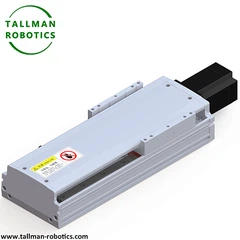
Linear Leadscrew Actuator is a fundamental electromechanical device that converts rotational motion into linear motion through a screw pair. Its core relies on the contact between the screw and nut to achieve displacement control. Unlike ball screws, its nut and screw are directly transmitted through sliding friction, with a simple structure and low cost, suitable for linear motion scenarios that do not require extremely high accuracy and speed but focus on economy.
Linear Leadscrew Actuator is a classic driving device that utilizes the mechanical meshing principle of screw and nut to efficiently convert rotational motion into precise linear motion. It has a sturdy structure, mature technology, and strong load-bearing capacity. It is the foundation and key automation component for achieving heavy load and high thrust linear positioning. It plays an indispensable role in industrial machinery, medical equipment, aerospace, and even home life.
Linear Leadscrew Actuator core working principle is based on the ancient inclined plane principle. When a motor (such as a servo motor, stepper motor, or even manual) drives the screw to rotate, the nut that matches it cannot rotate due to mechanical limitations, and is forced to move in a straight line along the axis of the screw.
According to the different friction modes and performance, Linear Leadscrew Actuator can be mainly divided into two types:
1). Sliding screw actuator: The most common is the trapezoidal screw actuator. The nut is usually made of engineering plastic, bronze, or metal, and directly experiences sliding friction with the metal screw thread. Its biggest advantage lies in its low cost, simple structure, and natural self-locking properties (i.e. when the screw stops rotating, the load cannot reverse the rotation of the screw, without the need for additional brakes). However, sliding friction also leads to lower transmission efficiency (usually only 20% -50%), slower operating speed, easy wear, and the formation of backlash after long-term use, which affects the accuracy of repeated positioning. It is very suitable for low to medium load applications that do not require high speed and accuracy, but emphasize cost, self-locking, and thrust.
2). Ball screw actuator: This is a high-performance evolved form. It adds a recyclable ball between the threaded raceway of the screw and nut, turning sliding friction into rolling friction. This brings significant advantages such as high transmission efficiency (>90%), high positioning accuracy, faster operating speed, and longer lifespan. But its manufacturing cost is high and it usually does not have self-locking properties, requiring closed-loop control of the motor to maintain position. It is the core component of high-end equipment such as CNC machine tools, industrial robots, and precision platforms.
You are welcome to watch more projects or visit our video gallery by Youtube: https://www.youtube.com/@tallmanrobotics
Here, we introduce Linear Leadscrew Actuator by Fully Sealed Screw drive linear Modules for Clean Environment from Tallman Robot,with following series TMS-CR.


Hot Tags: linear leadscrew actuator, China linear leadscrew actuator manufacturers, suppliers, factory, Automated Linear System, Linear Guide Actuator, Linear Indexing Table, Linear Motion Table, Mechanical Stage, Precision Positioning


