
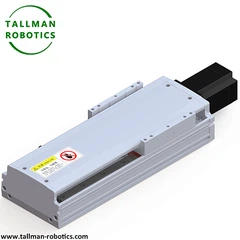


What Is a Screw Driven Modular Linear Actuator?
A screw driven modular linear actuator converts rotary motion into linear motion along a single axis. The unit pairs a ball screw or a lead screw with a linear guide rail inside one compact aluminum housing. Manufacturers build this linear actuator as a self-contained module. As a result, integration teams mount it directly onto a machine frame without custom brackets. A screw driven modular linear actuator holds position without external braking. The screw thread resists back-driving forces under load, unlike many belt-driven linear stages. For this reason, engineers select a screw driven modular linear actuator for vertical lift axes and clamping stations. This linear motion module also delivers repeatable precision positioning across thousands of duty cycles. Overall, the design supports both light-duty pick tasks and heavy press-fit operations within the same platform family.
Core Structural Components
Every screw driven modular linear actuator shares four core components. First, the ball screw or lead screw carries the rotary input from a servo motor or stepper motor. Second, a recirculating ball nut rides along the screw and converts rotation into straight-line travel. Third, a linear guide rail supports the moving carriage and manages side loads and moment loads. Fourth, an extruded aluminum housing protects the internal drive train from dust and debris.
The recirculating ball nut deserves special attention. Ball bearings inside the nut circulate through a return channel, so friction stays low across the full stroke. Consequently, this linear motion module reaches higher speeds than a plain lead screw design. However, a lead screw variant costs less to manufacture and still meets many positioning tasks. Therefore, TallMan Robotics offers both drive options within one modular linear actuator platform. Engineers then match the drive type to the load, speed, and duty-cycle requirements of each application.
What are the Basic Specification of Screw Driven Modular Linear Actuator from TallMan Roobics ?
|
Model No |
Max Payload(kgs) |
Max Stroke (mm) |
Repeatability (mm) |
Drive Solution |
Motor Power (W) |
|
TMS30 |
4 |
400 |
±0.01/±0.005 |
screw |
30 |
|
TMS45 |
10 |
800 |
±0.01/±0.005 |
screw |
50/100 |
|
TMB45 |
4 |
800 |
±0.04 |
belt |
50/100 |
|
TMS62 |
20 |
1050 |
±0.01/±0.005 |
screw |
100/200/400 |
|
TMB62 |
16 |
2000 |
±0.04 |
belt |
100/200/400 |
|
TMS65 |
30 |
800 |
±0.01/±0.005 |
screw |
50/100 |
|
TMB65 |
4 |
800 |
±0.04 |
belt |
50/100 |
|
TMS85 |
50 |
1050 |
±0.01/±0.005 |
screw |
100/200/400 |
|
TMB85 |
16 |
2000 |
±0.04 |
belt |
100/200/400 |
|
TMS100 |
65 |
1050 |
±0.01/±0.005 |
screw |
100/200/400 |
|
TMB100 |
40 |
3500 |
±0.04 |
belt |
100/200/400 |
|
TMS135 |
110 |
1250 |
±0.01/±0.005 |
screw |
200/400/750 |
|
TMB135 |
42 |
3500 |
±0.04 |
belt |
200/400 |
|
TMS150 |
120 |
1500 |
±0.01/±0.005 |
screw |
400/750 |
|
TMB150 |
75 |
3500 |
±0.04 |
belt |
400/750 |
|
TMS170 |
130 |
1500 |
±0.01/±0.005 |
screw |
400/750 |
|
TMB170 |
75 |
3500 |
±0.04 |
belt |
400/750 |
|
TMS220 |
150 |
1500 |
±0.01/±0.005 |
screw |
750 |
|
TMB220 |
75 |
3500 |
±0.04 |
belt |
750 |
You are welcome to watch more projects or visit our video gallery by Youtube: https://www.youtube.com/@tallmanrobotics


Drive Mechanism and Motion Conversion
The motor shaft connects to the screw through a coupling or a synchronous belt reduction. When the motor turns, the screw rotates inside fixed end bearings. Meanwhile, the recirculating ball nut travels along the screw thread and carries the load table with it. This motion conversion happens with minimal backlash, so the actuator achieves tight precision positioning down to a few microns per step. In addition, the linear guide rail keeps the carriage aligned along the travel axis. Consequently, the actuator resists twisting under off-center loads. A servo motor with an encoder closes the position loop and confirms each move. As a result, a motorized linear stage built on this platform supports both point-to-point moves and continuous path motion.
Technical Comparison
The table below compares the two common drive types within a screw driven modular linear actuator family.
|
Parameter |
Ball Screw Drive |
Lead Screw Drive |
|
Positioning accuracy |
High, suited for precision positioning tasks |
Moderate, suited for general assembly |
|
Efficiency |
High, due to rolling contact |
Lower, due to sliding contact |
|
Load capacity |
High axial and moment load support |
Moderate load support |
|
Speed range |
Wide range for fast cycle applications |
Narrower range for slower cycles |
|
Self-locking behavior |
Requires a brake for vertical holding in some cases |
Naturally self-locking under most loads |
|
Typical use case |
Robotics, semiconductor handling, packaging |
Clamping, light positioning, adjustment axes |
|
Maintenance need |
Periodic lubrication of the ball nut |
Minimal lubrication, simpler upkeep |
Engineers should review this comparison before final drive selection. A ball screw variant handles fast, repetitive cycles. A lead screw variant handles slower, self-locking axes instead.
Selection Considerations
Selecting the right screw driven modular linear actuator starts with the load profile. First, engineers should calculate the axial load and any moment load on the carriage. Next, they should confirm the required stroke length and mounting orientation. Then, teams should compare screw lead options. A shorter lead raises precision positioning resolution. In addition, a longer lead raises travel speed for the same motor RPM.
Duty cycle matters as well. For continuous, high-cycle industrial automation lines, a ball screw drive with a recirculating ball nut typically outperforms a lead screw drive. For occasional adjustment axes, a lead screw drive often meets the requirement at a simpler build. Environmental conditions also shape the choice. In washdown or dusty settings, a sealed housing and bellows cover protect the linear guide rail and screw assembly. Finally, motor sizing should account for peak load rather than average load. This approach keeps the motorized linear stage within its torque margin during acceleration and deceleration phases.
Application Areas
A screw driven modular linear actuator serves many industrial automation tasks. In semiconductor manufacturing, this linear motion module positions wafer handling arms with sub-micron precision positioning. In food and beverage lines, a sealed actuator variant drives portioning heads and case-packing arms. In medical device assembly, a motorized linear stage moves dispensing needles and inspection cameras along fixed paths. In automotive plants, the actuator drives welding fixtures and clamping arms across the body-in-white line. In new energy production, the same platform positions battery cell stacking tools and module alignment jigs. In general packaging operations, the modular linear actuator drives case erectors and pick-and-place heads. Across each vertical, the screw driven modular linear actuator adapts through stroke length, screw lead, and mounting orientation changes rather than a full redesign.
Installation Guidelines
Correct installation extends the service life of any screw driven modular linear actuator. First, technicians should mount the housing on a flat, rigid surface to prevent frame twist. Next, they should align the actuator axis with the intended load path before tightening fasteners. Then, installers connect the motor coupling and check shaft runout with a dial indicator. After that, the team should route cables through a drag chain to protect wiring during travel. Meanwhile, the linear guide rail requires a light film of lubricant before first operation. Subsequently, operators should run a slow-speed homing cycle to confirm limit switch placement. Finally, the team should verify load alignment. An off-center load shortens ball nut life otherwise. Once these steps are complete, the motorized linear stage is ready for full-speed production cycles.
Frequently Asked Questions
Q: What is the difference between a screw driven modular linear actuator and a belt-driven actuator?
A screw driven modular linear actuator uses a ball screw or lead screw for motion conversion, so it holds position without a separate brake. A belt-driven actuator moves faster over long strokes, but it needs a brake or counterweight for vertical holding.
Q: Which drive type suits high-speed pick-and-place tasks?
A ball screw drive suits high-speed, repetitive tasks, because the recirculating ball nut keeps friction low across the stroke. Teams place this linear motion module into pick-and-place cells and inspection stations often.
Q: How does a linear guide rail affect actuator performance?
The linear guide rail carries side loads and moment loads away from the screw. Consequently, the screw handles pure axial force, so wear stays low and precision positioning stays consistent over time.
Q: Can one modular linear actuator platform support multiple stroke lengths?
Yes. A screw driven modular linear actuator typically shares one housing profile across a stroke range. Engineers then select the screw lead and motor size for each specific axis.
Q: What maintenance does a motorized linear stage need?
The team should inspect the recirculating ball nut and linear guide rail on a scheduled interval. Regular lubrication and periodic runout checks keep the actuator within its rated precision positioning tolerance.
Hot Tags: screw driven modular linear actuator, China screw driven modular linear actuator manufacturers, suppliers, factory, Precision Positioning, Cross Roller Stage, Linear Feed Platform, Miniature Linear Actuator, Ball Screw Driven Linear Stage, Linear Material Transfer Unit


