
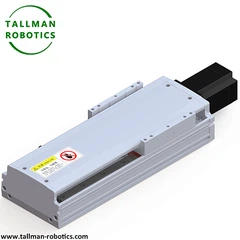


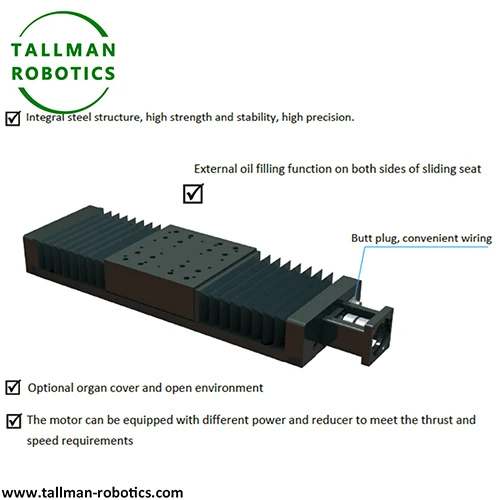


What is Heavy Duty Linear Module?
Heavy duty linear modules are high-rigidity motion units for heavy-load industrial automation scenarios. They adopt reinforced mechanical structures to bear large industrial payloads. They convert motor power into stable linear displacement for heavy equipment movement. They maintain steady motion output under mechanical impact and long cyclic operation.
Core Structural Composition
First, thickened rigid alloy frames enhance overall structural rigidity. Second, oversized load-bearing linear guides support heavy payload sliding. Third, high-strength transmission assemblies deliver stable power output. Meanwhile, reinforced fixed bases resist structural deformation. Lastly, thickened sliding carriages undertake concentrated industrial loads.

Technical Parameters of Heavy duty Screw Drive linear Modules from Tallman Robot Limited

You are welcome to watch more projects or visit our video gallery by Youtube: https://www.youtube.com/@tallmanrobotics
|
Model Number |
TMK150-CM |
TMK150-CR |
TMK200-CM |
TMK200-CR |
TMK300-CM |
TMK300-CR |
|
|
Body Width |
150mm |
150mm |
200mm |
200mm |
300mm |
300mm |
|
|
Drive solution |
Lead screw |
Lead screw |
Lead screw |
Lead screw |
Lead screw |
Lead screw |
|
|
Sealed or not |
Semi closed |
Fully closed |
Semi closed |
Fully closed |
Semi closed |
Fully closed |
|
|
Motor power |
400W |
750W |
750W |
750W |
750W |
750W |
|
|
Repeatability |
P7: ±0.01 P5: ±0.005 |
P7: ±0.01 P5: ±0.005 |
P7: ±0.01 P5: ±0.005 |
P7: ±0.01 P5: ±0.005 |
P7: ±0.01 P5: ±0.005 |
P7: ±0.01 P5: ±0.005 |
|
|
lead |
5 / 10 / 16 / 20 |
5 / 10 / 16 / 20 |
5 / 10 / 20 |
5 / 10 / 20 |
5 / 10 / 20 / 32 |
5 / 10 / 20/ 32 |
|
|
Fastest speed Motor speed 3000 (rpm) |
250 / 500 / 800 / 1000 |
250 / 500 / 800 / 1000 |
250 / 500 / 1000 |
250 / 500 / 1000 |
250 / 500 / 1000 / 1600 |
250 / 500 / 1000 / 1600 |
|
|
Max Load(kg) |
Horizontal |
120 / 58 / 35 / 27 |
120 / 58 / 35 / 27 |
280 /150 / 75 |
280 / 150 / 75 |
385/220/105/63 |
385 / 220 / 105 / 63 |
|
Vertical |
53 / 24 / 12 /- |
53 / 24 / 12 /- |
95 / 43 / 16 |
95 / 43 / 16 |
92142/13/- |
92142/13/- |
|
|
Rate Thrust (N) |
12761638 / 398/319 |
12761638/398/319 |
2100/1190/603 |
2100/1190/603 |
2100 / 1190 / 603 / 375 |
2100 / 1190 / 603 / 375 |
|
|
Effective Stroke |
0-1204 |
0-1204 |
0-1244 |
0-1244 |
0-1664 |
0-1664 |
|
|
Remark: |
If you exceed the valid itinerary, please consult the company's technical staff first. 2. Clean room rating: ISO Class 5 to 6 (100 to 1000) |
||||||


Technical Functions & Core Advantages
This module adapts high-load operation for heavy industrial equipment. Furthermore, it avoids structural distortion under long-term load pressure. It also retains stable motion accuracy in frequent impact scenarios. In addition, it supports large-stroke heavy-duty automation layouts.
|
Item |
Heavy Duty Linear Module |
Standard Linear Module |
|
Load Capacity |
Sustains concentrated heavy industrial payloads |
Only adapts light and medium load tasks |
|
Structural Rigidity |
Anti-deformation design under persistent stress |
Prone to bending under heavy load pressure |
|
Scenario Adaptability |
Fits gantry handling and heavy machining automation |
Serves precision light-load positioning scenes |
Frequently Asked Questions
Q1: What core industrial scenarios use heavy duty linear modules?
They apply to heavy gantry handling equipment, automotive component assembly, large-scale CNC auxiliary positioning and industrial palletizing automation. They serve all motion scenes with long-term heavy load bearing demands.
Q2: What structural designs support heavy-load performance?
Thickened rigid alloy frames and oversized load-bearing guides form core support. Reinforced transmission parts and anti-deformation bases eliminate structural shaking during heavy payload movement.
Q3: Can the module work stably under frequent mechanical impact?
Yes. Its optimized rigid structure resists instantaneous impact force. It keeps complete structural stability and consistent linear motion accuracy in repeated load impact cycles.
Q4: How does it differ from ordinary enhanced linear modules?
It adopts full-scale reinforced structural upgrades for persistent heavy loads. Ordinary enhanced modules only improve partial performance and cannot sustain long-term high-stress operation.
Q5: Does heavy-load design affect module motion smoothness?
No. Matched large-specification guiding and transmission parts balance load stress evenly. The module maintains smooth and jitter-free linear movement even under full load operation.
Hot Tags: heavy duty linear module, China heavy duty linear module manufacturers, suppliers, factory, Industrial Heavy Duty Linear Rail Assembly, Industrial Heavyweight Linear Motion System, High Load Linear Transmission Module, High Load Industrial Linear Slide, Industrial Heavyweight Linear Motion Module, High Capacity Linear Drive Module


