
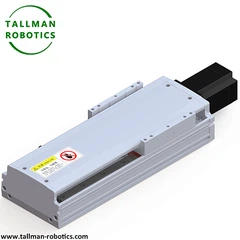


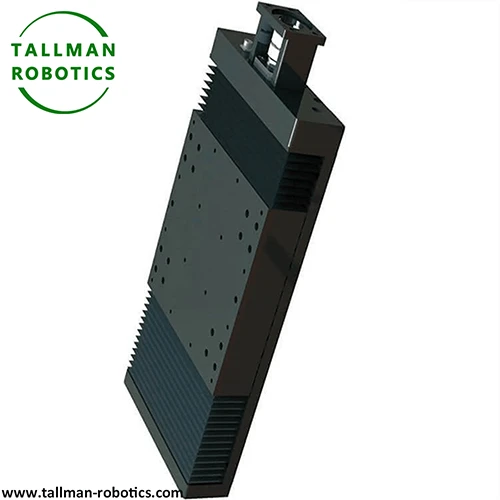

High Load Linear Module is a precision linear transmission device designed specifically to withstand heavy loads, capable of achieving stable and precise linear motion under high load conditions. It is the core component for handling linear displacement of heavy loads in industrial automation. The core feature of High Load Linear Module is to have a load-bearing capacity far exceeding that of ordinary modules (usually with rated loads ranging from hundreds of kilograms to tens of tons), while also balancing a certain degree of motion accuracy and rigidity.
The working principle of High Load Linear Module is consistent with that of ordinary linear modules, based on the "rotation linear" motion conversion mechanism: powered by a drive motor (mainly servo motor), the rotational motion is converted into linear motion through ball screws (preferred for high load scenarios) or heavy-duty synchronous belts; Guidance systems (such as heavy-duty linear guides and square guides) distribute loads through multi-point contact, ensuring the straightness of the motion trajectory while resisting overturning moments and maintaining high rigidity operation.
Structurally, high load linear modules emphasize high-strength design:
The driving unit adopts large-diameter ball screws (pitch usually ≥ 10mm) or reinforced synchronous belts, combined with high-power servo motors;
The guiding unit adopts heavy-duty guide rails (such as four column ball guides), with a larger contact area between the slider and the guide rail, and stronger load-bearing capacity;
The base is made of thick walled steel or cast iron, and some models are reinforced with ribs to enhance the overall deformation resistance;
Auxiliary components include metal dust covers and high-strength limiters, which are suitable for harsh environments such as dust and vibration.

Here, we introduce High Load Linear Module, TMK150 for general environment or dustproof or waterproof applications with data as follows:
You are welcome to watch more projects or visit our video gallery by Youtube: https://www.youtube.com/@tallmanrobotics
|
TMK150-CM Open type and TMK150-CR Closed type |
|||||||
|
Motor Power |
400/750 |
||||||
|
Repeatability |
±0.01/±0.005 |
||||||
|
Screw Lead |
5 |
10 |
16 |
20 |
|||
|
Max Speed at motor speed at 3000rpm |
250 |
500 |
800 |
1000 |
|||
|
Max Load (kgs) |
Acceleration |
Horizontal |
0.3G |
120 / 220 |
58 / 112 |
35 / 68 |
27 / 54 |
|
Deceleration |
Vertical |
0.3G |
53 / 85 |
24/47 |
12 / 30 |
- |
|
|
Rated Thrust(N) |
1276 / 2100 |
638 / 1190 |
398 / 745 |
319 / 603 |
|||
|
Linear Guide Rail |
15×12.5-2 |
||||||
|
Home Sensors |
Inside EE-SX674(NPN) EE-SX674P (PNP) |
||||||


The application scenarios of High Load Linear Module are concentrated in the field of heavy load requirements:
Heavy industry: steel billet conveying for metallurgical equipment, worktable feed for heavy-duty machine tools;
Logistics warehousing: heavy-duty stacker cranes and port container handling machinery for automated three-dimensional warehouses;
Automobile manufacturing: heavy-duty fixture translation for body welding production line;
Aerospace: Positioning adjustment of large component assembly platforms.
Compared with lightweight modules, High Load Linear Module sacrifices some speed (usually ≤ 1m/s) and lightweight characteristics in exchange for high load capacity and impact resistance, making it the core transmission component of heavy-duty automated production lines.
How to choose a High Load Linear Module that is suitable for your application scenario?
Choosing a High Load Linear Module that is suitable for the application scenario requires a comprehensive judgment based on the core parameters of the actual working conditions, environmental conditions, and long-term usage requirements. The specific steps can be analyzed as follows:
1.Clearly define the core load requirements
Load is the primary indicator for selection, and it is necessary to accurately calculate the actual force situation:
Rated load: Select a model with a rated load ≥ 1.2 times the actual total load based on the static load (such as the weight of the workpiece) and dynamic load (such as the inertia force during acceleration/deceleration) during operation (with a safety margin reserved to avoid long-term full load operation leading to lifespan degradation).
Impact load and overturning moment: If there is instantaneous impact force (such as collision during transportation) or cantilever load (such as one end of the module bearing weight), additional attention should be paid to the module's impact resistance level and overturning moment bearing capacity (refer to the moment deformation curve provided by the manufacturer). For example, the container handling of port machinery needs to focus on impact resistance, while the cantilever feeding of machine tools needs to strengthen anti overturning design.
2.Match motion parameter requirements
Filter based on the speed, acceleration, and travel requirements of the workflow:
Speed and acceleration: The speed of high load modules is usually ≤ 1m/s. If high-frequency start stop is required (such as in automated production lines), the maximum acceleration (generally ≤ 5m/s ²) needs to be confirmed to avoid wear of transmission components due to excessive inertial forces.
Travel length: Choose according to the actual movement distance, and note that for long travel (such as ≥ 3 meters) modules, the rigidity of the base should be considered to avoid deflection due to self weight; Some manufacturers of High Load Linear Module provide splicing modules that can meet the demand for ultra long false distance, but the accuracy loss at the splicing point needs to be evaluated.
3.Determine accuracy and rigidity standards
The precision requirement directly affects the selection cost, and it needs to be judged based on the application scenario:
Positioning accuracy and repeatability accuracy:
If used for precision assembly (such as aerospace component docking), it is necessary to choose a model with a positioning accuracy of ≤ 0.02mm and a repeat positioning accuracy of ≤ 0.01mm (usually paired with ball screw+servo motor closed-loop control);
If only used for heavy material handling (such as storage stacking), a positioning accuracy of ≤ 0.1mm is sufficient to meet the requirements.
Rigidity: High rigidity High Load Linear Module (such as cast iron bases and thick walled guide rails) can reduce deformation under load and are suitable for scenarios with high requirements for motion stability (such as heavy-duty machine tool feed); If the working condition is not sensitive to deformation (such as low-speed handling), a lightweight and high rigidity design (such as aluminum alloy+reinforcing ribs) can be chosen.
4.Adapt to installation and space limitations, and confirm structural compatibility based on on-site installation conditions:
Installation space: The installation dimensions of the measuring equipment are limited (length, width, height), and the corresponding module size is selected (such as compact design suitable for small spaces, standard design suitable for open layout).
Installation direction: When installing horizontally, attention should be paid to the uniformity of the slider's load-bearing capacity; Vertical installation (such as lifting heavy objects) requires additional braking devices (to prevent power outages and falls); The lateral load bearing capacity of the guide rail needs to be confirmed for inclined installation.
Interface compatibility: Ensure that the motor interface (such as servo motor power, communication protocol) and sensor interface (such as limit switch, encoder) of the module match the existing control system to avoid additional modification costs.
5.Assess environmental adaptability
Environmental factors directly affect the lifespan of modules and require targeted screening of environmental conditions
Scenarios with high levels of dust/oil pollution (such as metallurgy and mechanical processing): Choose a model with fully enclosed dust cover (metal material) and anti pollution design with guide rail grease;
Wet/corrosive environment (such as food processing, chemical industry): choose stainless steel material guide rail+anti-corrosion coating base;
High temperature environment (such as casting workshop): It is necessary to confirm the upper limit of temperature resistance of the motor and guide rail (usually ≥ 80 ℃, special models can reach 150 ℃).
6.Balancing costs and maintenance needs
Initial cost: The price of High Load Linear Module increases with load, precision, and material (such as cast iron+ball screw models being 30% -50% more expensive than aluminum alloy+synchronous belts), and the budget needs to be controlled under the premise of meeting performance requirements.
Long term maintenance: If the application scenario is difficult to frequently shut down (such as a production line), priority should be given to maintenance free guide rails (such as self-lubricating sliders) and long-life lead screws (such as hardened lead screws, with a lifespan of over 10000 hours).
When selecting, the priority can be gradually screened according to "load → motion parameters → accuracy → environment → cost". If necessary, provide operating parameters (such as load size, motion cycle, environmental photos) and communicate with the manufacturer's technical team to verify adaptability through simulation testing or sample testing, in order to avoid equipment failure caused by parameter misjudgment.
Hot Tags: high load linear module, China high load linear module manufacturers, suppliers, factory, Industrial Heavyweight Linear Motion Module, Heavy Load Linear Guide Module, High Capacity Linear Guide Rail Unit, High Load Industrial Linear Rail Module


