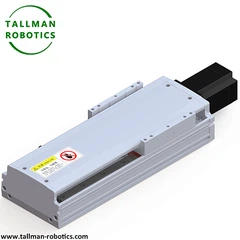
Electric Cylinder

Electric Cylinder

Details
Electric Cylinder is an electromechanical integrated actuator that converts the rotational motion of a servo motor or stepper motor into linear motion through a mechanical transmission mechanism (usually a ball screw or trapezoidal screw), which can be regarded as an "electrified hydraulic cylinder" or a "high-precision electric push rod".
Category
Linear Electric Cylinders
Share to
Send Inquiry
Description
Technical Parameters

Electric Cylinder is an electromechanical integrated actuator that converts the rotational motion of a servo motor or stepper motor into linear motion through a mechanical transmission mechanism (usually a ball screw or trapezoidal screw), which can be regarded as an "electrified hydraulic cylinder" or a "high-precision electric push rod". Mainly used to implement the pushing, lifting, extending, or positioning actions of loads. It combines the power output of the motor with the motion conversion function of the screw, the high precision of servo control, and the linear driving ability of traditional cylinders. Electric Cylinder is a widely used electric alternative to traditional hydraulic cylinders and cylinders in automation equipment, industrial machinery, and precision positioning systems.


Core Composition and Working Principle of Electric Cylinder

1

Drive motor

As a power source, common types include servo motors (high-precision closed-loop control), stepper motors (open-loop or simple closed-loop), or DC motors (low-cost open-loop). The motor outputs rotational torque to drive subsequent transmission components.

2

Transmission mechanism

Ball screw: The mainstream configuration consists of a screw shaft and a nut, which transmits motion through rolling of balls. It has low friction and high efficiency (85%~95%), with an accuracy of ± 0.01mm~± 0.1mm, suitable for high-precision scenarios.

Trapezoidal lead screw: The nut directly slides in contact with the lead screw, with low efficiency (30%~50%), but low cost and good self-locking (the load is not easy to slide down after power failure), suitable for low-speed and low precision scenarios (such as manual adjustment devices).

3

Guidance and support structure

Usually integrated with linear guides or sliding sleeves, ensuring that the output shaft (or load) moves along a linear trajectory, preventing rotation or offset, and ensuring motion stability.

4

Shell and output shaft

The metal shell (such as aluminum alloy, steel) protects the internal components, and the output shaft (piston rod) is directly connected to the load to transmit linear thrust or tension.

5

Control and Feedback (optional)

Servo motor models are usually paired with encoders or grating rulers to form closed-loop control, achieving high-precision adjustment of position, speed, and force.

Stepper motor or DC motor models are mostly open-loop control, suitable for scenarios with low precision requirements.


Key Features of Electric Cylinder

Motion Conversion

By using a screw to convert rotational motion into linear motion, the structure is mature and the technical threshold is low.

High precision positioning

The ball screw model can achieve a positioning accuracy of ± 0.01mm~± 0.1mm under closed-loop control, with a repeat positioning accuracy of ± 0.005mm, suitable for scenarios that require stable position control (such as component docking on assembly lines).

Strong load capacity

With a wide thrust range from a few newtons (N) to tens of tons (large industrial electric cylinders), it can drive heavy loads (such as machine tool workbenches).

Self locking

The trapezoidal screw model has mechanical self-locking function, and the load will not slide due to gravity after power failure, with high safety (such as lifting platforms).

Environmental adaptability

The shell can be designed to be dustproof and waterproof (IP level optional), suitable for complex environments such as industrial and outdoor environments, and has no oil or gas leakage problems of hydraulic/pneumatic equipment, making it cleaner.

Strong controllability

The motor controller can accurately adjust the speed, acceleration, and stroke, supporting multiple motion modes (such as constant speed and variable speed switching).


Main types of Electric Cylinder

Types

Transmission Methods,

Characteristics

Applic able Scenarios

Ball screw electric cylinder

Ball screw High

High precision (± 0.01 mm), high rigidity, but moderate speed (≤ 1 m/s)

Machine tools, injection molding machines, precision positioning

Planetary roller screw electric cylinder

Planetary roller screw

Ultra-high load (up to several tons), long life, but high cost

Heavy machinery, aerospace

Synchronous electric cylinder

Synchronous belt+gear

High-speed (≥ 2 m/s), long stroke, but low accuracy (± 0.1 mm)

Logistics sorting, automated conveying

Linear motor electric cylinder

Direct drive (without mechanical transmission)

Ultra-high speed (5 m/s) and nanometer level accuracy, but with low thrust, high cost

Semiconductor equipment, and optical precision adjustment


Electric cylinder is a linear actuator that combines precision, load capacity, and environmental adaptability. It achieves motion conversion through a mature "motor+screw" structure, making it particularly suitable for replacing hydraulic/pneumatic systems. It has significant advantages in scenarios that require clean, controllable, and high-precision linear motion. Its performance can be flexibly adjusted through motor type and screw selection, covering a wide range of needs from low-cost civilian equipment to high-end industrial equipment.


Electric cylinders achieve high-precision and high response linear motion through motors and transmission mechanisms, gradually replacing traditional hydraulic/pneumatic systems, and are particularly suitable for precision control, energy conservation, environmental protection, and intelligent demand scenarios. In Industry 4.0 and automation upgrades, electric cylinders have become the core execution components in high-end manufacturing, new energy, medical and other fields.

Here, we introduce series Electric Cylinder with data as follows:

You are welcome to watch more projects or visit our video gallery by Youtube: https://www.youtube.com/@tallmanrobotics

35

37

38

39

41


31
32
33
34
35
36
37
38


Electric cylinders are widely used in various fields due to their high precision, strong load capacity, strong controllability, and good environmental adaptability. The following is a detailed introduction to their typical application scenarios:

1. Industrial Automation and Intelligent Manufacturing

This is the most core application area of electric cylinders,used to achieve precise handling, positioning, assembly and other actions in production lines:

Material handling and conveying

In automated production lines, the conveyor belt is driven to lift, translate, or control the robotic arm to grab materials and transfer them in a straight line (such as pushing parts from one station to another).

Precision Assembly

Used in precision assembly scenarios such as electronics and automotive components for parts docking and pressing (such as linear feed during bearing pressing and screw tightening), ensuring assembly force and position accuracy through closed-loop control, and avoiding part damage.

Machine tools and processing equipment

Drive the linear feed of machine tool worktables and cutting tools, or control the stamping action of stamping equipment, especially suitable for processing links that require stable speed and position control.

Packaging Machinery

Adjust the sealing position and material pushing distance of the packaging machine, or control the label pasting height of the labeling machine to ensure packaging accuracy and consistency.


2. Robotics Technology

Robot Joint Drive

In multi degree of freedom robots (such as six axis industrial robots and humanoid robots), as joint actuators, it is necessary to achieve the extension and contraction of arms and legs, such as the bending and extension of knee joints in humanoid robots, while balancing load capacity and motion flexibility.

Collaborative robot end effector

Paired with the "claw" of the collaborative robot, it can achieve linear pushing, pressing, and other actions after grasping (such as inserting and assembling electronic components), and is suitable for collaborative scenarios with humans due to its leak free electric cylinder and low noise.

Mobile robot lifting device

such as the lifting platform on AGV (Automatic Guided Vehicle), the load height is adjusted by an electric cylinder to achieve material loading and unloading docking. The self-locking of the trapezoidal screw type ensures that the platform does not slide down when power is cut off, improving safety.


3. Medical and rehabilitation equipment

Medical bed and operating table

Drive the lifting, tilting, and translation of the bed body (such as adjusting the patient's lying angle), requiring smooth movement, low noise, and the cleanliness of the electric cylinder (free of oil stains) in accordance with medical environmental hygiene standards.

Rehabilitation equipment

In limb rehabilitation devices such as leg traction machines and upper limb training devices, precise control of the thrust and stroke of electric cylinders is used to assist patients in joint mobility training and avoid secondary injuries caused by excessive force.

Medical device positioning

For example, in CT and MRI equipment, the patient's bed is driven to enter and exit the detection platform, or the instrument arm positioning of the surgical robot is controlled to ensure detection/surgical accuracy.


4. Logistics and Warehousing

Stacker crane and three-dimensional warehouse

Drive the lifting platform of the stacker crane to achieve the up and down handling of goods between shelves. The large load electric cylinder can adapt to the lifting needs of heavy-duty palletized goods.

Sorting equipment

In an automated sorting system, the expansion and contraction of sorting baffles are controlled to push packages of different categories to the corresponding conveyor lines, and sorting efficiency is improved through speed adjustment.

Conveyor Line Adjustment

Adjust the tilt angle or height of the conveyor line according to the height of the goods or the conveying requirements, to achieve smooth docking of different conveying sections.


5. Aerospace and Military Industry

Simulation testing equipment

In ground testing of aircraft, high-precision speed and force control is required to drive the linear motion of the simulation platform (such as simulating acceleration and vibration environment during takeoff).

Cabin door and mechanism control

Control the opening and closing of aircraft and spacecraft cabin doors, or the extension and retraction of satellite deployment mechanisms (such as solar panel brackets). The reliability and environmental adaptability of electric cylinders (resistance to high and low temperatures, vacuum) can meet strict requirements.

Weapons and equipment

such as the lifting mechanism of shipborne equipment and the angle adjustment of missile launchers, require high thrust and rapid response capabilities.


6. New Energy and Special Industries

Lithium battery production

precise pressure is applied through an electric cylinder during the electrode pressing and cell assembly process to ensure stable battery performance; Or drive the scraper position of the coating machine to control the coating thickness.

Photovoltaic manufacturing

In the welding and laminating processes of photovoltaic modules, materials such as silicon wafers and glass are positioned to ensure splicing accuracy.

Heavy machinery

such as gate opening and closing of mining equipment, roll gap adjustment of rolling mills in the metallurgical industry, and large tonnage electric cylinders can replace traditional hydraulic cylinders to avoid oil leakage pollution.


7. Civil and commercial equipment

Lift Platform

Small household or commercial lift platforms (such as accessible elevators, stage lifts), with the self-locking feature of the trapezoidal screw type to ensure personnel safety.

Furniture and office equipment

The backrest angle of electric lifting tables and smart sofas can be adjusted manually or remotely through a simple electric cylinder, improving convenience of use.

Agricultural machinery

such as sowing depth adjustment of seeders and cutting height control of harvesters, adapted to different crop and terrain requirements.


The application scenarios of electric cylinde cover from high-precision industrial manufacturing to daily civilian equipment, with the core advantage of "controllable linear motion" - it can meet millimeter or even micrometer level positioning accuracy, drive ton level loads, and balance cleanliness and environmental adaptability. It is an ideal choice to replace hydraulic and pneumatic systems, especially in the trend of automation and intelligent upgrading, and its application scope is constantly expanding.


Hot Tags: electric cylinder, China electric cylinder manufacturers, suppliers, factory, Electric Powered Linear Drive, Electric Rod Actuator, Electrical Mechanical Linear Cylinder, Motor Driven Linear Actuator, Servo Powered Electric Cylinder

Send Inquiry
Contact us

You can either contact us via phone, email or online form below. Our specialist will contact you back shortly.

Contact now!