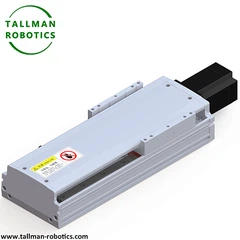
Electric linear actuator, is an electromechanical device that converts rotational motion into linear motion (such as push-pull, lifting, stretching, etc.) driven by an electric motor, mainly used to achieve precise linear displacement, force or velocity control. It is widely used in scenarios that require automated linear motion and is a core component in industrial automation, smart homes, medical equipment, and other fields.
An electric linear actuator is an electromechanical device that converts electrical energy into linear motion, driving mechanical transmission mechanisms such as screws, belts, or gears through motors (servo, stepper, or DC motors) to achieve high-precision push, pull, or positioning functions. It is widely used in automation, industrial machinery, medical equipment and other fields, and is a modern solution to replace traditional hydraulic/pneumatic systems.
The basic structure of an electric linear actuator usually includes the following parts:
Drive Motor: Provides power source, common types include DC motor, stepper motor, or servo motor, which determines the accuracy, speed, and load capacity of the actuator.
Transmission mechanism: converts the rotational motion of the motor into linear motion, common forms include:
Screw/nut structure (such as ball screw, trapezoidal screw);
Gear rack structure;
Synchronous belt drive;
Worm gear and worm structure, etc.
Shell/Rail: Protects internal components and provides guidance for linear motion, ensuring smooth movement.
Control system (optional): such as encoders, limit switches, controllers, etc., used to achieve position feedback, travel limitation, or remote control (such as through PLC, wireless signals, etc.).
Electric cylinder is a specific form of electric linear actuator, usually referring to a more compact structure, screw drive, and appearance similar to a "cylinder body", focusing on industrial heavy-duty or high-precision scenarios. In a broad sense, all devices that achieve linear motion through motors can be referred to as electric linear actuators, including some lightweight devices such as small push rods in smart homes.
Typical application scenarios of Electric linear actuator
Industrial Automation: Material pushing on production lines, joint drive of robotic arms, valve opening and closing, etc.
Medical equipment: Operating table lifting, limb training mechanism for rehabilitation equipment, bed angle adjustment.
Smart Home: Electric lifting table, smart curtains, sofa backrest adjustment.
Agriculture and Logistics: Depth adjustment of seeders, lifting of storage shelves, and connection of conveyor lines.
Automobile and Transportation: Electric vehicle tailgate opening and closing, wheelchair lifting device.
Electric linear actuator is the core solution for "electrification+linear motion control". Their flexible design and high controllability make them the mainstream choice to replace traditional hydraulic and pneumatic actuators.
Electric linear actuators have become the core driving components of modern automation systems due to their advantages of high precision, intelligence, environmental friendliness, and energy efficiency. Its modular design can flexibly adapt to different scenarios, gradually replacing traditional fluid power systems and playing a key role in fields such as Industry 4.0, healthcare, and new energy. When selecting, it is necessary to comprehensively evaluate the load, speed, accuracy, and environmental requirements.
Here, we introduce series Electric Cylinder with data as follows:
You are welcome to watch more projects or visit our video gallery by Youtube: https://www.youtube.com/@tallmanrobotics


Electric linear actuator and traditional hydraulic cylinder are both driving devices that achieve linear motion, but there are significant differences in principle, structure, and performance. The advantages of electric linear actuators are mainly reflected in the following aspects:
|
Items |
Electric actuator |
Hydraulic cylinder |
|
Higher control accuracy and more flexible adjustment |
Through feedback devices such as servo motors and stepper motors combined with encoders, it can achieve millimeter or even micrometer level positioning accuracy, and can adjust speed, thrust, and stroke in real time, supporting complex motion curves such as uniform acceleration and variable speed operation. For example, in precision assembly production lines, the pushing distance can be precisely controlled to avoid workpiece collisions |
relies on hydraulic valves and flow control, and its accuracy is affected by hydraulic compressibility and pipeline pressure loss. The positioning accuracy is usually above millimeter level, and the speed and thrust adjustment are complex, making it difficult to achieve high-frequency and refined dynamic control. |
|
Stronger environmental adaptability and higher cleanliness |
No need for oil or pipelines, no risk of leakage, suitable for clean environments (such as medical equipment, food processing), dust-free workshops, or outdoor scenes (to avoid low-temperature solidification or high-temperature deterioration of hydraulic oil). For example, the electric push rod of the operating table will not contaminate the sterile environment due to oil leakage. |
relies on hydraulic oil to transmit power, and aging seals can easily lead to oil leakage and environmental pollution; And the oil is sensitive to temperature (low temperature viscosity, high temperature oxidation), and its reliability decreases in extreme environments such as cold storage and deserts. |
|
Easy installation and maintenance |
Compact structure (integrated motor and transmission mechanism), no additional hydraulic pump station, oil tank or pipeline required, small installation space, flexible horizontal, vertical or inclined installation. Maintenance only requires regular inspection of mechanical components (such as screw lubrication), without the need to replace oil or seals, resulting in low maintenance costs. |
requires supporting pump stations, oil pipes, valves, etc., with a large system volume and installation layout limited by pipelines; And it is necessary to regularly replace hydraulic oil, clean oil filters, and repair seals, which requires a large amount of maintenance work. |
|
Higher energy efficiency and lower operating costs |
The motor only consumes electricity during operation, and the energy is directly converted into mechanical energy, with an energy efficiency of up to 70% -90%; No no-load energy loss (such as hydraulic pump running without load). |
The hydraulic pump needs to operate continuously (even if the actuator is stationary), and there are pipeline losses, overflow losses, etc. when energy is transmitted through the oil. The energy efficiency is usually only 30% -50%; Long term operation incurs higher electricity and oil replacement costs. |
|
Better safety and controllability |
It can achieve emergency stop and overload protection (such as motor power failure locking) through circuit design, and can maintain its current position in case of fault (such as power failure) to avoid accidental movement. |
relies on hydraulic lock for positioning. If the pipeline ruptures or the hydraulic lock fails, it may suddenly fall due to the weight of the load; And oil leakage may pose a fire risk, especially in high-temperature environments. |
Differences in Applicable Scenarios
Electric linear actuators are more suitable for high-precision, low pollution, small space, and low maintenance scenarios (such as medical, automated production lines, and smart homes); Hydraulic cylinders still have advantages under extremely high loads (such as 10000 ton hydraulic presses) and extreme impact conditions, but are gradually being replaced by electric actuators (especially in the field of medium and low loads).
Hot Tags: electric linear actuator, China electric linear actuator manufacturers, suppliers, factory, Electric Actuating Rod Device, Electric Rod Actuator, Electrical Mechanical Linear Cylinder, Motor Driven Linear Actuator, Servo Powered Electric Cylinder


