
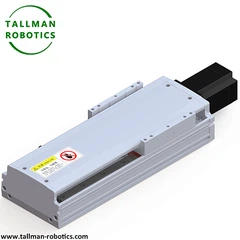


Electric linear cylinder is an executive device that converts rotational motion into precise linear motion through electric motor drive. It belongs to the category of electric linear actuator and is structurally closer to the "cylinder body" form of traditional hydraulic cylinders. It combines the advantages of electric motor control with the high-precision characteristics of mechanical transmission.
An electric linear cylinder is an electromechanical integrated actuator that directly converts electrical energy into linear motion. It drives mechanical transmission mechanisms such as ball screws, planetary roller screws, or synchronous belts through built-in motors such as servo motors or stepper motors, achieving high-precision, high response push-pull or positioning functions. Electric linear cylinder is a modern alternative to traditional hydraulic cylinders and pneumatic cylinders, combining the precision of electric drive and the reliability of mechanical transmission, widely used in industrial automation, medical equipment, new energy and other fields.
Electric linear cylinder compared to traditional driving methods
|
Characteristics |
Electric Linear Cylinder |
Hydraulic Cylinder, |
Cylinder |
|
Accuracy |
± 0.01 mm (closed loop) |
± 0.1 mm |
± 1 mm (open loop) |
|
Speed |
ranging from 0.1 to 5 m/s, |
moderate (0.5 m/s), |
fast (but with significant impact) |
|
maintenance cost |
Extremely low(no lubrication) |
high (requires oil change), |
medium (requires air leakage prevention) |
|
Control flexibility |
programmable (multi-mode) |
relies on hydraulic system |
simplicity (ON/OFF) |
Main features of Electric linear cylinder
|
High precision positioning |
With the support of servo motors and precision screws, the positioning accuracy can reach ± 0.01mm, and the repeated positioning accuracy is in the micrometer level, far higher than pneumatic cylinders or ordinary hydraulic cylinders. |
|
High load capacity |
Depending on the model, the thrust can range from tens of newtons to tens of tons, covering industrial scenarios from light to medium to heavy loads. |
|
Controllable speed |
By adjusting the motor speed, adjustable speeds from 0.1mm/s to 1m/s can be achieved, supporting complex motion curves such as constant speed and variable speed. |
|
Compact structure |
The motor and cylinder body are mostly designed as an integrated unit (such as the motor directly flange connected to the cylinder body), without the need for additional transmission components, saving installation space. |
|
No oil pollution |
No need for hydraulic oil or compressed air, avoiding leakage problems, suitable for clean environments (such as food, medical, electronics industries). |
|
Low maintenance cost |
Mechanical transmission components (such as ball screws) have minimal wear and only require regular lubrication, with a long maintenance cycle and lower operating costs than hydraulic systems. |
Electric Linear Cylinder achieves efficient and precise linear motion through motor and precision transmission, combining environmental protection, intelligence, and low maintenance advantages, and has become a core component of modern automation systems. Its application scenarios have expanded from industrial to medical, new energy and other fields, making it an ideal choice to replace traditional fluid power. When selecting, it is necessary to comprehensively evaluate the load, speed, accuracy, and environmental adaptability requirements.
Here, we introduce series Electric Cylinder with data as follows:
You are welcome to watch more projects or visit our video gallery by Youtube: https://www.youtube.com/@tallmanrobotics


Relationship and difference with related terms
Electromechanical cylinder: Both are highly similar and often considered synonymous, emphasizing the integrated design of "motor+mechanical transmission" for high-precision industrial scenarios. In some contexts, 'electric linear cylinder' emphasizes more on the 'cylinder body shape', while 'electromechanical cylinder' emphasizes more on the 'high-end performance of mechatronics integration'.
Compared to Electric linear actuator: Electric linear cylinder is an "industrial grade enhanced version" of electric linear actuator, with a more robust structure, higher load and accuracy; Ordinary electric linear actuators may use simplified transmission methods such as trapezoidal screws, which are suitable for light load scenarios such as smart homes and small devices.
Compared to hydraulic cylinders: electric linear cylinders do not require hydraulic pump stations and pipelines, providing more flexible control and higher cleanliness. However, they are still slightly inferior to hydraulic cylinders in ultra-high pressure (such as 10000 ton level) scenarios.
Typical application scenarios of Electric linear cylinder
Industrial Automation: Material handling on production lines, precision assembly positioning, and driving of robot end effectors.
Machine tool equipment: The feed axis of CNC machine tools and the worktable movement of laser cutting/welding equipment.
Medical equipment: Operating table posture adjustment, assisted driving of rehabilitation equipment.
Testing and simulation: Loading control of material fatigue testing machine and automotive shock absorber testing platform.
Special equipment: Precision control of aerospace simulation cabins and ship servos.
Electric linear cylinder is the core executive component under the trend of "replacing hydraulic with electricity". With high precision, high integration and environmental friendliness, it gradually replaces traditional hydraulic cylinders in the field of automation and has become the mainstream choice for high-end linear motion control.
Hot Tags: electric linear cylinder, China electric linear cylinder manufacturers, suppliers, factory, Electromechanical Servo Cylinder, Electric Rod Actuator, Electrical Mechanical Linear Cylinder, Motor Driven Linear Actuator, Servo Powered Electric Cylinder


