
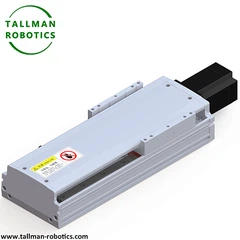


Electric Rod Actuator is an electromechanical integrated device that converts rotational motion into linear reciprocating motion through motor drive. Its core structure includes a drive motor, transmission mechanism, and push rod (piston rod), mainly used to achieve pushing, pulling, lifting, or opening/closing actions of loads. Electric Rod Actuator is a common linear drive equipment in industrial and civilian fields.
Electric Rod Actuator is a compact linear motion device that uses a motor to drive a rod to perform telescopic movements, achieving push, pull, or positioning functions. It is a subdivision type of electric linear actuator, characterized by an exposed/extendable metal rod structure, with simple structure and flexible installation, suitable for linear motion scenarios with small and medium loads.
The structure of Electric Rod Actuator is relatively compact, and its core components include:
|
Drive motor |
Provides power source, common types include DC motor (12V/24V, suitable for small equipment), AC motor (220V/380V, suitable for industrial scenarios), or stepper motor (used for simple positioning control). |
|
Transmission mechanism |
Convert the rotational motion of the motor into linear motion, and the most commonly used is the screw nut structure (such as trapezoidal screw or ball screw) 1).The motor drives the screw to rotate, and the nut is rigidly connected to the push rod. When the screw rotates, the nut moves along the axial direction of the screw, thereby pushing the push rod to extend or retract. 2).Some models use gear reduction mechanisms (such as worm gears), which combine the functions of reducing speed and increasing force, as well as self-locking (to prevent the load from slipping due to its own weight). |
|
Push rod (piston rod) |
Usually a metal rod (such as chrome plated steel), directly connected to the load, with a mounting interface (such as a pin shaft, flange, or thread) designed at the end for easy connection with the driven component. |
|
Shell and guide device |
The metal shell protects the internal structure, and the guide sleeve ensures stability during linear movement of the push rod, reducing radial offset. |
|
Control and limit components |
1).Travel limit switch: When the push rod reaches the maximum extension/contraction position, the trigger switch cuts off the motor power supply to prevent overload. 2).Optional feedback device: Some industrial grade models are equipped with potentiometers or encoders for feedback of push rod position, supporting simple position control. |
Key performance characteristics of Electric Rod Actuator
|
Compact structure |
The motor and transmission mechanism are integrated into one, with a small volume and low installation space requirements, suitable for narrow scenes. |
|
Easy to operate |
By directly controlling the forward and reverse rotation of the motor through switches, relays, or PLC, the extension and retraction of the push rod can be achieved without the need for a complex control system. |
|
Self locking ability |
Models using worm gears or trapezoidal lead screws can self lock after power failure, preventing the load from moving under gravity (such as the lifting platform staying in mid air). |
|
Load and stroke range |
The thrust is usually between 10N-100kN (10 tons), and the stroke ranges from tens of millimeters to several meters (commonly 50mm-1000mm), which can be customized according to needs. |
|
Protection level |
Most civilian models are IP44 (dustproof, waterproof, splash proof), while industrial models can reach IP65 (high-pressure water spray proof), suitable for humid and dusty environments. |
|
Lower cost |
Compared to servo electric cylinders or hydraulic cylinders, it has a simpler structure, lower manufacturing costs, and is easy to maintain (without the need for hydraulic oil or compressed air). |
Differences from related products
|
Product Type |
Core Differences |
Typical Features |
|
Electric push rod actuator |
Simple structure, with "push rod extension and contraction" as the core function, low control accuracy |
Low cost, easy installation, suitable for simple driving |
|
Servo electric cylinder |
Servo motor+closed-loop control, emphasizing high precision and high dynamic response |
Positioning accuracy up to ± 0.01mm, used in precision scenes |
|
Pneumatic push rod |
Driven by compressed air, dependent on air source, with low thrust |
Fast speed but poor rigidity, suitable for light load scenarios |
Electric Rod Actuator is an economical and practical linear drive solution with the core advantage of "simple push-pull and reliable operation", widely used in scenarios with low precision requirements (usually positioning accuracy within ± 1mm). Compared to hydraulic or pneumatic systems, it does not require complex pipelines, is easy to install and maintain, and is clean and environmentally friendly, making it a common choice to replace traditional manual or pneumatic drives.
Electric Rod Actuators are evolving from simple execution components to intelligent electromechanical units, with their modular design and low-cost advantages continuously increasing their penetration rate in Internet of Things (IoT) devices. For scenarios that require reliable linear motion and minimalist control, electric push rods are still the most cost-effective solution.
Here, we introduce series Electric Cylinder with data as follows:
You are welcome to watch more projects or visit our video gallery by Youtube: https://www.youtube.com/@tallmanrobotics


Electric push rod actuators are widely used in various fields such as industry, civilian, medical, and agriculture due to their compact structure, easy operation, low cost, and the absence of complex auxiliary systems such as hydraulic oil and compressed air. The following is a detailed classification of its typical application scenarios:
1. Industrial Automation Field
In industrial scenarios, electric push rods are mainly used to achieve material pushing, equipment opening and closing, or position adjustment, especially suitable for scenarios that do not require high accuracy but require stable driving:
|
Assembly line and warehousing |
Material push: pushing the flow of workpieces in the assembly line, such as material transfer between conveyor belts and the pushing action of sorting equipment. Shelves and Conveyor Mechanisms: Control the extension/retraction of telescopic shelves, or adjust the tension and tilt angle of conveyor belts. |
|
Valve and Gate Control |
Automatic opening and closing of industrial valves (such as gate valves, butterfly valves, ball valves), replacing manual operation, suitable for pipeline fluid control (water, gas, dust, etc.). The lifting and lowering of small gates (such as silo gates and sewage treatment gates) control the flow of materials or liquids. |
|
Machine tools and equipment assistance |
Automatic opening and closing of machine tool protective covers, clamping/releasing of workpiece fixtures (low load scenarios). The action drive of pushing and sealing mechanisms in packaging machinery, such as the tightening device of a cardboard box packing machine. |
2. Civil and Commercial Equipment
In daily life and business scenarios, electric push rods are often used to enhance equipment automation and convenience, and improve user experience
|
Furniture and Office Equipment |
Electric sofa/seat: adjust the backrest angle and leg support to achieve lying posture switching. Elevating table/bar counter: Adjust the height of the desktop through the push rod to meet the needs of standing office or users of different heights. TV cabinet/storage cabinet: The concealed push rod drives the automatic opening/closing of the cabinet door, or adjusts the pitch angle of the TV. |
|
Doors, Windows, and Sunshade Systems |
Automatic window opener: Used for high-rise buildings, basements, or windows that are difficult to manually operate (such as factory skylights, greenhouse side windows), to achieve ventilation or smoke exhaust automation. Sunshade/blinds: Control the extension and retraction of the sunshade or the angle of the blinds to adjust indoor lighting. |
|
Commercial display equipment |
Booth lifting: Drive the lifting or lowering of the exhibition platform to highlight the key display points (such as switching between exhibits in museums and exhibitions). Automatic door assistance: push-pull drive for small commercial doors (such as glass doors in convenience stores and banks). |
3.Medical and Rehabilitation Equipment
The medical field has high requirements for the safety and stability of equipment, and the self-locking function of the electric push rod (to prevent accidental movement) makes it an ideal choice:
|
Bed and nursing equipment |
Electric nursing bed: Adjust the lifting of the bed board, the tilt angle of the back and legs, making it convenient for patients to get up, turn over, or for medical staff to care for them. Wheelchairs and mobility scooters: Some electric wheelchairs have backrest adjustment and foot pedal lifting to enhance riding comfort. |
|
Rehabilitation and treatment equipment |
Rehabilitation training equipment: such as leg stretching machines and arm rehabilitation devices, which control the movement trajectory through push rods to assist patients in joint activity training. Surgical auxiliary equipment: fine-tuning of small operating tables (such as adjusting the height and angle of dental chairs). |
4. Agricultural and Environmental Protection Equipment
In agricultural and environmental scenarios, electric push rods are suitable for outdoor or humid environments (some models have a protection level of IP65) and can replace manual operation:
|
Agricultural facilities |
Greenhouse: Control the opening and closing of skylights and side windows (adjust temperature and humidity), or the rolling and unwinding of film machines (control ventilation). -Breeding equipment: such as the lifting of the feeding trough in the chicken coop and the pushing and pulling of the feces cleaning board, to achieve automated breeding. |
|
Environmental Protection and Sanitation |
Sewage treatment equipment: cleaning action of small grid machines, opening and closing of sedimentation tank gates, controlling water flow or cleaning impurities. Garbage disposal equipment: automatic flip of garbage bins, push plate action of compression garbage trucks (low load scenarios). |
5. Automobiles and Transportation
In vehicles or traffic assistance equipment, electric push rods are used for small driving needs:
|
Special vehicles |
RV: The retractable table, sunshade, and step board inside the car enhance the convenience of travel. Engineering vehicle: lifting and lowering of small operating platforms (such as auxiliary support adjustment for high-altitude work vehicles). |
|
Transportation Facilities |
Barrier and railing: Control the lifting/lowering of the barrier (such as in parking lots, toll stations), replacing pneumatic or hydraulic drive. Bus/subway: door assist drive (small vehicles), seat angle adjustment. |
The core advantage of electric push rod actuators lies in their simple driving, low cost, and easy maintenance, making them more suitable for scenarios with low positioning accuracy requirements (usually within ± 1mm) and moderate loads (10N-100kN). From industrial production to daily life, from medical care to agricultural breeding,The applications of Electric Rod Actuator cover various light and medium load drive needs that require linear reciprocating motion, making it an economical and practical alternative to manual, pneumatic, or hydraulic drives.
Hot Tags: electric rod actuator, China electric rod actuator manufacturers, suppliers, factory, Electric Actuating Rod Device, Electric Rod Actuator, Electrical Mechanical Linear Cylinder, Motor Driven Linear Actuator, Servo Powered Electric Cylinder


