
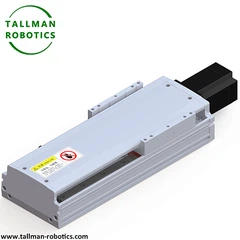


What is Multi-Axis Linear Actuator?
A multi-axis linear actuator is a motion assembly that provides controlled straight-line movement along two or more independent axes-typically arranged orthogonally (X, Y, and/or Z)-by combining multiple single-axis linear actuator modules into a coordinated unit, without incorporating rotary motion. It enables precise multi-directional positioning purely through translational movement, commonly used as a compact alternative to full gantry robots for smaller-scale applications.
Structure
The assembly stacks or orthogonally mounts individual linear actuator modules, each consisting of a motor (servo or stepper) coupled to a ball screw, lead screw, belt-drive, or linear motor mechanism that drives a carriage along an enclosed guide rail. One axis module is typically mounted atop another, with the base axis supporting the full assembly weight and subsequent axes cantilevering off it. Encoders on each axis provide closed-loop position feedback, coordinated through a shared or networked multi-axis motion controller.
Selection Considerations
Key factors include stroke length per axis, payload capacity (accounting for reduced capacity on outer, cantilevered axes), positioning accuracy and repeatability, maximum speed and acceleration, drive mechanism per axis, and controller compatibility for synchronized multi-axis motion. Combined weight and moment loading across stacked axes should be verified against each stage's rated capacity to avoid premature wear or accuracy loss.
Applications
Multi-axis linear actuators are used in precision dispensing, small-parts pick-and-place, laboratory automation, inspection and testing equipment, and compact assembly stations where coordinated multi-directional linear motion is needed within a smaller footprint than a full gantry system.
Installation Considerations
The base axis must be mounted on a flat, rigid surface capable of supporting the full stacked assembly weight. Perpendicularity between axes should be verified to prevent binding. Cable management between stacked stages must accommodate full travel without strain, and encoder calibration and coordinated multi-axis accuracy should be tested across the complete range before commissioning.
Here, we introduce the combination options of Muti Axis Linear Modules in applications with code as follows for you to select for your projects:
You are welcome to watch more projects or visit our video gallery by Youtube: https://www.youtube.com/@tallmanrobotics
|
|
|
|
|
|
TM-FA |
TM-FB |
TM-FB2Z2 |
TM-FBZ2 |
|
|
|
|
|
|
TM-FC |
TM-FCZ |
TM-FD |
TM-FDZ |
|
|
|
|
|
|
TM-FE |
TM-FEZ |
TM-FF |
TM-FFZ |
|
|
|
|
|
|
TM-FG |
TM-FF2 |
TM-FGZ |
TM-FBZ2 |


|
Model of Each Axis |
Model of Each Axis |
Model of Each Axis |
||||||
|
X Axis |
Y Axis |
Z Axis |
X Axis |
Y Axis |
Z Axis |
X Axis |
Y Axis |
Z Axis |
|
TM100 |
TM45 |
TM135 |
TM100 |
TM100 |
TM150 |
TM135 |
TM135 |
|
|
TM100 |
TM62 |
TM135 |
TM135 |
TM100 |
TM200 |
TM100 |
TM62 |
|
|
TM100 |
TM100 |
TM45 |
TM135 |
TM135 |
TM135 |
TM200 |
TM100 |
TM100 |
|
TM100 |
TM100 |
TM62 |
TM150 |
TM62 |
TM200 |
TM135 |
TM100 |
|
|
TM100 |
TM100 |
TM100 |
TM150 |
TM100 |
TM62 |
TM200 |
TM150 |
TM100 |
|
TM135 |
TM62 |
TM150 |
TM100 |
TM100 |
TM200 |
TM150 |
TM135 |
|
|
TM135 |
TM100 |
TM62 |
TM150 |
TM135 |
TM100 |
|||
|
Model of Each Axis |
Model of Each Axis |
Model of Each Axis |
|||||||
|
X Axis |
Y Axis |
Z Axis |
X Axis |
Y Axis |
Z Axis |
X Axis |
Y Axis |
Z Axis |
|
|
TM100 |
TM45 |
TM135 |
TM100 |
TM100 |
TM150 |
TM135 |
TM135 |
||
|
TM100 |
TM62 |
TM135 |
TM135 |
TM100 |
TM200 |
TM100 |
TM62 |
||
|
TM100 |
TM100 |
TM45 |
TM135 |
TM135 |
TM135 |
TM200 |
TM100 |
TM100 |
|
|
TM100 |
TM100 |
TM62 |
TM150 |
TM62 |
TM200 |
TM135 |
TM100 |
||
|
TM100 |
TM100 |
TM100 |
TM150 |
TM100 |
TM62 |
TM200 |
TM150 |
TM100 |
|
|
TM135 |
TM62 |
TM150 |
TM100 |
TM100 |
TM200 |
TM150 |
TM135 |
||


FAQ
What's the difference between a multi-axis linear actuator and a gantry robot?
A multi-axis linear actuator is typically a smaller, self-contained stacked assembly for compact applications, while a gantry robot usually involves a larger overhead frame structure designed for extended travel and higher payloads.
Can a multi-axis linear actuator include a rotary axis?
Not typically-by definition it focuses on linear (translational) motion only; adding rotary capability would generally classify the assembly as a multi-axis actuator or robot rather than a purely linear actuator system.
How does stacking axes affect overall accuracy?
Stacking axes can compound minor deflections and backlash from each stage, so overall tip accuracy depends on the rigidity and precision of every stacked module, particularly the outermost axis.
What payload can a multi-axis linear actuator support?
Payload capacity varies by actuator size and stacking configuration, generally ranging from under a kilogram for compact precision units to tens of kilograms for larger industrial-grade stacked assemblies.
What drive type offers the best precision for a multi-axis linear actuator?
Ball screw and linear motor drives generally provide the highest precision, while belt-drive or lead screw options offer a more cost-effective solution for applications with less stringent accuracy requirements.
Hot Tags: multi axis linear actuator, China multi axis linear actuator manufacturers, suppliers, factory, Multi Axis Linear Motion Stage, Multi Axis Linear Platform System, 3 Axis Gantry Platform, Multi Axis Linear Positioning System, Multi Axis Linear Actuator Module, Triaxial Gantry Manipulator


