
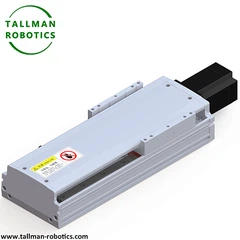


High Speed Linear Module is a precision transmission component that integrates guidance, drive, and motion platforms, designed specifically for achieving high-speed and stable reciprocating motion of objects in a straight direction. Its core feature is the coordination between optimized driving methods (such as linear motors, high-speed synchronous belts, or precision ball screws) and low friction guiding structures (such as steel guide rails with ball sliders) to achieve a motion speed of several meters per second (some models can reach 5m/s or more), while maintaining high positioning accuracy (usually up to ± 0.01mm level).
Structurally, High Speed Linear Module includes a high-speed drive system (transmitting power), high-precision guide rails (ensuring guidance), motion sliders (carrying loads), and a base (providing rigid support). Some models are equipped with dust-proof, lubrication, and limit devices to enhance reliability. Widely used in electronic manufacturing (such as chip packaging), logistics sorting, laser processing and other automation scenarios that require strict speed and efficiency, balancing high-speed response and smooth motion, it is the core transmission unit of modern high-speed automation equipment.
Embedded linear module of steel guide rail is a precision mechanical transmission component that integrates steel guide rail and drive system, mainly used to achieve high-precision and high stability reciprocating motion of objects in the linear direction. Its core feature is to embed the steel guide rail structure into the module body, forming an integrated design, which is widely used in fields such as automation equipment, precision machine tools, robots, and electronic manufacturing.
You are welcome to watch more projects or visit our video gallery by Youtube: https://www.youtube.com/@tallmanrobotics
Steel Type: Guide Rail Built-in Linear Modules. Bottom plate of the module is steel , sliding block is steel, and cover plate of the sliding seat , and the support seat is aluminum.
|
Model No |
Body Width (mm) |
Lead (mm) |
Rail Length(mm) |
Repeatability (mm) |
Walking parallelism(mm) |
Speed (mm/sec) |
Application Environment |
|
TK60 |
60 |
5/10 |
150~600 |
±0.003/±0.005 |
0.01/0.015 |
Max: 600 |
General/ Dust and Waterproof with Organ Cover |
|
TK86 |
86 |
10/20 |
340~940 |
±0.003/±0.005 |
0.015/0.03 |
Max: 1220 |


TK Steel Guide Rail Built-in linear modules Load specification

TK Steel Guide Rail Built-in linear modules Accuracy Level

TK Steel Guide Rail Built-in linear modules max speed


1.Core structure composition
The structure of the steel guide rail embedded linear module can be disassembled into the following key parts, which work together to ensure motion accuracy and stability:
1)Steel guide rail
Made of high-strength steel (such as bearing steel) through precision machining, the surface is usually treated with quenching, chrome plating, etc. to enhance wear resistance and corrosion resistance.
Embedded in the base or slider of the module, it cooperates with the rolling elements (balls, rollers) on the slider to form a low friction guiding structure.
2)Drive system
Common driving methods include ball screw drive (high-precision scenarios), synchronous belt drive (high-speed scenarios), or linear motor drive (ultra high speed, high response scenarios).
The driving components are arranged parallel to the guide rail, and the power is transmitted to the slider through connecting parts such as couplings and synchronous wheels.
3)Sliding block/motion platform
Directly in contact with the steel guide rail, the bottom is equipped with rolling elements or sliding friction pairs to drive the load to move in a straight line along the guide rail.
The platform surface is usually designed with mounting holes for easy fixation of workpieces or other equipment.
4)Base/shell
The main structure that carries the guide rail, drive system, and slider needs to have sufficient rigidity to reduce deformation. It is generally made of aluminum alloy or steel, and some scenarios may undergo aging treatment to enhance stability.
5) Auxiliary components
Such as dust cover (to prevent dust from entering the guide rail), limit switch (to control the movement stroke), lubrication device (to extend the service life), etc.
2.Core features and advantages
1)High precision guidance
The processing accuracy of steel guide rails themselves, such as straightness and parallelism, is extremely high. The embedded design reduces assembly errors, and with the contact of rolling elements, it can achieve positioning accuracy at the micrometer or even nanometer level.
2)High rigidity and load capacity
The high-strength characteristics and integrated structure of steel guide rails enable the module to withstand large radial and axial loads, and maintain stable motion accuracy even when the load changes.
3)Low friction and high speed
The contact between the rolling element and the guide rail has a low coefficient of friction (usually<0.001), which not only reduces energy loss, but also supports high motion speeds (some models can reach 5m/s or more).
4)Compact structure
The guide rail is embedded in the base, and compared to modules with external guide rails, the overall volume is smaller, saving installation space and suitable for automated layout in narrow scenes.
5)Convenient maintenance
The integrated design reduces the clearance between components, and most models are equipped with centralized lubrication interfaces, which can maintain performance by regularly adding lubricants, resulting in lower maintenance costs.
3. Application scenarios
Due to its high precision and stability, steel guide rail embedded linear modules are widely used in fields that require strict motion accuracy:
Electronic manufacturing: such as semiconductor wafer handling and positioning motion in PCB board inspection equipment.
Precision machine tools: used for key processes such as tool feed and worktable movement.
Robotics technology: such as arm joints for collaborative robots and linear drive for mobile platforms.
Automated detection: Sample transfer and positioning in coordinate measuring instruments and visual inspection equipment.
Medical equipment: precision motion control for infusion pumps and surgical robots.
Through reasonable selection, the steel guide rail embedded linear module can effectively improve the motion performance of automation equipment and is a key component in precision mechanical transmission.
Hot Tags: high speed linear module, China high speed linear module manufacturers, suppliers, factory, Belt Drive Linear Actuator, Belt Driven Linear Motion Actuator, Compact Linear Actuation Module, Linear Servo Actuator System, Precision Belt Linear Stage, Servo Linear Motion Device


