
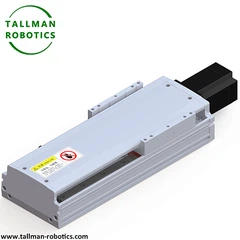


Linear stepper actuator is an open-loop control linear drive device that directly couples a stepper motor with a linear transmission mechanism, and achieves discrete position movement through pulse signal control. A linear stepper actuator is an electromechanical device that converts electrical pulse signals into precise linear displacement, combining the pulse driving characteristics of a stepper motor with linear motion output capability. It is widely used in scenarios that require precise positioning but do not require high closed-loop control.
The core features of Linear stepper actuator are simple structure, low cost, and positioning without feedback, suitable for automation scenarios with low to medium precision and low to medium load, such as 3D printing, medical equipment, automated packaging, etc.
The working principle of Linear stepper actuator is based on the step-by-step rotation characteristics of stepper motors:
the controller sends pulse signals to drive the stepper motor to rotate step by step at a fixed angle (such as 1.8 °/step), and then converts the rotational motion into linear displacement through transmission mechanisms such as screws and gears. For each input pulse, the actuator moves a fixed step distance (usually in micrometers), and the displacement is proportional to the number of pulses. It can achieve open-loop precise control without feedback sensors and has a relatively simple structure.
Structurally, a linear stepper actuator is mainly composed of three parts:
a driving unit (stepper motor and driving circuit), a transmission component (ball screw or trapezoidal screw, responsible for converting rotation into linear motion), and a guiding system (linear bearings or guide rails, ensuring smooth motion). Some models integrate limit switches to prevent overtravel operation and simplify system design.
The application is focused on low to medium precision positioning scenarios:
nozzle feed for 3D printers, worktable drive for small CNC machine tools, sample transfer for laboratory automation equipment, dose control for medical devices (such as infusion pumps), lens focusing for security equipment, etc. Its advantages lie in its lower cost compared to servo systems, simple control, no need for complex closed-loop circuits, and no vibration during low-speed operation. Linear stepper actuator is suitable for intermittent motion scenarios with light loads and high repeatability. The step accuracy can usually reach ± 0.01mm, meeting the needs of most small and medium-sized automation equipment.
Here we introduce Guide Rail Built-in Linear Module, TMTH8 to you as follows:
You are welcome to watch more projects or visit our video gallery by Youtube: https://www.youtube.com/@tallmanrobotics
|
Model No |
Motor Power(W) |
Body Width (mm) |
Repeatability (mm) |
Ball Screw Rod (C7) |
Max Load (kgs) |
Stroke (mm) at Max speed (mm/s) |
Speed (mm/s) at Max stroke (mm) |
Rated Thrust |
||
|
Out dia (mm) |
Lead (mm) |
Horizontal |
Vertical |
|||||||
|
TMTH8 |
100W |
82 |
±0.01 ±0.005 |
16 |
5 |
30 |
10 |
750mm at 250mm/S |
75mm/S at 1100mm |
341 |
|
10 |
15 |
5 |
750mm at 500mm/S |
150mm/S at 1100mm |
170 |
|||||
|
20 |
10 |
2.5 |
750mm at 1000mm/S |
300mm/S at 1100mm |
85 |
|||||
|
200W |
5 |
50 |
15 |
750mm at 250mm/S |
75mm/S at 1100mm |
682 |
||||
|
10 |
30 |
8 |
750mm at 500mm/S |
150mm/S at 1100mm |
340 |
|||||
|
20 |
18 |
3 |
750mm at 1000mm/S |
300mm/S at 1100mm |
170 |
|||||
|
400W |
5 |
50 |
15 |
750mm at 250mm/S |
75mm/S at 1100mm |
1353 |
||||
|
10 |
40 |
12 |
750mm at 500mm/S |
150mm/S at 1100mm |
674 |
|||||
|
20 |
22 |
5 |
750mm at 1000mm/S |
300mm/S at 1100mm |
337 |
|||||


There are significant differences between linear stepper motor actuators and linear servo motor actuators in terms of control methods, performance characteristics, and applicable scenarios. The specific differences are as follows:
1. Different control principles
Linear stepper motor actuator: adopts open-loop control, drives the motor to rotate (or move in a straight line) at a fixed step distance by receiving pulse signals, and the displacement strictly corresponds to the number of pulses, without the need for position feedback sensors. As long as the pulse signal is accurate, the preset motion can be achieved, but it cannot sense whether the actual position deviates from the instruction.
Linear servo motor actuator: adopts closed-loop control, integrates position sensors (such as grating ruler, encoder), and feeds back the actual position and speed to the controller in real time. The controller compares the command value with the feedback value, dynamically adjusts the output to ensure motion accuracy, and can correct deviations caused by load changes and mechanical errors.
2. Different precision and error handling capabilities
Linear stepper motor actuator: accuracy depends on the consistency of step angle (or linear step), without error correction capability. If the load is too large and the pulse frequency is too high, there may be step loss (actual displacement is less than the commanded displacement), and errors will accumulate. The step accuracy is usually ± 0.01mm~± 0.1mm.
Linear servo motor actuator: Real time error correction through closed-loop feedback, strong anti-interference ability, higher repeatability accuracy (up to ± 0.001mm~± 0.01mm), even if there is load fluctuation or external interference, it can be restored to the commanded position through adjustment without cumulative error.
3. Different speed and dynamic response
Linear stepper motor actuator: stable low-speed performance, but prone to vibration and step loss during high-speed operation, and the output torque decreases with increasing speed (there is a risk of "step loss"), suitable for low-speed and intermittent motion scenarios.
Linear servo motor actuator: With fast high-speed response and closed-loop control, it can maintain stable output over a wide speed range. The acceleration and deceleration processes are smoother, making it suitable for scenarios that require fast start stop or continuous high-speed motion.
4. Different load capacity and torque characteristics
Linear stepper motor actuator: The output torque (or thrust) decreases with increasing speed. At low speeds, the torque is larger, but at high speeds, it is prone to overload under heavy loads. It is suitable for light loads (usually less than 500N) and low inertia scenarios.
Linear servo motor actuator: Through closed-loop control, the output force can be adjusted according to load changes. It has stronger high-speed and heavy-duty capabilities, and can maintain stable thrust at high speeds. It is suitable for scenarios with medium to high loads (up to thousands of newtons) and high inertia.
5. Different costs and complexities
Linear stepper motor actuator: simple structure, no need for feedback sensors, simplified control circuit, low cost (usually 1/3~1/2 of servo system), low debugging difficulty, suitable for small and medium-sized equipment with limited budget.
Linear servo motor actuator: requires the integration of sensors and complex closed-loop control algorithms, which is costly, and controller debugging (such as parameter tuning) is more complex, making it suitable for precision equipment with high performance requirements.
6. Different applicable scenarios
Linear stepper motor actuator: suitable for low precision, light load, low-speed repetitive motion scenarios, such as 3D printer nozzle feed, small conveying equipment, laboratory sample stage positioning, home appliance valve control, etc.
Linear servo motor actuator: suitable for high-precision, high load, high-speed dynamic response scenarios, such as semiconductor wafer handling, laser cutting positioning, precision assembly robots, medical surgical equipment, etc.
Summary and Comparison Table
|
Comparison dimension |
Linear stepper motor actuator |
Linear servo motor actuator |
|
Control mode |
Open loop (no feedback) |
Closed loop (with position/speed feedback) |
|
Accuracy |
Medium (± 0.01mm~± 0.1mm), no correction |
High accuracy (± 0.001mm~± 0.01mm), correctable |
|
Speed and response |
Stable at low speeds, easy to lose steps at high speeds |
Fast response at high speeds, smooth operation |
|
Load capacity |
Light load, decreased high-speed torque |
Medium high load, stable high-speed torque |
|
Cost |
Low |
High |
|
Core advantages |
Simple control, low cost, low-speed vibration free |
High precision, strong anti-interference, good high-speed performance |
When selecting, it is necessary to make a comprehensive judgment based on the application's requirements for accuracy, speed, load, and cost budget: for lightweight and simple scenarios, stepping is preferred, while for high-precision and high dynamic scenarios, servo is required.
Hot Tags: linear stepper actuator, China linear stepper actuator manufacturers, suppliers, factory, Belt Drive Linear Actuator, Belt Driven Linear Motion Actuator, Compact Linear Actuation Module, Linear Servo Actuator System, Precision Belt Linear Stage, Fast Acting Linear Module


