
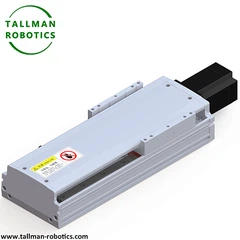


Robotic Belt Actuation Unit is a belt transmission device designed specifically for robot joints or limbs. It achieves precise and lightweight motion control through flexible transmission of synchronous belts, balancing power transmission and structural flexibility. Robotic Belt Actuation Unit is widely used in fields such as collaborative robots and biomimetic robots that are sensitive to weight and response speed.
Robotic Belt Actuation Unit is a modular transmission device designed specifically for robot joints or linear motion, which achieves power transmission and motion control through high-precision synchronous belt transmission. Its core features are lightweight (40% lighter than gear reduction), low backlash (<1 arc minute), and high response (bandwidth>100Hz), widely used in collaborative robots, SCARA robots, Delta robots, and other scenarios that require high dynamic performance.
The working principle of Robotic Belt Actuation Unit is based on flexible meshing transmission:
the rotational power output by the motor is transmitted to the synchronous belt through the active pulley, and the belt drives the driven pulley through toothed meshing, transmitting the power to the robot joints or execution end; By utilizing the flexible characteristics of the belt, non coaxial transmission or multi joint linkage can be achieved. At the same time, by controlling the motor speed and steering, the motion angle, speed, and force of the robot limbs can be adjusted. Some units are integrated with torque sensors to achieve force feedback control.
Structurally, Robotic Belt Actuation Unit typically consists of three core parts:
a drive module (micro servo motor and reducer, providing power output adapted to the robot); Transmission components (high-precision synchronous belts, pulleys, and tensioning mechanisms, with belts mostly made of high-strength polyurethane material and embedded with fiber reinforcement layers to enhance tensile strength); Connecting and guiding components (joint bearings, limit structures, ensuring stable transmission direction, adapting to the motion trajectory of robot limbs) The overall design emphasizes lightweight, often using aluminum alloy or carbon fiber frames to reduce robot load.
Here we introduce EU Standard Belt Driven Actuators, TMEB65, with data to you as follows:
You are welcome to watch more projects or visit our video gallery by Youtube: https://www.youtube.com/@tallmanrobotics
|
Model No |
Motor Power(W) |
Body Width (mm) |
Repeatability (mm) |
Timing Belt Specs |
Max Load (kgs) |
Max Stroke (mm) at max speed (mm/s) |
Rated Thrust |
Linear guide rail |
|||
|
Width (mm) |
Deceleration ration |
Lead (mm) |
Horizontal |
Vertical |
|||||||
|
TMEB65-CR |
200W |
65 |
±0.1 |
32 |
3:1 |
50 |
4 |
2 |
5500mm at 2500mm/S |
59 |
15×12.5-1 |
|
5:1 |
30 |
12 |
5 |
5500mm at 1500mm/S |
99 |
||||||
|
7:1 |
21.43 |
25 |
9 |
5500mm at 1071.5mm/S |
139 |
||||||
|
10:1 |
15 |
50 |
14 |
5500mm at 750mm/S |
199 |
||||||
|
400W |
3:1 |
50 |
12 |
7 |
5500mm at 2500mm/S |
159 |
|||||
|
5:1 |
30 |
34 |
15 |
5500mm at 1500mm/S |
265 |
||||||
|
7:1 |
21.43 |
65 |
24 |
5500mm at 1071.5mm/S |
372 |
||||||
|
10:1 |
15 |
65 |
38 |
5500mm at 750mm/S |
531 |
||||||
|
750W |
3:1 |
50 |
23 |
13 |
5500mm at 2500mm/S |
300 |
|||||
|
5:1 |
30 |
65 |
28 |
5500mm at 1500mm/S |
500 |
||||||
|
7:1 |
21.43 |
65 |
45 |
5500mm at 1071.5mm/S |
700 |
||||||
|
10:1 |
15 |
65 |
65 |
5500mm at 750mm/S |
1000 |
||||||
|
10:1 |
20 |
76 |
26 |
5500mm at 1000mm/S |
398 |
||||||
|
750W |
3:1 |
66.66 |
13 |
8 |
5500mm at 3333mm/S |
225 |
|||||
|
5:1 |
40 |
36 |
18 |
5500mm at 2000mm/S |
375 |
||||||
|
7:1 |
28.5 |
71 |
30 |
5500mm at 1425mm/S |
525 |
||||||
|
10:1 |
20 |
80 |
50 |
5500mm at 1000mm/S |
750 |
||||||


The application scenario of Robotic Belt Actuation Unit focuses on flexible motion control of robots:
arm joint drive of collaborative robots to achieve flexible grasping and assembly; The leg or finger joints of bionic robots (such as robotic arms and quadruped robots) simulate natural limb movements; The auxiliary motion mechanism of medical rehabilitation robots provides smooth and controllable driving force; Joint module for educational robots, simplifying complex motion programming. Its core advantages lie in low transmission noise, fast response speed (delay ≤ 10ms), compact structure, and the ability to achieve multi degree of freedom movement in a limited space. The maintenance cost is lower than that of gear transmission, making it suitable for scenarios with high requirements for flexibility and human-machine interaction safety.
Robotic Belt Actuation Unit perfectly balances the requirements of motion accuracy and safety through the design concept of "combining rigidity and flexibility", and its modular characteristics significantly reduce the threshold for robot development. With the expansion of human-machine integration scenarios, this technology will become the mainstream choice for lightweight robot joints.
Hot Tags: robotic belt actuation unit, China robotic belt actuation unit manufacturers, suppliers, factory, Belt Drive Linear Actuator, Belt Driven Linear Motion Actuator, Compact Linear Actuation Module, Linear Servo Actuator System, Precision Belt Linear Stage, Servo Linear Motion Device


