

What is the acceleration of linear motors? Well, as a supplier of linear motors, I've had my fair share of chats with customers who are scratching their heads over this very question. So, let's dive right in and break it down in a way that's easy to understand.
First off, let's get a basic idea of what a linear motor is. A Linear Motor is a type of electric motor that produces a linear force instead of a rotational one like your typical motors. It's like taking the concept of a regular motor and straightening it out. This straight - line motion makes it super useful in a whole bunch of applications, from high - speed transportation systems to precision manufacturing equipment.
Now, acceleration. In simple terms, acceleration is how quickly an object changes its velocity. When we talk about the acceleration of linear motors, we're referring to how fast the motor can increase or decrease the speed of the object it's moving. It's measured in units like meters per second squared (m/s²).
The acceleration of a linear motor depends on several factors. One of the most important ones is the force that the motor can generate. Force and acceleration are directly related through Newton's second law of motion, which states that force (F) is equal to mass (m) times acceleration (a), or F = ma. So, if you want to achieve a high acceleration, you either need a motor that can produce a large force or you need to reduce the mass of the object being moved.
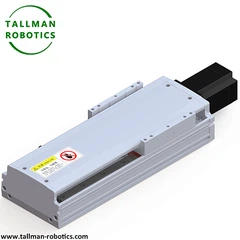
Let's say you're using a Single Axis Linear Motor Robot in a factory to move small parts around. If the robot has a light - weight arm and a powerful linear motor, it can accelerate quickly and move those parts from one place to another in no time. On the other hand, if you're trying to move a heavy load, like a large piece of machinery, you'll need a motor with a much higher force output to achieve the same level of acceleration.
Another factor that affects the acceleration of a linear motor is the power supply. A linear motor needs a sufficient amount of electrical power to generate the force required for acceleration. If the power supply is weak or unstable, the motor won't be able to reach its maximum acceleration potential. It's like trying to run a race with a half - charged battery in your electric shoes. You just won't be able to go as fast as you could with a full charge.


The design of the linear motor also plays a role. Different types of linear motors, such as Linear Drive Motor, have different performance characteristics. For example, some linear motors are designed for high - speed applications, while others are better suited for high - force, low - speed tasks. The way the motor's coils are wound, the type of magnetic materials used, and the overall construction of the motor can all impact its acceleration capabilities.
In practical applications, the acceleration of a linear motor needs to be carefully balanced with other factors. For instance, in a precision manufacturing process, you might need a smooth and controlled acceleration to ensure that the parts being produced are of high quality. If the acceleration is too high, it could cause vibrations or inaccuracies in the machining process. On the other hand, in a high - speed sorting system, a high acceleration might be more important to increase the throughput of the system.
Let's take a look at some real - world examples to better understand the importance of acceleration in linear motors. In the semiconductor industry, linear motors are used to move wafers around in the manufacturing process. These wafers are extremely delicate, and any sudden movements or vibrations can cause defects. So, the linear motors used in this application need to have a precise and controlled acceleration to ensure that the wafers are handled gently and accurately.
In the field of logistics, linear motors are used in automated storage and retrieval systems. These systems need to be able to move heavy loads quickly from one location to another. High acceleration is crucial here to improve the efficiency of the system and reduce the time it takes to retrieve and store items.
As a supplier of linear motors, I've seen firsthand how important it is to choose the right motor with the appropriate acceleration capabilities for each application. That's why we offer a wide range of linear motors, from small, high - precision motors to large, high - force motors. Our team of experts can help you select the motor that best fits your needs, taking into account factors like the load, the required speed, and the acceleration requirements.
If you're in the market for a linear motor and you're not sure where to start, don't hesitate to reach out to us. We're here to answer your questions, provide technical support, and help you find the perfect solution for your application. Whether you're a small - scale manufacturer or a large - scale industrial operation, we have the products and the expertise to meet your needs.
In conclusion, the acceleration of linear motors is a crucial factor that can have a big impact on the performance of your system. By understanding the factors that affect acceleration and choosing the right motor for your application, you can ensure that your system operates efficiently, accurately, and reliably. So, if you're looking for a linear motor that can deliver the acceleration you need, give us a call. Let's work together to find the best solution for your business.
References
- Newton, Isaac. Philosophiæ Naturalis Principia Mathematica. London: Joseph Streater, 1687.
- Various technical documents on linear motors from industry manufacturers.