
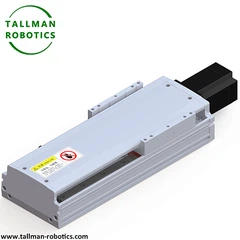


Linear Motion Stage is a precision mechanical structure that integrates drive, transmission, and guidance functions, mainly used to achieve high-precision displacement control of loads in the linear direction. Linear Motion Stage can move stably according to the preset track, and its positioning accuracy can reach micrometer or even nanometer level. It is the core component for adjusting the position of workpieces or detecting components in precision manufacturing and testing equipment. It can be used alone or combined into a multi axis system to complete complex movement.
Working principle of Linear Motion Stage Linear Modules
Its core is the synergistic effect of "power transmission+precise guidance". Power sources such as servo motors and linear motors provide driving force, which is converted into linear motion through transmission mechanisms such as ball screws, synchronous belts, and linear motors. At the same time, guiding components such as precision rails and cross roller bearings limit the excess degrees of freedom of the load, ensuring that the motion strictly follows the set axis and reducing offset and vibration. Combined with feedback devices such as grating rulers and encoders, displacement errors can be corrected in real time to ensure repeat positioning accuracy.
Application Cases of Linear Motion Stage Linear Modules
In the semiconductor industry, the wafer inspection platform adopts a linear motion platform, which achieves frictionless movement through an air static pressure guide rail, with a positioning accuracy of ± 0.5 microns, meeting the high-resolution requirements of chip defect detection; In the 3C manufacturing industry, the XY axis motion platform of mobile phone screen fitting equipment relies on ball screw transmission to achieve precise alignment between the screen and the housing at a speed of 0.5 meters per second; In the field of biomedical science, microscope stages utilize micro Linear Motion Stage to drive samples to achieve nanoscale stepping, and cooperate with optical systems to complete cell observation; In laser processing equipment, the motion platform carries the workpiece along the laser path and achieves high-speed reciprocating through synchronous belt transmission, ensuring the continuity of cutting and engraving trajectories. In addition, the focusing mechanism and high-precision coordinate measuring machine of astronomical telescopes also rely on such platforms to achieve stable and reliable linear displacement control.
You are welcome to watch more projects or visit our video gallery by Youtube: https://www.youtube.com/@tallmanrobotics
Here, we introduce Linear Motion Stage, TMSL200-CM with data as follows:


Key points for selecting linear motion platforms
1. Matching of core performance parameters
1). Accuracy requirements
If used for semiconductor wafer inspection (requiring ± 0.5 μ m level positioning), priority should be given to ball screw platforms equipped with grating ruler closed-loop feedback, combined with air floating guides to reduce friction errors;
Ordinary 3C product assembly (± 0.01mm is sufficient), synchronous belt drive platform has more cost advantages.
2). Load and speed balance
Heavy load scenarios (such as machine tool feed, load>50kg) are suitable for roller guide+planetary screw combination, with strong anti overturning torque;
High speed light load (such as laser engraving, speed>2m/s) can be equipped with a linear motor direct drive platform, without mechanical transmission lag.
3). Travel itinerary and installation space
Long stroke applications (such as large coordinate measuring machines with a stroke greater than 5m) prioritize gear rack drive to avoid resonance caused by a large aspect ratio of the lead screw;
Compact spaces (such as microscope stages) can be equipped with stacked micro platforms, which have high integration and save axial space.
2. Environmental adaptability screening
1). Cleanliness requirements
The medical or food industry needs to choose a fully enclosed structure, with dust covers installed on the guide rails to avoid lubricant contamination; The semiconductor workshop prioritizes the air flotation platform, which reduces particle generation through non-contact wear.
2). Response to special working conditions
In humid/dusty environments (such as outdoor detection equipment), platforms with a protection level of IP65 or above should be selected, and the guide rails should be made of stainless steel material and coated with anti rust coating;
High temperature environments (>80 ℃) should avoid using polymer materials such as synchronous belts, and instead use metal gear transmission with high-temperature lubricating grease.
3. Adaptation of Drive and Control Modes
1). Power source selection
Frequent start stop and fast reversal are required (such as sorting equipment), and the combination of servo motor and ball screw has better response speed;
Simple reciprocating motion (such as material conveying) can be controlled by open-loop stepper motors to reduce costs.
2). Control compatibility
When the automated production line needs to be linked with PLC or robot systems, priority should be given to platforms with industrial bus interfaces such as EtherCAT and Modbus to reduce the workload of secondary development.
4. Economic and maintenance considerations
1). Full lifecycle cost
Long term high-frequency operation (such as automotive welding production lines) should choose heavy-duty platforms with a lifespan of more than 10000 hours, with high initial investment but reduced downtime losses;
Low frequency laboratory use, economical screw platform is more cost-effective.
2). Maintain convenience
Unmanned scenarios (such as remote astronomical observation) require maintenance free design, such as pre tensioned guide rails and self-lubricating screws;
Fragile parts (such as step belts) should be easy to replace to avoid prolonged downtime due to complex maintenance.
5.Typical scenario decision example
Electronic component mounting: Choose an XY axis combination platform, with a linear motor (high-speed) for the X-axis and a ball screw (high rigidity) for the Y-axis, balancing a speed of 300mm/s and a positioning accuracy of ± 0.005mm;
Outdoor photovoltaic panel testing: single axis rack drive platform, equipped with dust-proof and waterproof motor and absolute value encoder, suitable for temperature difference of -20 ℃~60 ℃;
Biological sample scanning: Micro piezoelectric driven platform, achieving nanoscale stepping, combined with vacuum adsorption device to fix thin film samples
Hot Tags: linear motion stage, China linear motion stage manufacturers, suppliers, factory, Automated Linear System, High Load Capacity, Linear Motion Table, Linear Sliding Table, Linear Translation Stage, Ball Screw Driven Linear Stage


