
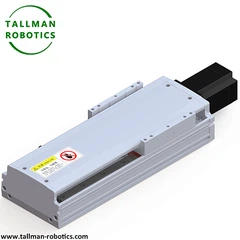


Multi Axis Robot refers to an automated device with three or more motion axes, which achieves complex trajectory motion and attitude adjustment in three-dimensional space through coordinated control of linear and rotational axes. Its core advantages lie in high degree of freedom, high flexibility, and environmental adaptability, widely used in industrial manufacturing, medical, aerospace, and other fields, becoming the core equipment of modern automated production.
What are the mechanical Architecture and Motion Logic of Multi Axis Robot? Multi axis robots are mainly composed of four parts: the robotic arm body, the drive system, the controller, and the sensors
|
Mechanical arm structure |
Mechanical arm structure |
including rotary joints (R axis, such as shoulder and elbow joints) and linear joints (T axis, such as lifting axis). A typical six axis robot consists of three rotary joints (controlling position) and three wrist joints (controlling posture), which can achieve six degrees of freedom motion at any point in space. |
|
Transmission components |
Harmonic reducers (accuracy ± 10 arc seconds) or planetary gearboxes (strong load capacity) are commonly used for rotary joints, while ball screws or linear motors are used for linear joints. |
|
|
Drive and Control |
The servo motor drives joint motion through a reducer and forms a closed-loop control with an absolute value encoder, achieving a positioning accuracy of ± 0.02mm; |
|
|
The controller plans trajectories based on kinematic algorithms (such as inverse solution calculation), supports demonstration programming, offline simulation (such as RobotStudio software), and real-time path correction. |
||
|
Sensor Fusion |
Integrating force sensors (collision detection), visual cameras (target recognition), and LiDAR (environmental modeling) to enhance the adaptability of robots in unstructured environments. |
|
You are welcome to watch more projects or visit our video gallery by Youtube: https://www.youtube.com/@tallmanrobotics
|
|
|
|
|
|
TM-FA |
TM-FB |
TM-FB2Z2 |
TM-FBZ2 |
|
|
|
|
|
|
TM-FC |
TM-FCZ |
TM-FD |
TM-FDZ |
|
|
|
|
|
|
TM-FE |
TM-FEZ |
TM-FF |
TM-FFZ |
|
|
|
|
|
|
TM-FG |
TM-FF2 |
TM-FGZ |
TM-FBZ2 |


|
Model of Each Axis |
Model of Each Axis |
Model of Each Axis |
||||||
|
X Axis |
Y Axis |
Z Axis |
X Axis |
Y Axis |
Z Axis |
X Axis |
Y Axis |
Z Axis |
|
TM100 |
TM45 |
TM135 |
TM100 |
TM100 |
TM150 |
TM135 |
TM135 |
|
|
TM100 |
TM62 |
TM135 |
TM135 |
TM100 |
TM200 |
TM100 |
TM62 |
|
|
TM100 |
TM100 |
TM45 |
TM135 |
TM135 |
TM135 |
TM200 |
TM100 |
TM100 |
|
TM100 |
TM100 |
TM62 |
TM150 |
TM62 |
TM200 |
TM135 |
TM100 |
|
|
TM100 |
TM100 |
TM100 |
TM150 |
TM100 |
TM62 |
TM200 |
TM150 |
TM100 |
|
TM135 |
TM62 |
TM150 |
TM100 |
TM100 |
TM200 |
TM150 |
TM135 |
|
|
TM135 |
TM100 |
TM62 |
TM150 |
TM135 |
TM100 |
|||
|
Model of Each Axis |
Model of Each Axis |
Model of Each Axis |
|||||||
|
X Axis |
Y Axis |
Z Axis |
X Axis |
Y Axis |
Z Axis |
X Axis |
Y Axis |
Z Axis |
|
|
TM100 |
TM45 |
TM135 |
TM100 |
TM100 |
TM150 |
TM135 |
TM135 |
||
|
TM100 |
TM62 |
TM135 |
TM135 |
TM100 |
TM200 |
TM100 |
TM62 |
||
|
TM100 |
TM100 |
TM45 |
TM135 |
TM135 |
TM135 |
TM200 |
TM100 |
TM100 |
|
|
TM100 |
TM100 |
TM62 |
TM150 |
TM62 |
TM200 |
TM135 |
TM100 |
||
|
TM100 |
TM100 |
TM100 |
TM150 |
TM100 |
TM62 |
TM200 |
TM150 |
TM100 |
|
|
TM135 |
TM62 |
TM150 |
TM100 |
TM100 |
TM200 |
TM150 |
TM135 |
||


What are the Core advantages and technological breakthroughs of Multi Axis Robot?
|
Full dimensional athletic ability |
Six axis robots can simulate human arm movements and complete complex curved surface operations such as welding and spraying; Four axis robots (such as SCARA) are known for their high-speed planar motion and are suitable for electronic component assembly (with speeds up to 200 times per minute). |
|
Compact space adaptability |
The working radius to footprint ratio of the articulated structure can reach 5:1. For example, the base area of a six axis robot with a load of 10kg is only 0.2 square meters, which can be deployed in narrow workstations (such as internal assembly of chassis). |
|
Flexible production support |
Through quick change of end tools (clamps, welding guns, suction cups) and program switching, multiple product varieties can be produced on the same production line, reducing the changeover time to less than 15 minutes. |
|
Human robot collaboration safety |
Equipped with collision detection and torque limiting technology (such as the UR series collaborative robot), it automatically decelerates when the contact force is less than 50N, meeting the ISO/TS 15066 safety standard. |
What are the Typical application scenarios of Multi Axis Robot?
|
In the field of industrial manufacturing |
Automotive welding |
The six axis robot is equipped with a laser welding gun to complete continuous welding along the body curve, with a weld accuracy of ± 0.1mm and an efficiency four times higher than manual labor. |
|
3C product assembly |
SCARA robot completes the fitting of mobile phone camera modules with an accuracy of ± 0.01mm, with a single workstation yield rate of 99.8%. |
|
|
In the field of healthcare and services |
Surgical robot |
The seven axis robotic arm of the da Vinci system achieves 540 ° rotation operation through magnetic coupling transmission, with incisions of only 3-8mm, reducing patient trauma. |
|
Logistics sorting |
AGV is equipped with a four axis robot that dynamically grasps packages through visual recognition, with a sorting efficiency of 3600 pieces/hour, adapting to the peak demand of e-commerce promotion. |
|
|
Aerospace and scientific research |
Aircraft skin riveting |
A seven axis robot, in conjunction with a force control system, completes curved riveting with an accuracy of ± 0.3mm, replacing traditional manual hammer riveting and increasing efficiency by 60%. |
|
Space robotic arm |
The Canadarm2 seven axis robot on the International Space Station completes satellite capture and equipment installation in a weightless environment with a positioning error of less than 5cm. |
Multi axis robot is reshaping the manufacturing industry with their ability to approach human operational limits infinitely. In the future, with breakthroughs in technologies such as brain computer interfaces and tactile feedback, multi axis robots will further expand to extreme scenarios such as deep-sea exploration and nuclear radiation processing, becoming powerful assistants for humans to explore the unknown world.
Hot Tags: multi axis robot, China multi axis robot manufacturers, suppliers, factory, Multi Axis Linear Actuation System, Multi Axis Linear Motion Stage, Multi Axis Linear Positioning Module, Pinion rack linear actuators, XY Axis Linear Stage


