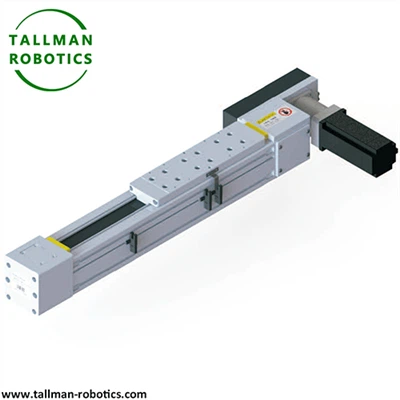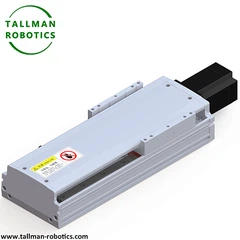


What is Linear Telescopic Transfer Arm?
A linear telescopic transfer arm is a material-handling mechanism that extends and retracts along a single linear path to reach into a process chamber, storage rack, or conveyor line, pick up or place a workpiece, and withdraw back to its home position-commonly paired with a gripper, vacuum end-effector, or fork at its tip. Unlike a general telescopic actuator focused purely on push/pull force, the transfer arm is purpose-built around carrying and precisely placing a payload during its extend-retrieve-retract cycle.
Structure
The arm consists of nested or stacked linear guide segments (often a scissor-link, roller-chain, or synchronized belt-driven telescoping frame) that extend the payload-carrying end far beyond the arm's retracted footprint, mounted on a base carriage that may itself travel on a separate transport axis. A servo motor drives the extension mechanism-frequently through a rack-and-pinion, timing belt, or lead screw-while the tip carries an interchangeable end-effector suited to the workpiece, with sensors confirming part presence and position before retraction.
Selection Considerations
Key factors include maximum reach (extended stroke), payload capacity at full extension, extension/retraction speed, positioning accuracy and repeatability at the pick/place point, end-effector compatibility, and deflection or droop at maximum reach under load. Cycle time requirements and duty cycle should be weighed against drive type, since higher-speed extension mechanisms may sacrifice some positioning precision.
Applications
Linear telescopic transfer arms are used in semiconductor wafer transfer between process chambers, warehouse pallet and case retrieval, automated storage and retrieval systems (AS/RS), oven and kiln loading/unloading, and CNC machine tending where a part must be reached into a confined space and retrieved without full robot articulation.
Installation Considerations
The base carriage must be mounted level and rigid to prevent deflection during extension under load. Clearance along the full extend/retract path should be verified to avoid collision with surrounding equipment or chamber walls. End-effector alignment and part-presence sensors should be calibrated, and full-stroke extension/retraction cycles should be tested under representative payload before production commissioning.
You are welcome to watch more projects or visit our video gallery by Youtube: https://www.youtube.com/@tallmanrobotics
Steel Type: Guide Rail Built-in Linear Modules. Bottom plate of the module is steel , sliding block is steel, and cover plate of the sliding seat , and the support seat is aluminum.
|
Model No |
Body Width (mm) |
Lead (mm) |
Rail Length(mm) |
Repeatability (mm) |
Walking parallelism(mm) |
Speed (mm/sec) |
Application Environment |
|
TK60 |
60 |
5/10 |
150~600 |
±0.003/±0.005 |
0.01/0.015 |
Max: 600 |
General/ Dust and Waterproof with Organ Cover |
|
TK86 |
86 |
10/20 |
340~940 |
±0.003/±0.005 |
0.015/0.03 |
Max: 1220 |


TK Steel Guide Rail Built-in linear modules Load specification

TK Steel Guide Rail Built-in linear modules Accuracy Level

TK Steel Guide Rail Built-in linear modules max speed


FAQ
How does a telescopic transfer arm differ from a robotic arm with rotary joints?
A telescopic transfer arm moves along a single linear extend/retract path for straightforward reach-and-retrieve tasks, while a rotary-jointed robotic arm offers multi-directional flexibility at the cost of greater programming and control complexity.
What determines the maximum reach of a telescopic transfer arm?
Maximum reach depends on the number of nested or linked segments and the drive mechanism's stroke capacity, with more segments enabling longer reach but generally reducing tip rigidity and load capacity.
Can a telescopic transfer arm carry heavy or fragile payloads?
Yes, provided the end-effector and drive mechanism are matched to the payload's weight and fragility, though capacity typically decreases as the arm approaches full extension due to increased cantilever loading.
Where are telescopic transfer arms commonly used in semiconductor equipment?
They are frequently used to transfer wafers or cassettes between load locks, process chambers, and storage stockers, where a compact retracted footprint and precise linear reach are essential.
What safety measures are needed for telescopic transfer arms?
Common measures include presence sensors to confirm the extend path is clear, soft-start/stop motion profiles to reduce payload disturbance, and interlocks that prevent extension into occupied or unsafe chamber spaces.
Hot Tags: linear telescopic transfer arm, China linear telescopic transfer arm manufacturers, suppliers, factory, Endless Belt Linear Unit, Belt Drive Linear Stage, Servo Belt Actuator, Linear Belt Drive Actuator, Fast Acting Linear Module