
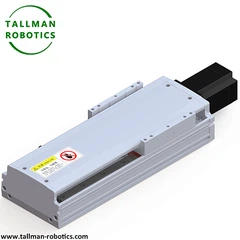


What is Telescopic Actuator?
A telescopic actuator is a linear motion device that extends and retracts through a series of concentrically nested tubes, converting rotary motor input (or hydraulic/pneumatic pressure) into push-pull force along a single axis. Its collapsible, layered tube design allows a large stroke length to be stored within a much shorter closed length, making it a common choice for lifting, tilting, and positioning tasks where full extension length exceeds available mounting space.
Structure
The actuator consists of an outer housing tube, one or more intermediate sliding tubes, and an innermost extension tube, each nested within the next and connected by an internal drive mechanism-typically a lead screw or ball screw threaded through the tube assembly, driven by an electric motor (or hydraulic/pneumatic cylinder in fluid-power versions). Seals or bushings between tube stages prevent contamination ingress and maintain smooth sliding action, while mounting brackets or clevis ends at both the base and extending tip allow pivoting attachment to the driven structure.
Selection Considerations
Key factors include stroke length, push/pull force rating, number of telescoping stages, retracted vs. extended length ratio, speed, duty cycle, mounting configuration (fixed vs. pivoting), and ingress protection rating for outdoor or harsh environments. Side-load capacity should be checked carefully, since telescopic actuators are generally designed for axial force and have limited tolerance for lateral loading, especially at full extension.
Applications
Telescopic actuators are used in hospital and patient-lift beds, agricultural equipment, solar panel tracking systems, industrial access platforms, tailgates and ramps, and recreational vehicle leveling systems where compact stowed length combined with substantial linear reach is required.
Installation Considerations
Mounting brackets at both ends must allow the intended range of pivoting motion without binding or interference with surrounding structure. The actuator should be installed within its rated side-load limits, and electrical or hydraulic connections must be sealed and protected from the operating environment. Full stroke cycling should be tested before final installation to confirm smooth extension/retraction and correct limit switch or stop function.
You are welcome to watch more projects or visit our video gallery by Youtube: https://www.youtube.com/@tallmanrobotics
Bottom plate of the module is steel , sliding block is steel, and cover plate of the sliding seat , and the support seat is aluminum.
|
Model No |
Body Width (mm) |
Lead (mm) |
Rail Length(mm) |
Repeatability (mm) |
Walking parallelism(mm) |
Speed (mm/sec) |
Application Environment |
|
TK60 |
60 |
5/10 |
150~600 |
±0.003/±0.005 |
0.01/0.015 |
Max: 600 |
General/ Dust and Waterproof with Organ Cover |
|
TK86 |
86 |
10/20 |
340~940 |
±0.003/±0.005 |
0.015/0.03 |
Max: 1220 |


TK Steel Guide Rail Built-in linear modules Load specification

TK Steel Guide Rail Built-in linear modules Accuracy Level

TK Steel Guide Rail Built-in linear modules max speed


FAQ
What's the difference between a telescopic actuator and a telescopic linear module?
A telescopic actuator is typically a self-contained cylinder-style push/pull device for lifting or tilting tasks, while a telescopic linear module usually refers to a guided rail-based system designed for precise multi-axis positioning rather than simple extend/retract force application.
Can telescopic actuators handle side loads?
Telescopic actuators are generally designed primarily for axial (in-line) loading; significant side loads, especially at full extension, can accelerate wear or cause binding, so applications with lateral forces should use additional guide supports.
Are telescopic actuators available in electric, hydraulic, and pneumatic versions?
Yes, telescopic actuators can be driven electrically (motor with lead screw), hydraulically (fluid pressure), or pneumatically (air pressure), with selection depending on required force, precision, and environmental conditions.
How is stroke length related to the number of telescoping stages?
More stages generally allow a longer total stroke relative to the retracted length, but each additional stage typically reduces rigidity and load capacity due to smaller-diameter inner tubes.
What maintenance do telescopic actuators typically require?
Routine maintenance includes checking seals for wear or contamination ingress, verifying smooth extension/retraction without binding, lubricating the drive screw (for electric versions), and inspecting mounting pivots for wear.
Hot Tags: telescopic actuator, China telescopic actuator manufacturers, suppliers, factory, Endless Belt Linear Unit, Belt Drive Linear Stage, Servo Belt Actuator, Linear Belt Drive Actuator, Fast Acting Linear Module


